Pilleriin Peets awarded the Women in Science Baltic Fellowship

We are happy to announce that Pilleriin Peets, the PI of our Chemical Space & Omics group, was one of the three Estonian recipients of this year’s Women in Science Baltic Fellowships, awarded by the academies of sciences and UNESCO National Commissions of the Baltic States!

Pilleriin (photo: Martin Mae)

All awardees receive a fellowship of €7,000 in recognition of their research so far and to support further research in their scientific field. The joint award ceremony for the Baltic laureates will take place next Thursday, 1 October, starting at 13:00 at the Estonian Academy of Sciences in Tallinn and will be broadcast live on the website of the Academy. Read more about the fellowship and the other awardees here. Below, more about Pilleriin and her research.

Pilleriin won the fellowship in the category of Doctor of Sciences in the fields of natural sciences, engineering and technology, medical and health sciences, agriculture and veterinary sciences. Her research focuses on developing better methods and tools to identify and understand the composition of the complex chemical systems that surround us – from textile fibres and dyes to environmental contaminants and biological metabolites.

Pilleriin (photo: Martin Mae)

Natural environments containing animals, plants, fungi and microbes are particularly complex, as they can contain tens of thousands of different chemical compounds at the same time. Non-targeted high-resolution mass spectrometry makes it possible to search for as many different compounds as possible in a sample, rather than only for predefined substances. It is currently one of the most powerful approaches for analysing small molecules, but even this method cannot capture the full chemical diversity present.

Pilleriin’s innovative and interdisciplinary research combines analytical chemistry and environmental studies with machine learning, artificial intelligence and computational methods to expand the range of chemical compounds that can be detected in measurements. To achieve this, she develops new analytical methods that enable complex chemical samples to be compared more effectively and improve the reproducibility of results.

Congratulations from all of us to you, Pilleriin!
On-line LC-MS Method Validation Course 2026-2027: Registration is open!

We are glad to announce that the seventh edition of the online course LC-MS Method Validation is open for registration (registration link is here)! The course will be offered as a Massive Open On-line Course (MOOC) during Dec 15, 2026 – Feb 26, 2027.

This is a practice-oriented on-line course on validation of analytical methods, specifically using liquid chromatography-mass spectrometry (LC-MS) as technique, mostly (but not limited to) using the electrospray (ESI) ion source. The course will also be of interest to chromatography practitioners using other detector types. The course introduces the main concepts and mathematical apparatus of validation, covers the most important method performance parameters and ways of estimating them. More information about the course can be found in Course introduction page.

Participation in the course is free of charge. Receiving digital certificate (in the case of successful completion) is also free of charge. Printed certificate (to be sent by post) is available for a fee of 62 EUR. Registration is possible until the start of the course. The course material is available from the above address all the time and can be used via web by anyone who wishes to improve the knowledge and skills in analytical method validation (especially when using LC-ESI-MS).

You are welcome to distribute this message to potentially interested people!

Presenting ValChrom at IMEKO 2026 in Manila, Philippines

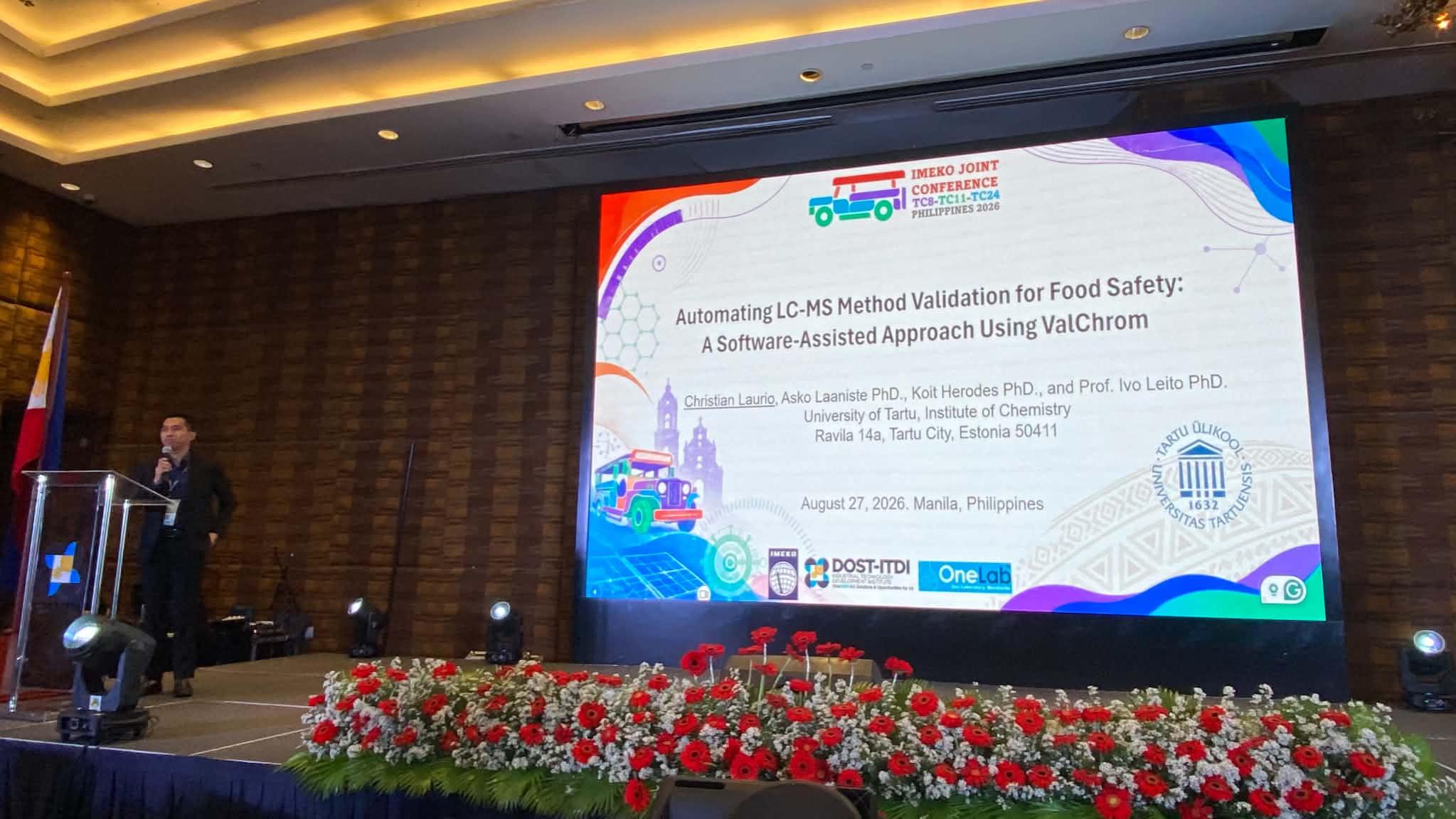
From August 26 to 29, 2026, Christian Laurio had the opportunity to participate in the IMEKO Joint Conference of Technical Committees TC-8, TC-11, and TC-24, held in Manila, Philippines.

The joint conference brought together researchers, scientists, metrologists, and industry professionals working in the fields represented by IMEKO TC-8 (Traceability in Metrology), TC-11 (Measurement in Testing, Inspection, and Certification), and TC-24 (Chemical Measurements). The event provided an excellent platform for discussing current developments, challenges, and innovations in measurement science, traceability, and chemical analysis. Topics in the parallel sessions varied from chemical measurements for the food industry, health, and environment, to reference materials, traceability, and measurement uncertainty, and to digital transformation in testing, inspection and certification.

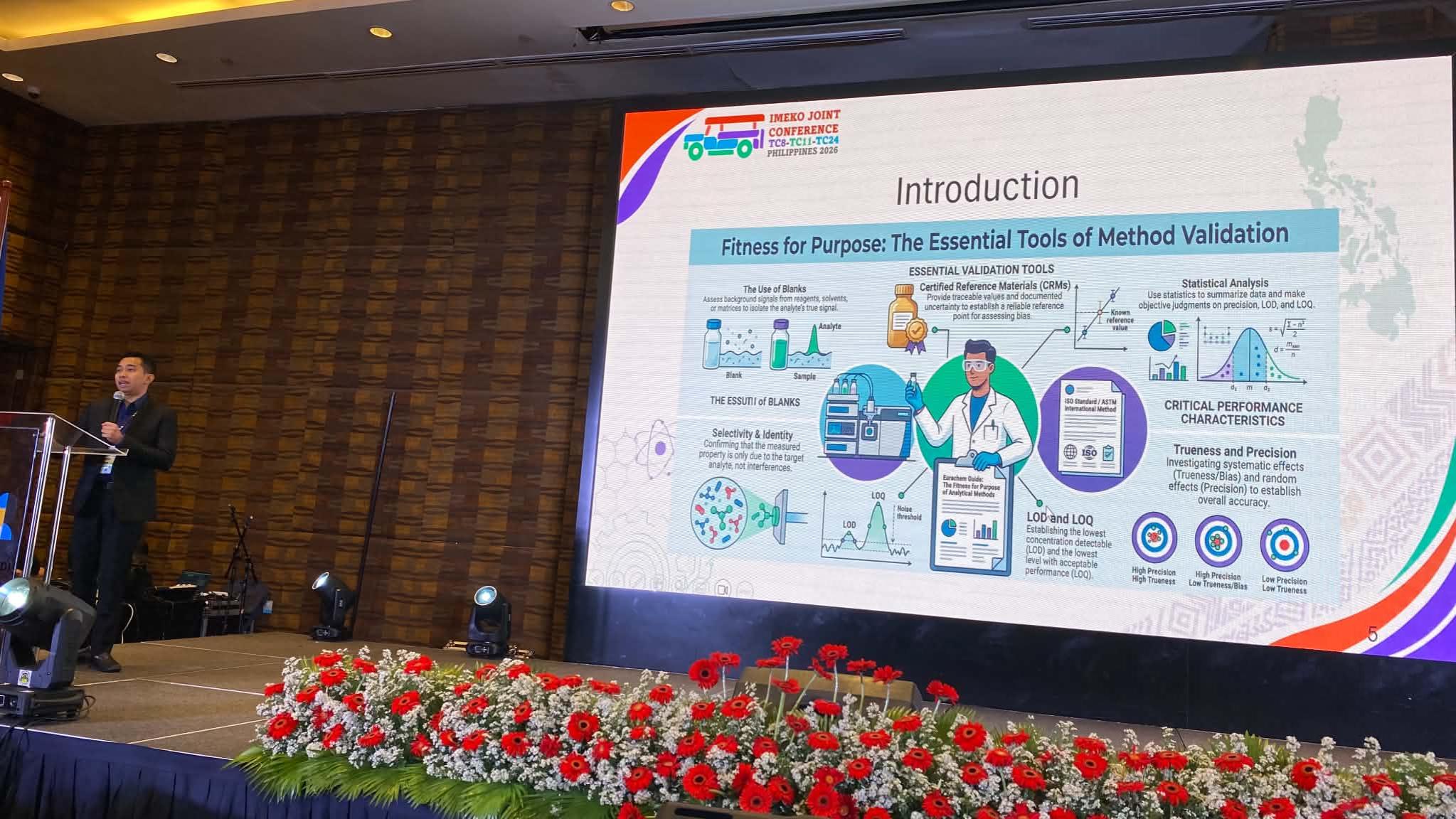
He delivered an oral presentation on the ValChrom software tool, focusing on its application in the validation of LC-MS/MS analytical methods. As a proof-of-concept, ValChrom was demonstrated using a pesticide residues analysis workflow based on tandem liquid chromatography–mass spectrometry (LC-MS/MS). The presentation highlighted how the tool can support a more streamlined and efficient approach to evaluating method validation parameters and processing validation data. The feedback and questions from attendees highlighted a clear interest for more accessible software solutions in routine analytical chemistry.  He also took the opportunity to invite interested attendees to try out ValChrom and to participate in the upcoming offerings of LC-MS method validation MOOC course found in our page.

Participating in IMEKO 2026 was a valuable opportunity to share this work, exchange ideas with fellow researchers, and gain insights into ongoing advances in metrology and chemical measurement. The discussions and connections made during the conference will undoubtedly contribute to the continued development and application of ValChrom in analytical method validation.

LC-MS Validation online course 10th run has finished!

On March 6, 2026 the on-line course (MOOC) LC-MS Method Validation offered by University of Tartu finished successfully.

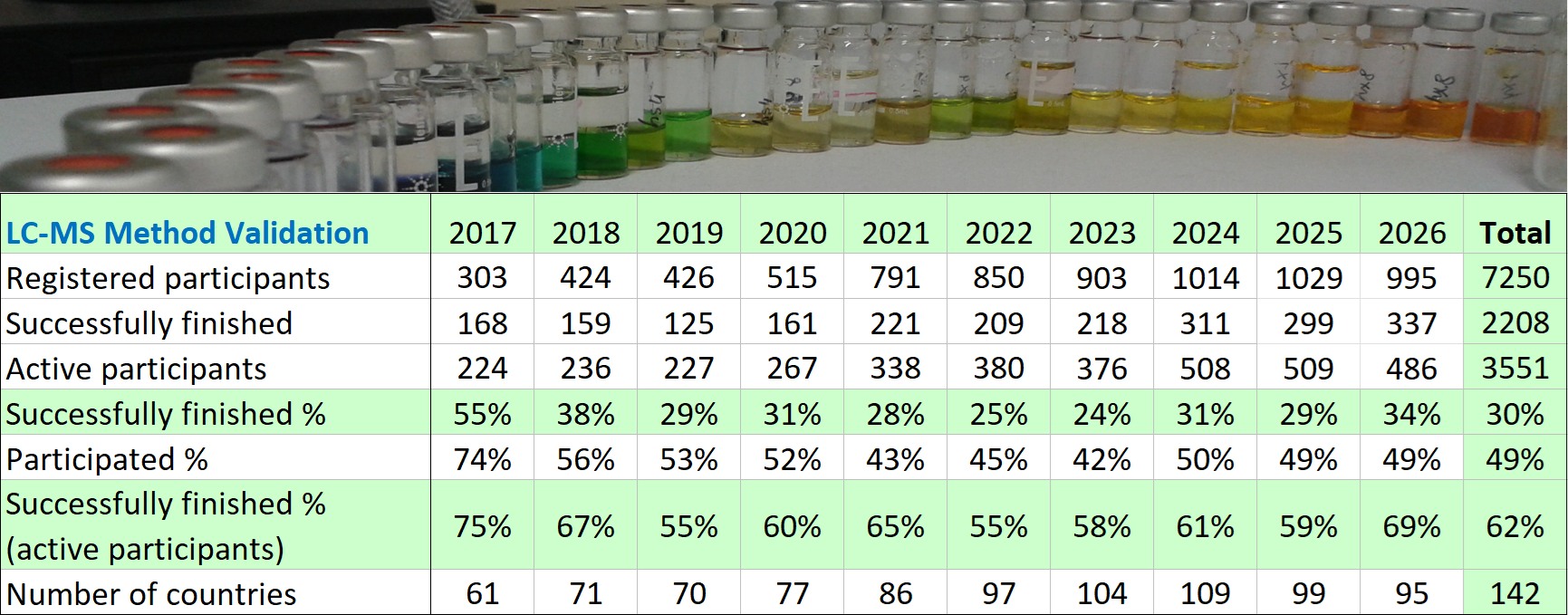
Eventually, altogether 995 people registered from 95 countries. Roughly half of them, 486 participants, actually started the course (i.e. tried at least one graded test at least once), and out of them, 337 successfully completed the course. The overall completion rate was 34%. The completion rate of participants who started the studies was 69%. The completion rates of active participants (i.e. who started the course) seem to have stabilised at around 60% and have increased during the current run. In any case, there is some food for thought for us on how we could improve the participation rate…

At the same time, those participants who actually took part in the course were very active and asked lots of questions. The questions were often very much to the point and addressed things that are really important to analysts in their everyday work. The course has several forums (general and by topic). During the course period, the overall number of forum posts was around 200 (overall number of posts, both from participants and from teachers), and the forums are still active, and posts are still coming in.

This active participation made teaching this MOOC a great experience also for us, the teachers. The discussion threads gave a lot of added value to the course.

We want to thank all participants for helping to make this course a success!

We plan to repeat this course again in Autumn 2026.

LC-MS Method Validation web course: 999 participants from 95 countries!

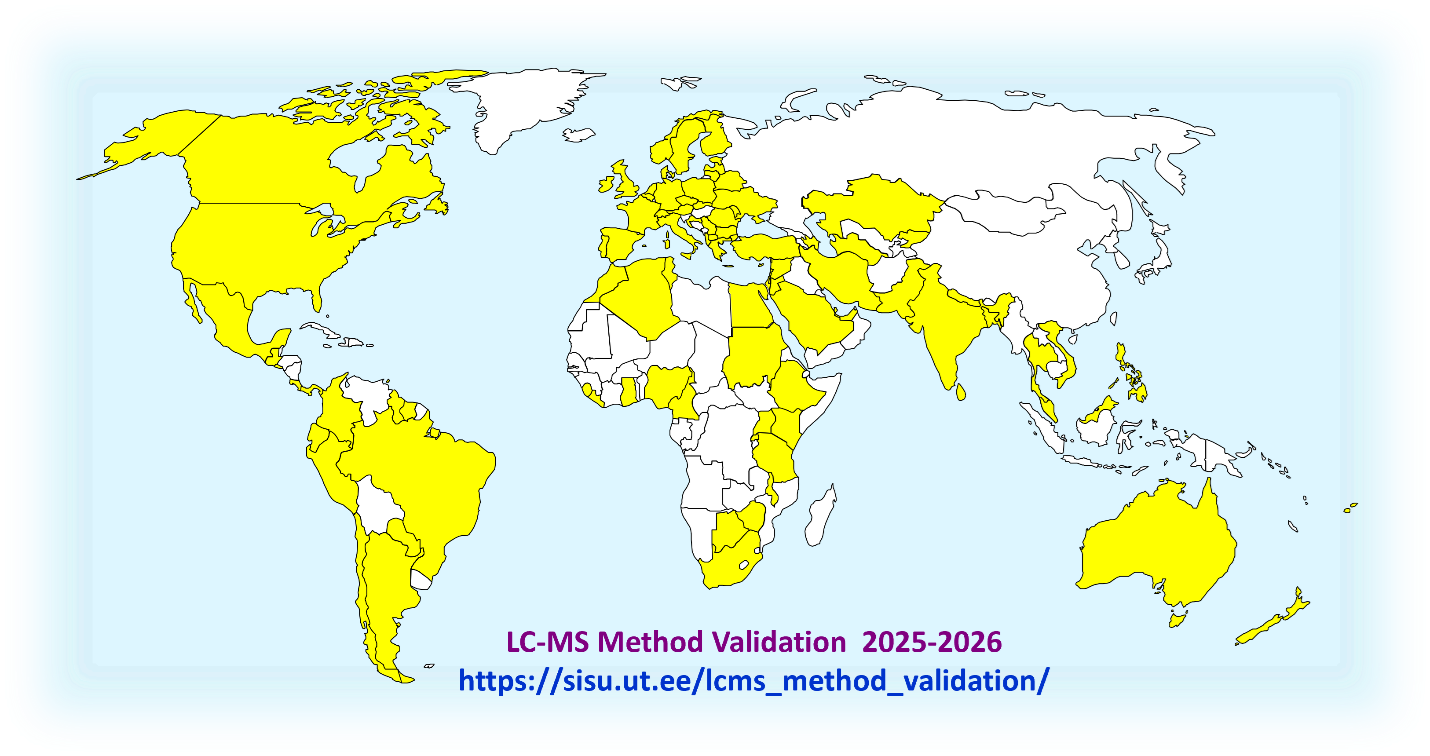
On Tuesday, December 16, 2025 the web course LC-MS Method Validation was launched for the tenth time as a MOOC (Massive Online Open Course). There are 999 registered participants from 95 countries, ranging from Canada to New Zealand and from Peru to Thailand. The image above shows the countries where the participants come from.

This is a practice-oriented on-line course on validation of analytical methods, specifically using LC-MS as the technique. The course introduces the main concepts and mathematical apparatus of validation, covers the most important method performance parameters and ways of estimating them. The LC-MS validation course is delivered by a team of 7 teachers, each with their own specific area of competence. This way it is expected to offer the best possible knowledge in all the different subtopics of analytical method validation.

The full set of course materials is accessible from the web page https://sisu.ut.ee/lcms_method_validation/. The course materials include videos, schemes, calculation files and numerous self-tests (among them also full-fledged calculation exercises). In order to pass the course, the registered participants have to take all tests and get higher than 50% score from each of them. These tests are available to registered participants via the Moodle e-learning platform. Participants who successfully pass the course will get a certificate from the University of Tartu.

Tenth run of the On-line LC-MS Method Validation Course: already 536 registered people!

The tenth edition of the course on LC-MS Method Validation already has 536 registered participants! Don’t miss your chance to join – spots are filling up fast. Register now (here) and start learning! The course will be offered as a Massive Open On-line Course (MOOC) from Dec 16, 2025 to Feb 27, 2026.

This is a practice-oriented online course on validation of analytical methods, specifically using liquid chromatography-mass spectrometry (LC-MS) as the technique, mostly (but not limited to) using the electrospray (ESI) ion source. The course will also be of interest to chromatography practitioners using other detector types. The course introduces the main concepts and mathematical apparatus of validation, covers the most important method performance parameters and ways of estimating them. More information about the course can be found on the Course introduction page.

Participation in the course is free of charge. Receiving a digital certificate (in the case of successful completion) is also free of charge. A printed certificate (to be sent by post) is available for a fee of 61 EUR. Registration is possible until the start of the course. The course material is available from the above address all the time and can be used via the web by anyone who wishes to improve their knowledge and skills in analytical method validation (especially when using LC-ESI-MS).

You are welcome to distribute this message to potentially interested people!

Publication: Derivatization for success

Riin Rebane

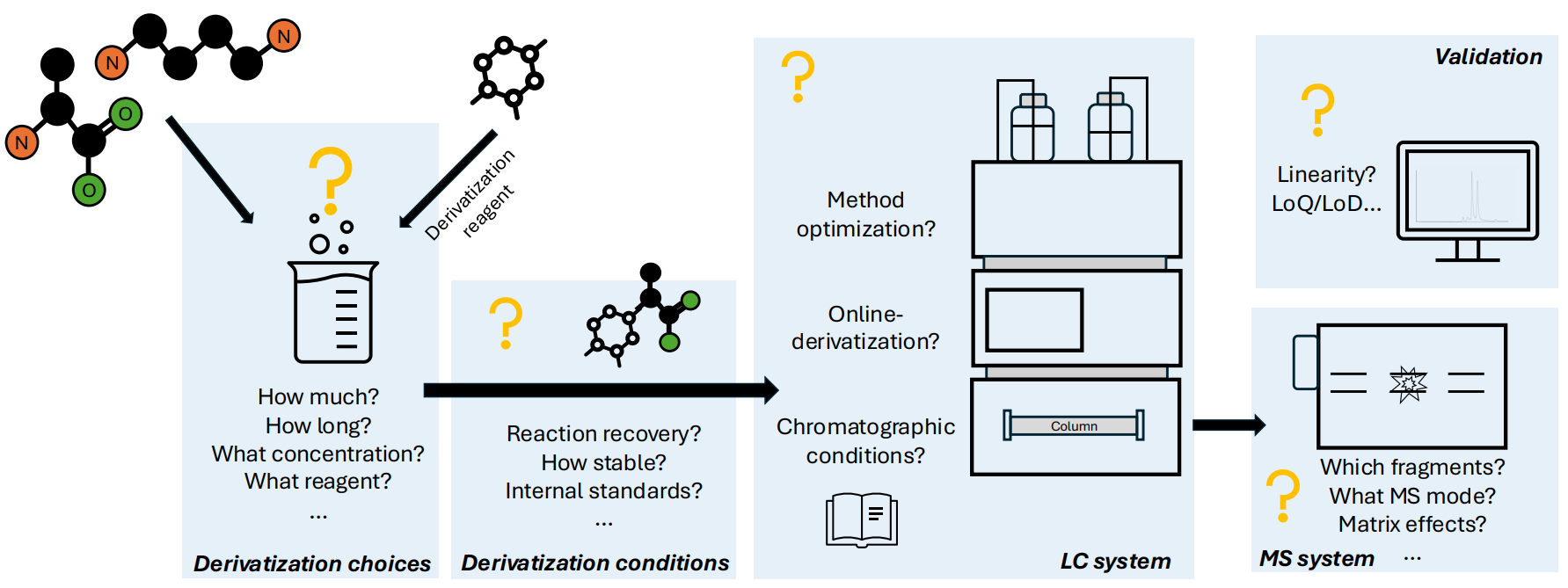
Recently, a tutorial review was published in Analytica Chimica Acta by Riin Rebane and Ivo Leito, named Derivatization for success: a tutorial review of liquid chromatography mass spectrometry method optimization for determining amino compounds. Read next what Riin has to say about the review.

“This comprehensive review brings together technical depth and years of personal lab experience, shaped by long hours at the bench, countless peer discussions, and valuable lessons learned along the way. It offers a detailed, practice-oriented guide to how derivatization can dramatically improve analyte retention and ionization in LC-MS, especially for challenging amino compounds. The article dives into reagent selection, method optimization, and real-world troubleshooting – tools I wish I’d had starting out.”

This work was supported by the Estonian Research Council grant PUT1589, and by the Estonian Ministry of Education and Research (TK210). The research was conducted using the Estonian Center of Analytical Chemistry, funded by the Estonian Research Council (TT4).

Graphical abstract for the tutorial review

LC-MS Validation online course 9th run has finished!

On February 14, 2025, the on-line course (MOOC) LC-MS Method Validation offered by the University of Tartu finished successfully.

Eventually, altogether 1029 people registered from 99 countries. Roughly half of them, 509 participants actually started the course (i.e. tried at least one graded test at least once) and, out of them, 299 successfully completed the course. The overall completion rate was 29%. The completion rate of participants who started the studies was 59%. The completion rates of active participants (i.e. who started the course) seems to have stabilized at around 60%, which can be considered good. In any case, there is some food for thought for us on how we could improve the overall completion rate…

At the same time, those participants who actually took part in the course were very active and asked lots of questions. The questions were often very much to the point and addressed things that are really important to analysts in their everyday work. The course has several forums (general and by topic) and during the course period the overall number of forum posts was above 300 (!) (overall number of posts, both from participants and from teachers) and the forums are still active and posts are still coming in.

This active participation made teaching this MOOC a great experience also for us, the teachers. The discussion threads gave a lot of added value to the course.

We want to thank all participants for helping to make this course a success!

We plan to repeat this course again in Autumn 2025.

LC-MS Method Validation web course: 1034 participants from 99 countries!

On Tuesday, November 26, 2024 the web course LC-MS Method Validation was launched for the ninth time as a MOOC (Massive Online Open Course). There are 1034 registered participants from 99 countries, ranging from Mexico to Japan and from Australia to Iceland. The image below shows the countries where the participants come from.

This is a practice-oriented online course on validation of analytical methods, specifically using LC-MS as the technique. The course introduces the main concepts and mathematical apparatus of validation and covers the most important method performance parameters and ways of estimating them. The LC-MS validation course is delivered by a team of 7 teachers, each with their own specific area of competence. This way it is expected to offer the best possible knowledge in all the different subtopics of analytical method validation.

The full set of course materials is accessible from the web page https://sisu.ut.ee/lcms_method_validation/. The course materials include videos, schemes, calculation files and numerous self-tests (among them also full-fledged calculation exercises). In order to pass the course, the registered participants have to take all tests and get higher than 50% score from each of them. These tests are available to registered participants via the Moodle e-learning platform. Participants who successfully pass the course will get a certificate from the University of Tartu.


Congratulations on the ERC Consolidator Grant!

We are delighted to announce that the prestigious ERC Consolidator Grant 2023 was awarded to a former member of our Analytical Chemistry group, Associate Professor Anneli Kruve at Stockholm University!

Anneli Kruve

The European Research Council (ERC) Consolidator Grant is aimed to support early-career researchers to consolidate their own independent research team or program over the next five years. We are very proud that this year one of the awardees was Anneli Kruve, Associate Professor at Stockholm University and head of the Mass Spectrometry Laboratory. In her research, she combines analytical chemistry with modeling and machine learning. The goal of the ERC funding is to support the research of her group on developing broader and more accurate methods to characterize and measure toxic chemicals in environmental samples. 

Only a few percent of chemicals that cause the toxic activity of environmental samples are currently known. In this project, Anneli and her group will combine high-resolution mass spectrometry and machine learning to find novel toxic chemical structures, which enables focusing the toxicity research on chemicals that truly matter. Understanding the emission and transformation processes of toxic chemicals is a necessary step to decrease the chemical risks in the environment. 

More information about the research performed by Anneli’s group can be found on the Kruve lab webpage.