In January 2026, the cultural heritage research group – in collaboration with physicists, material scientists, conservators, and IT specialists – launched a challenging new five-year Personal Research Funding Team (PRG) project, led by Dr Signe Vahur. The main goal of the PRG3112 project is to develop a novel, portable, automated laser ablation sampling probe. This tool will enable minimally destructive stratigraphic and imaging analysis of artefacts directly on the object under ambient conditions. In the future, the probe could be coupled with various analytical devices (MS, Py-GC-MS, and FORS) and sampling containers.
We will keep you updated on the progress of this demanding and exciting project!
The research team remains largely the same as in our previous project.
The main members of the PRG team: team leader Dr Signe Vahur (in the centre), from left Dr Aleksei Treshchalov, Prof. Hilkka Hiiop, Dr Anu Teearu-Ojakäär, Dr Rünno Lõhmus and specialist Martin Leissoo.
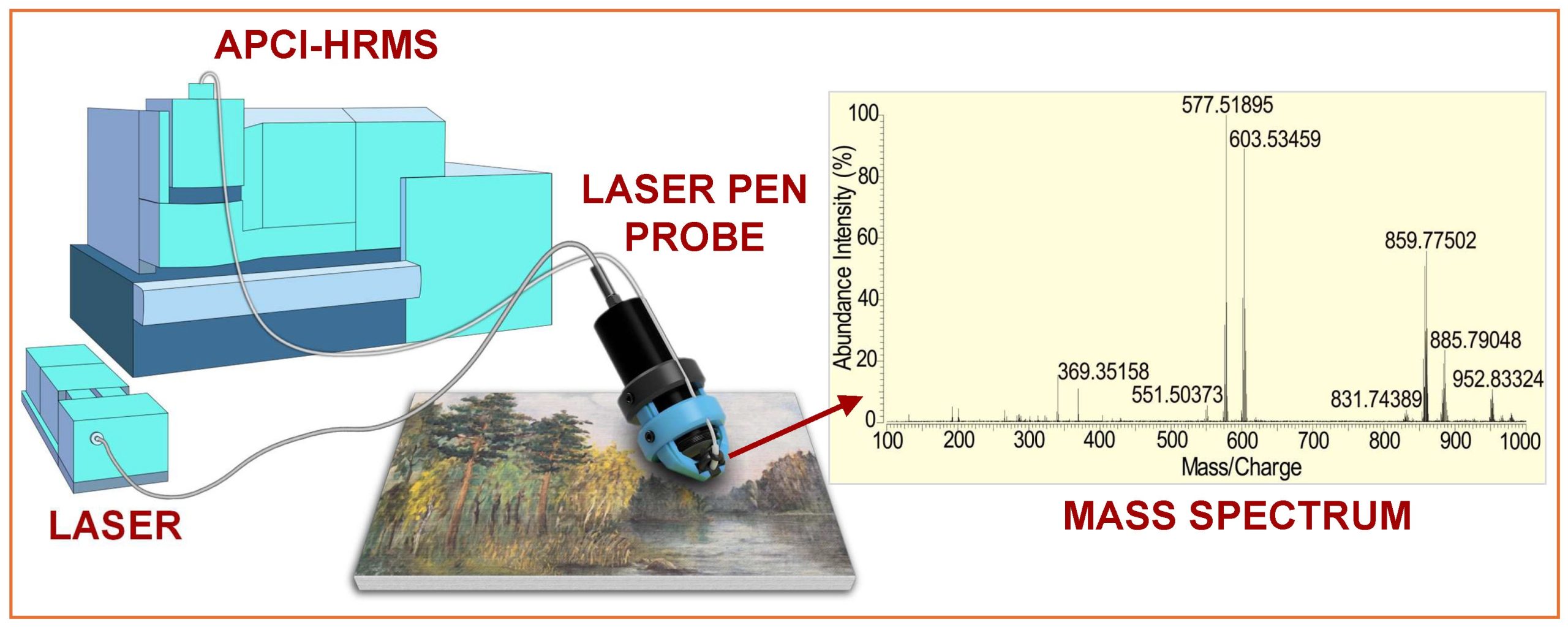
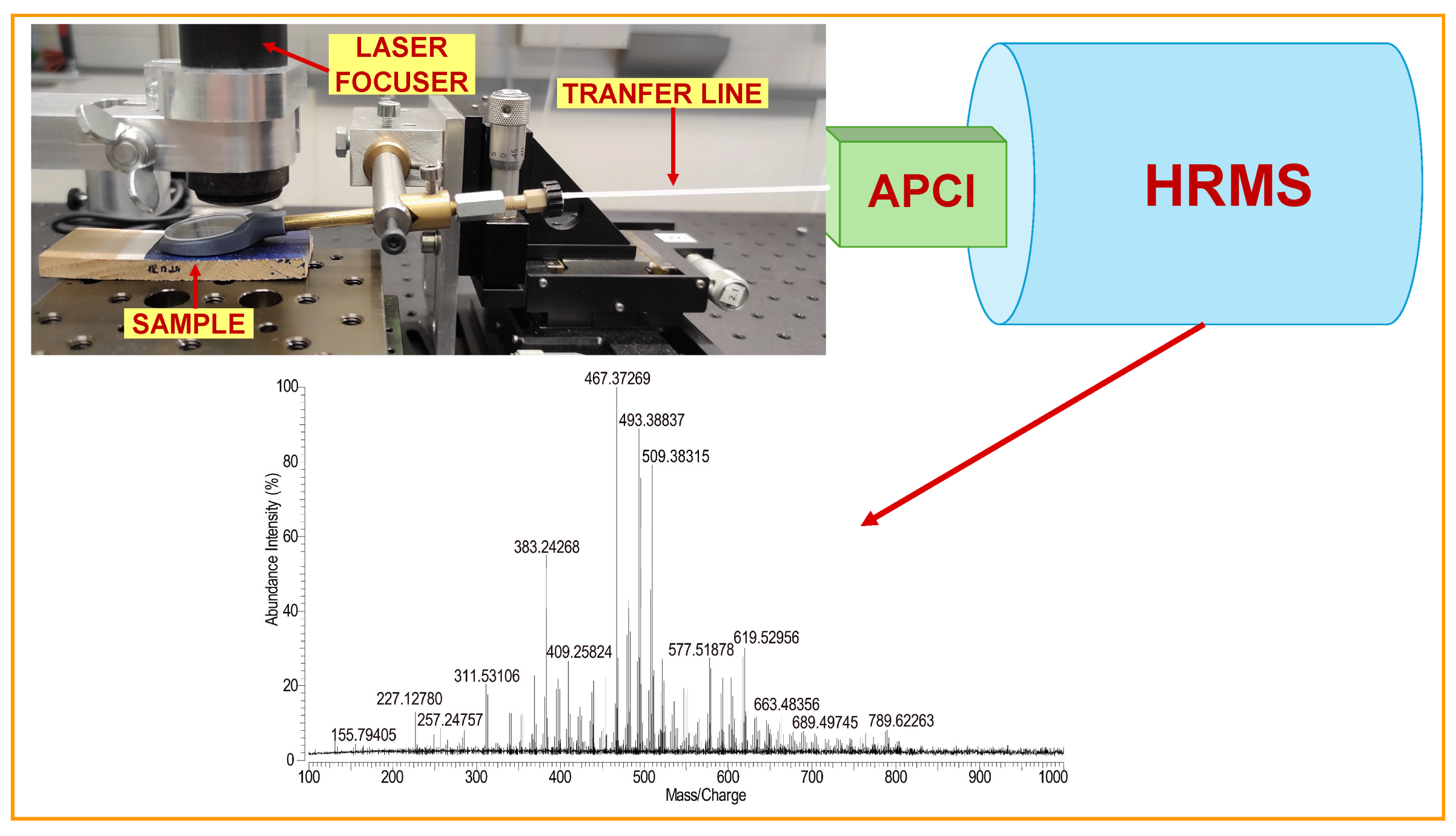
The Cultural Heritage research group, as part of this year-end PRG1198 research project, has published an open-access article titled “Laser ablation APCI-HRMS method for the analysis of cultural heritage materials” by Anu Teearu, Martin Leissoo, Rynno Lohmus, Alexey Treshchalov, Tõiv Haljasorg, Victor Augusto Xavier da Silveira, Hilkka Hiiop, and Signe Vahur in the Journal of the American Society for Mass Spectrometry. The article is available here.
Graphical Abstract for the publication
This research article highlights a novel 355 nm optical fibre-coupled laser ablation (LA)-APCI-FT-ICR-MS system, developed for direct, controllable, rapid, and accurate analysis of organic materials from the solid surface of an artefact under ambient conditions with minimal surface damage and without the need for sample removal or sample preparation for the analysis. In this study, the effectiveness and capabilities of the developed LA-APCI-HRMS system for analysing five aged mock-up materials (copper resinate, Prussian blue oil and egg tempera paints, lead white oil paint and matte dammar varnish) and the blackish-brown material from an ointment jar from a 16th-century shipwreck were investigated. The results can be read in the article.
The PRG1198 project team has done excellent work over the past five years, culminating in a working laser-based HRMS system. The same team will begin next year with a new project, and we will continue to keep you updated on all new developments.
In the photo, the main members of the PRG team: team leader Dr Signe Vahur (in the centre), from left Dr Aleksei Treshchalov, Prof. Hilkka Hiiop, Dr Anu Teearu-Ojakäär, Dr Rünno Lõhmus and specialist Martin Leissoo.
During June 4-8, 2023, Signe Vahur and Anu Teearu-Ojakäär attended the 71st ASMS Conference on Mass Spectrometry and Allied Topics, held in Houston, USA.
Signe and Anu presenting their poster
At the ASMS conference, Signe and Anu presented their poster “MALDI-MS for the analysis of cultural heritage materials” during the Monday (June 5) poster session.
On Wednesday evening (June 7), Signe was an invited panelist (along with Dr G. Asher Newsome from Smithsonian Museum Conservation Institute, USA; Prof Paul Haynes from Macquarie University, Australia; Dr Aleksandra Popowich from the Metropolitan Museum of Art, USA; Assoc Prof Enrico Cappellini from University of Copenhagen, Denmark; and Assoc Prof Troy Wood from University of Buffalo, USA) in the workshop “Art, Museums, and Archaeology” and had a very interesting discussion with approximately 70 attendees.
Altogether, the ASMS 2023 conference had more than 6300 attendees from all over the World. During four days there were 384 oral presentations (that ran in 8 parallel panels) and 4 presentations by invited speakers; 2939 poster presentations (more than 700 posters per day) and 178 corporate members presenting their products – instruments, labware, sample preparation, software solutions, etc. In addition, there were 50 evening workshops, 49 breakfast seminars, and 16 daily corporate hospitality suits.
All in all, the 71st ASMS Conference was a great experience with a lot of new connections, great discussions, and networking opportunities. Thank you to the organisers of the 71st ASMS Conference for delivering such a high-level event!
Signe talking during the panel sessionSigne in the main conference hall
Larissa: “The excellent scientific program provided a wide range of topics, but the topics metabolomics and proteomics in biomarker discovery were of most interest to me. Besides, it was interesting to learn how mass spectrometry is playing a role in unraveling Covid-19. The companies held interesting workshops about their latest instruments and their applications too.
The conference also had amazing after-hours activities. For instance, attendees were able to watch a performance by “Mangueira” (famous Samba school from Rio), a capoeira (Afro-Brazilian martial art) performance as well as a party with live pagode (Brazilian style of music). Moreover, the conference was held in the beautiful city of Rio de Janeiro. It was a pleasure to attend an international mass spectrometry conference in my home country.”
Rio de JaneiroConference venue
Ernesto: “There were very good talks during the conference, even though the use of mass spectrometry usage in the medical field (including COVID-19 detection) was one of the main topics, the conference also offered excellent presentations in a varied range of areas such as metabolomics, proteomics, natural products, etc.
The new trends and applications of new instrumentation were also shown by the different instrument providers companies during the workshops.
Something that I really liked were the social activities held every day after the conference, for example capoeira performance, live music, etc.
The fact that the 3rd Iberoamerican Conference on Mass Spectrometry took place in Rio de Janeiro, also allowed to the participants to discover a bit of the beauty that a big country like Brazil has to offer.”
From the 27th of August to the 2nd of September, two members of our Chair of Analytical Chemistry – Ngan and Larissa – attended the 24th International Mass Spectrometry Conference (IMSC 2022) in Maastricht, The Netherlands. They both presented their posters under section B: Instrumentation and methods. All abstracts of the posters can be found in the abstract book.
Larissa: “The topics that stood out the most to me were proteomics and metabolomics, especially in the field of single-cell analysis. Overall, the talks were very interesting because there was a huge variety in what kind of investigated samples. Besides, vendors were able to present their latest products, mainly focused on LC-MS/MS instrumentation.”
Ngan: “The conference program had so diverse topics. Personally, I loved the talk by Livia S. Eberlin – a Curt Brunnée awardee about Guiding Medical Decisions with the MasSpec Pen Technology. Different workshops were held in the end of each day, for example: FeMS (females in MS), Forensics, and Career workshops in which professors, vendors, and recruiters gave speeches to inspire students to do internship, to find balance in work-life, or to connect mentees and mentors. The first day of the IMSC 2022 conference coincidentally happened to be on my birthday which made this experience very special and memorable to me. I had a chance to open my eyes and see the world through the MS glasses.”
Maastricht
Larissa’s poster was about derivatization-targeted analysis, where derivatization with diethyl ethoxymethylenemalonate (DEEMM) was combined with neutral loss scan mode for the detection of amino compounds.
Ngan presented her poster about Coumarin-based derivatization reagent for LC-MS analysis of amino acids. In this study, she reported a first time synthesized fluorogenic derivatization reagent in UT lab named Coumarin151-N-succinimidyl Carbamate (Cou151DSC) using HPLC compatible with different detectors: FLD or UV and ESI-MS/MS. An analytical method for derivatization of amino acids was developed for Kvass (Estonian soft drinks) as a demonstration. The results were compared with a commercially available reagent (6-Aminoquinolyl-N-Hydroxysuccinimidyl Carbamate aka 6-AQC) which has been commonly employed in different applications for 30 years.
Larissa would like to thank the Estonian Education and Youth Board for the Dora+ short-term mobility scholarship. Ngan would like to thank the Chair of Analytical Chemistry for the financial support.