The measurement uncertainty online course will start again next week!

Measurement_Uncertainty_Value_Error_EtcThe online course Estimation of measurement uncertainty in chemical analysis will start its 4th edition on Monday, Mar 27, 2017. 300 participants have already been registered from 58 countries. Registration is still open and all people interested to learn this important topic are welcome to participate!

The registration link is available from the course website: https://sisu.ut.ee/measurement/uncertainty


LC-MS Method Validation MOOC finished with 55% completion rate!

LCMS Method Validation online course offered by UTOn Feb 16, 2017 the MOOC LC-MS Method Validation finished successfully.
Altogether 303 people were registered from 61 countries. 224 participants actually started the course (i.e. tried at least one graded test at least once) and out of them 168 successfully completed the course. The overall completion rate was 55%. The completion rate of participants who started the studies was 75%. Both completion rates are all time highest that our group has seen in our MOOCs!

The questions from the participants were often very interesting, often addressed things that are really important to analysts in their everyday work and in several cases led to improvements in the course. This active participation made teaching this MOOC a great experience also for us, the teachers! The discussion threads gave a lot of added value to the course and some of them triggered making important modifications to the course materials.

We want to thank all participants for helping to make this course a success!

We plan to repeat this course again in Autumn 2017.


EACH Winter School 2017 Ended

EACH_Winter_School_2017_Group_Photo_on_Lake_ErkenFriday 27.01.2017 was the last day of the EACH Winter School 2017. It appears to have been a memorable experience for all participants, especially those from southern countries. For example, quite some people had never walked on ice in their life, not to speak about jumping into water from sauna or under ice fishing! (See the previous post).

We were able to experience the best of Sweden – Swedish food, nature and hospitality, which was spiced up and complemented with exotic dishes and participants’ enthusiasm.

Sunset_on_Lake_Erken
The next Winter School will take place in January 2018 in Lyon.

Photos by Jayaruwan and Jonas: group photo and beautiful sunset on Lake Erken.


EACH Winter School: Fishing on Lake Erken!

Wednesday Jan 25, 2017: a major entertainment on that day of the Winter School was a short fishing trip to the nearby lake
Erken.

Photos by Santosh, Sadakat and Jayaruwan:  🙂

The lake is covered with ice and the participants had to use an ice drill for making the holes for fishing. It was a lot of fun and an exotic entertainment for those from southern countries!

EACH Winter School 2017 Started!

EACH_Winter_School_2017_Group_Photo
On Jan 23, 2017, the second Winter School of the EACH programme started in Erken Laboratory (Erken, Sweden). Altogether 34 students from more than 20 countries participate.
The Winter School offers a diverse set of activities to the participants. There are lectures on advanced analytical chemistry topics by top experts, group works and entertainment. Several sessions are presented by industry practitioners. The intense working is counterbalanced by social activities.

Uppsala_Students_Presenting_their_Master_Thesis_TopicsProf_Jonas_Bergquist_enjoying_Presentations


Traditionally an important activity in the Winter school is selecting first year students to study tracks. In order to give one more piece of information what the study tracks are about, there was a session of presentations on the first day by second year students on their master thesis topics.

Students_Watching_Presentation
Full information about the Winter School activities is available at the EACH Winter School web page.

Group Photo (Jayaruwan Gunathilake): in front of the main building of the Erken Laboratory; Photos in the middle (Ivo Leito): Uppsala students presenting their master theses and prof. Jonas Bergquist enjoying their presentation; Photo on bottom left (Ivo Leito): Vietnamese students following the presentation.

EACH students meeting Nobel laureate Sir Fraser Stoddart

each-students-meeting-prof-fraser-stoddartOn Monday 12.12.2016 the 2nd year EACH students studying at Uppsala had the wonderful opportunity to meet Sir J. Fraser Stoddart, one of the three 2016 Chemistry Nobel prize laureates. The 2016 Chemistry Nobel prize was awarded for the contributions to design and synthesis of molecular machines.

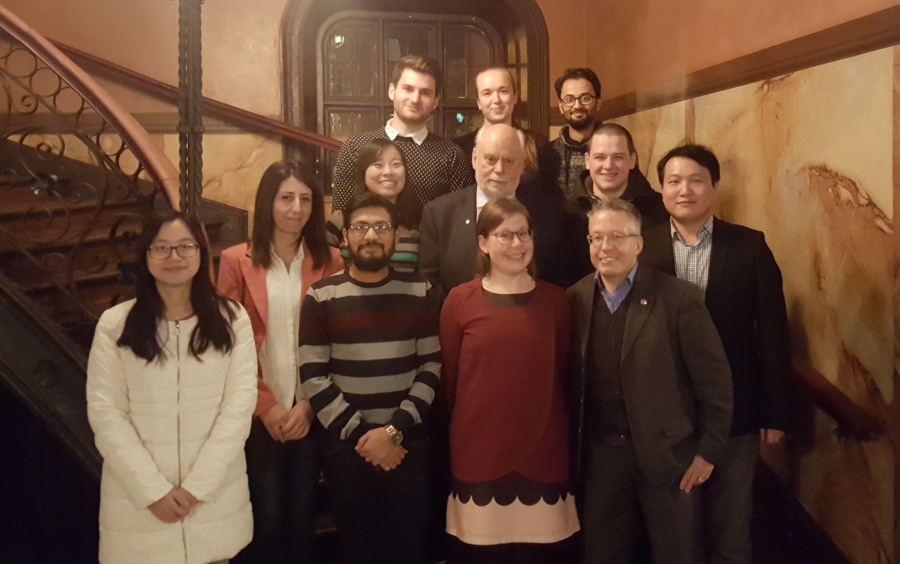
On the photo Prof. Stoddart is in the middle of the second row. In the first row on the right is prof. Jonas Bergquist (the EACH coordinator at Uppsala) who organized the meeting.


LC-MS Method Validation online course (MOOC): 301 participants from 61 countries!

UT_LC_MS_Validation_MOOC_Participants_2016On Monday, November 28, 2016 the web course LC-MS Method Validation was launched for the first time as a MOOC (Massive Online Open Course). There are 301 registered participants from 61 countries, ranging from Vietnam to Peru and from Norway to Zambia. Image on the left shows the countries where the participants come from.

This is a practice-oriented on-line course on validation of analytical methods, specifically using LC-MS as technique. The course introduces the main concepts and mathematical apparatus of validation covers the most important method performance parameters and ways of estimating them. The course follows the tradition set by the course Estimation of Measurement Uncertainty in Chemical Analysis launched in 2014. Differently, from the uncertainty course, the LC-MS validation course is delivered by a team of 8 teachers, each with their own specific area of competence. This way it is expected to offer the best possible knowledge in the different subtopics of analytical method validation.

The full course material is accessible from the web page https://sisu.ut.ee/lcms_method_validation/. The course materials include videos, schemes, calculation files and numerous self-tests (among them also full-fledged calculation exercises). In order to pass the course, the registered participants have to take all tests and get higher than 50% score from each of them. These tests are available to registered participants via the Moodle e-learning platform. Participants who successfully pass the course will get a certificate from the University of Tartu.

It is planned to run this course as MOOC again in autumn 2017.

(Image: Wikimedia Commons)


EACH Programme – A Good Practice Example!

ut_each_leito_vilnius_251116_good_practice_exampleOn 25.11.2016, in the framework of the Erasmus+ International Dimension Information Days 2016 event (Vilnius, Lithuania) Ivo Leito from UT made a presentation on the Practical experience of applying for and managing the Erasmus Mundus Joint Master Degree Programme Excellence in Analytical Chemistry (EACH). In recognition of its quality the EACH programme was selected as a “Good Practice Example” by the organizers. The presentation triggered a large number of questions and intensive discussion about funding the studies of the students who do not have the Erasmus Mundus scholarships.


Admission to the EACH programme is open!

EACH_Erasmus_Mundus_JMDWe are glad to announce that the 2017 admission is officially open to the Excellence in Analytical Chemistry (EACH) Erasmus Mundus Joint Master Degree programme!

This international two-year joint master degree programme educates specialists in analytical chemistry well qualified to work in industry (food, pharmaceutical, materials, energy, etc) and chemical analysis laboratories (environment, food, health, etc) worldwide. EACH provides knowledge and practical skills in both fundamental and applied aspects of modern analytical chemistry. Practical internship placement in industry or laboratories is an important part of the training.

The programme is suitable both for students who have finished their bachelor’s studies and want to continue in master’s studies, as well as for working analytical chemistry practitioners wishing to spend couple of years to bring their knowledge and skills to a new level.

The programme features generous scholarships as detailed in the Scholarships and tuition fees page.

The programme is taught by four universities: University of Tartu (UT, coordinator), Estonia; Uppsala University (UU), Sweden; University Claude Bernard Lyon 1 (UCBL), France; and Åbo Akademi University (AAU), Finland. The language of instruction is English, but students will also learn to communicate in one of the languages of the countries involved.

The online application form, admission requirements, deadlines, list of necessary documents, instructions/explanations, as well as contact data for questions are available from the EACH Admission information page.


Online Course: LC-MS Method Validation

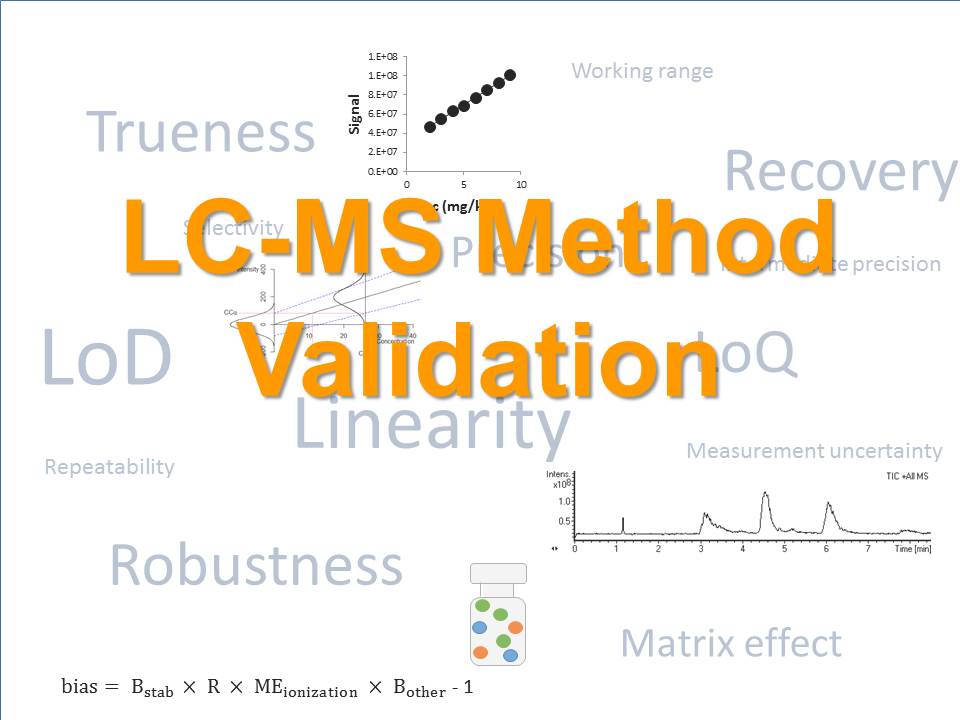
esikaas_2We are glad to announce the online course LC-MS Method Validation!

It has been set up at University of Tartu during 2015-2016 and its version 1 is now accessible from the address https://sisu.ut.ee/lcms_method_validation/

The course will be offered as a Massive Open On-line Course (MOOC) during Nov 28, 2016 – Feb 09, 2017 and it is now open for registration via the above address. The course is free of charge. This is the first edition of this MOOC and it will be offered to a limited number of participants.

This is a practice-oriented on-line course on validation of analytical methods, specifically using liquid chromatography-mass spectrometry as technique, mostly (but not limited to) using the electrospray (ESI) ion source. The course introduces the main concepts and mathematical apparatus of validation, covers the most important method performance parameters and ways of estimating them. The course is largely based on the recently published two-part tutorial review:

The course contains lectures, practical exercises and numerous tests for self-testing. In spite of being introductory, the course intends to offer sufficient knowledge and skills for carrying out validation for most of the common LC-MS analyses in routine laboratory environment. The real-life analysis situations for which there are either examples or self-tests are for example pesticide analyses in fruits and vegetables, perfluororalkyl acids in water, antibiotics in blood serum, glyphosate and AMPA in surface water, etc. It is important to stress, that for successful validation experience (both in analytical chemistry as such and also specifically in validation) is crucial and this can be acquired only through practice.

This course material is available from the above address all the time and can be used via web by anyone who wishes to improve the knowledge and skills in analytical method validation (especially when using LC-ESI-MS).