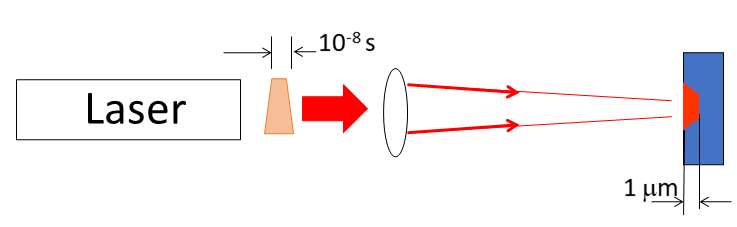
A new article about a developed laser ablation-based mass spectrometric system for the analysis of cultural heritage materials has now been published!

The Cultural Heritage research group, as part of this year-end PRG1198 research project, has published an open-access article titled “Laser ablation APCI-HRMS method for the analysis of cultural heritage materials” by Anu Teearu, Martin Leissoo, Rynno Lohmus, Alexey Treshchalov, Tõiv Haljasorg, Victor Augusto Xavier da Silveira, Hilkka Hiiop, and Signe Vahur in the Journal of the American Society for Mass Spectrometry. The article is available here.
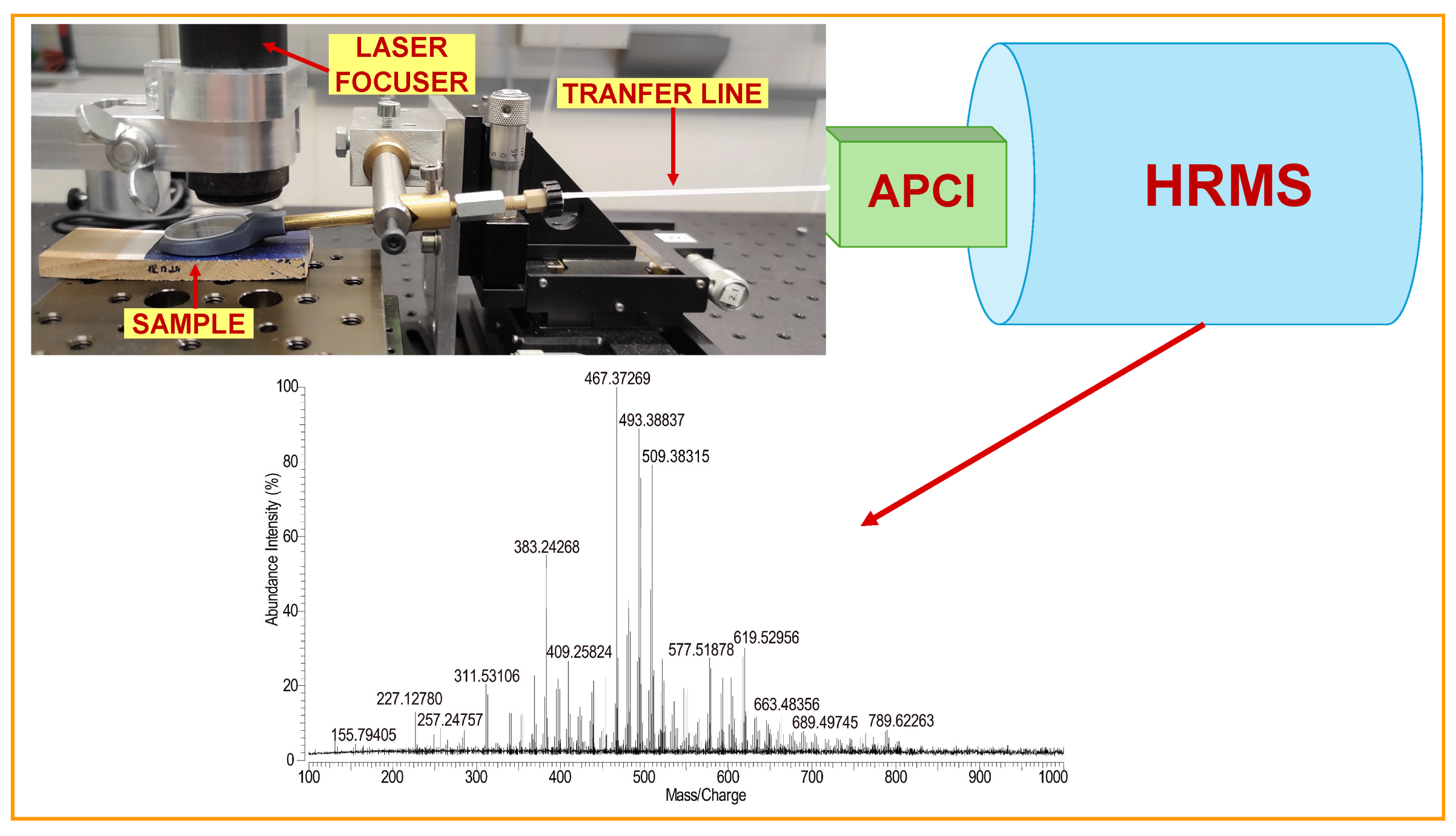
Graphical Abstract for the publication

This research article highlights a novel 355 nm optical fibre-coupled laser ablation (LA)-APCI-FT-ICR-MS system, developed for direct, controllable, rapid, and accurate analysis of organic materials from the solid surface of an artefact under ambient conditions with minimal surface damage and without the need for sample removal or sample preparation for the analysis. In this study, the effectiveness and capabilities of the developed LA-APCI-HRMS system for analysing five aged mock-up materials (copper resinate, Prussian blue oil and egg tempera paints, lead white oil paint and matte dammar varnish) and the blackish-brown material from an ointment jar from a 16th-century shipwreck were investigated. The results can be read in the article.

The PRG1198 project team has done excellent work over the past five years, culminating in a working laser-based HRMS system. The same team will begin next year with a new project, and we will continue to keep you updated on all new developments.

In the photo, the main members of the PRG team: team leader Dr Signe Vahur (in the centre), from left Dr Aleksei Treshchalov, Prof. Hilkka Hiiop, Dr Anu Teearu-Ojakäär, Dr Rünno Lõhmus and specialist Martin Leissoo.


Professor Hilkka Hiiop was elected as the rector of the Estonian Academy of Arts

Professor Hilkka Hiiop

On January 31, 2025, Professor Hilkka Hiiop was elected as the next rector of the Estonian Academy of Arts (EKA). Hilkka has been the Dean of the Faculty of Art and Culture since 2021 and the leading force in the Department of Cultural Heritage and Conservation for more than 10 years. Since 2021, she has also been a member of the PRG 1198 project working on the development of the laser-pen probe-MS system.

Hilkka has led numerous award-winning projects, the most recent one being the recovery and restoration of the Plafond painting in the Estonian Knighthood House. In this project, assoc. prof. Signe Vahur from our chair was also involved in performing the analysis of numerous samples to help identify the materials used in this rare work of art.

For more on Hilkka, our collaboration, and the magnificent plafond, see here (in Estonian): https://jupiter.err.ee/1609565348/eesti-lood

Congratulations, Hilkka! We wish you strength and success in your new position!

New Research Correlates Mineral Composition and Firing Temperature with the Porosity Produced in Replicate Archaeological Ceramics

We’re delighted to share that members of our Archemy and Analysis of Cultural Heritage Objects groups have published a new article titled, “Influence of Mineral Composition and Firing Temperature on the Micro- and Mesoporosity of Replicate Archaeological Ceramics” in the journal of Clays and Clay Minerals (Volume 72, 2024, e13). Read the Open Access article here.

This study examines how the mineral composition of clay and temper, along with firing temperatures, influences the formation of micro- and mesopores in pottery. The porosity of ceramics is considered a significant factor in the absorption and preservation of organic compounds, such as lipids, within archaeological pottery. Our research provides the first quantitative analysis of pore structures in ceramics designed to replicate archaeological samples, establishing valuable baseline information for future investigations into ceramic porosity and organic residue analysis.

Non-invasive analysis of natural textile dyes using fluorescence excitation-emission matrices

Elsa Vanker
Sigrid Selberg

Our group recently published a new article Non-invasive analysis of natural textile dyes using fluorescence excitation-emission matrices, Talanta, 2022, 123805 led by Sigrid Selberg and Elsa Vanker.

In this study, multidimensional front-face fluorescence spectroscopy measured from surfaces using a fiber optic probe was assessed as a non-invasive and non-destructive method for the analysis of components in natural textile dyes. Multidimensional fluorescence data was acquired for a collection of wool yarns dyed with natural dyes (31 dyed wool yarn samples that were self-dyed with 18 different natural dyes) that were used as references in a case study of two historical textiles for which liquid chromatography-mass spectrometry was used as a confirmatory technique.

Self-dyed reference yarns
Selection of characteristic EEMs of self-dyed reference samples

Natural dyes are multicomponent mixtures and can originate from different sources (e.g., plants, insects, and fungi). Due to their complex chemical composition and the inherent lability (photooxidative fading and bleaching), the analysis of natural dyes can be quite challenging and in order to analyze dyes on textiles, it is often best to combine different analytical methods.  However, for the analysis of dyes, common and often the most informative methods, like chromatographic separations coupled with different detectors, are all invasive/destructive. The aim of this work was to explore the potential and limitations of fluorescence spectroscopy in analyzing natural dyes from dyed wool yarns using EEMs (excitation-emission matrices), measured directly from the surface of the objects, non-destructively and without any sample preparation.

To demonstrate the utility of the fluorescence method, analysis was conducted on two case study samples – fibers from historical artifacts. Comparing the EEMs of the reference yarns with our unknown case study samples, we were able to identify that dye from a plant of the Rubiaceae family (bedstraws and madders) was used for dyeing the case study samples. 

Here you can find the 50-day free access to the article.

One of the case study objects; Tapestry “Solomon is receiving a bride. Solomon Court” (year of production 1547); Textile sample was obtained from the Conservation and Digitization Centre Kanut (Estonia).

Order of Merit of the White Star – Prof. Hilkka Hiiop

Prof. Hilkka Hiiop

Today it was announced that the president of Estonia, Alar Karis, has honored 148 Estonians or our friends from abroad with national awards, also known as decorations.

It is a great pleasure to announce that the Order of Merit of the White Star was awarded to Prof. Hilkka Hiiop, a valued member of our workgroup! She has been acknowledged for bringing the conservation of cultural heritage into the focus of Estonian society.

The press release can be found here (in Estonian). But to translate some of the words of our president: “On the eve of Independence Day, the Republic of Estonia thanks people with its decorations whose perseverance, selflessness, dedication, ingenuity, or creation are an example to many others and have made Estonia better, more caring, more noticed, and more entrepreneurial.”

Congratulations from all of us to you, Hilkka!

Dr. Matti Laan – Laser cleaning in cultural heritage

Yesterday, on the 7th of May, Associate Professor emeritus of physics Matti Laan gave a highly interdisciplinary lecture about laser cleaning in the field of cultural heritage.

On this project, Dr. Laan (presenting his lecture in the picture on the right) worked with the late Associate Professor emeritus of chemistry Tullio Ilomets. Dr. Laan gave an exciting lecture about different lasers (e.g., Nd:YAG, XeCl, Er:YAG) and which of them is most suitable for laser cleaning of various artefacts (such as paintings or sculptures). For this laser ablation is used, which removes any undesired material (including ageing products and materials from previous conservation works) layer by layer.

Most of the listeners participated via the Zoom platform – over 70 physics, chemists, conservators, material scientists, and people from other disciplines joined in this interdisciplinarity lecture. The lecture was organised by our Cultural Heritage workgroup, Institute of Physics, and The Estonian Academy of Arts in the framework of Dr. Signe Vahur’s PRG1198. The recording (in Estonian) can be found here.

The secrets of two mummies have been unravelled

PLOS ONE has recently published a multidisciplinary paper on two Egyptian child mummies lead and participated by the members of our group. The team of 19 experts unravelled the secrets of two Graeco-Roman child mummies by applying most recent analytical techniques from archaeology, forensic sciences, analytical chemistry, medicine, entomology, and genetics. This is one of the most extensive multidisciplinary study of ancient mummies and the paper is free to download here.

New publication – Instrumental techniques in the analysis of natural red textile dyes

A wide variety of different dyes, complex composition of natural dye sources and low concentrations in samples make the identification of textile dyes challenging. In our cultural heritage group, work has been done for years to overcome some of these problems. Using seven different red dye sources and five instrumental approaches, a method for the analysis of textile dyes has now been developed in our lab to study different archaeological findings, museum artifacts, and other textile pieces. More about the results can be found in the article published in the Journal of Cultural Heritage by P. Peets, S. Vahur, A. Kruve, T. Haljasorg, K. Herodes, T. Pagano and I. Leito.

The usefulness of this developed method has been proved by analyzing several case-study samples from Estonian National Museum, KANUT, and private collections. Thanks to the multiple instrument combination and especially the usage of high-resolution mass-spectrometry, it was also possible to identify synthetic organic dyes without the use of any standard substances.

MaSC 2019 Workshop and Meeting in Ottawa, Canada

Eliise giving her talk

The 9th Workshop and Meeting of the Users’ Group for Mass Spectrometry and Chromatography (MaSC ) for the study of cultural heritage objects took place on June 3-7, 2019 in Ottawa, the capital of Canada. One of our group members – PhD fellow Eliise Tammekivi – also participated in the workshop and gave an oral presentation at the meeting.

Practical instructions for the analysis of dyes, resins and volatile organic compounds (VOCs)

The workshop of MaSC 2019 took place in the Canadian Conservation Institute (CCI) and Parks Canada, where the Thermal Separation Probe (TSP) was presented as a novel device for thermal desorption and „slow pyrolysis“ analyses in gas chromatography-mass spectrometry (GCMS) by the leading researchers in the study of cultural heritage materials. With the instructions from Jennifer Poulin (CCI) the participants were able to conduct the analysis of dyes and identify natural resins by the help of AMDIS  software. With instructor Dr. Gregory D. Smith (Indianapolis Museum of Art at Newfields) participants could perform evolved gas analysis of museum exhibition materials once again with TSP and GCMS.

Topics from fish oil in paintings to the interpretation of highly complex GCMS data

The Meeting of MaSC 2019 took place in the National Gallery of Canada. Presentations were given by the world’s leading analysts about the GCMS analysis of art and historical artifacts. For example, Kate Fulcher (British Museum) talked about the complications of identifying black liquids applied to ancient Egyptian coffins and Corina Rogge (The Museum of Fine Arts Houston) about the utilization of fish oil containing house paints to artists’ paintings in economically difficult times. Additionally, Michael Schilling and Henk van Keulen presented the wonderful advantages of using AMDIS software and ESCAPE for the identification of compounds in complex and small cultural heritage samples. Also, it was Eliise’s first full talk at an international conference, where she presented our groups’ work on the topic „Quantitative analysis of binders in cultural heritage objects“. Specifically, she presented the comparison of four common derivatization procedures in the field of cultural heritage for the quantitative GCMS analysis of oils. For the opportunity to attend the workshop and meeting she would like to thank the organizers of MaSC 2019 and Dora Pluss scholarship (Archimedes).

New publication – Comparison of derivatization methods for the quantitative gas chromatographic analysis of oils

Often paints contain oils that bind together the components (pigments, fillers, etc) of the paint. Analysis of these oils requires derivatization, but which derivatization method is the best for a quantitative approach?

The work on this topic began with the need of our cultural heritage group to have a routine method for the determination of fatty acid composition of oils with gas chromatography (GC). The analysis of oils with GC requires derivatization and for this a wide variety of procedures have been applied. It turned out there are only few comparisons of derivatization methods in the literature and all are quite limited by scope. For that reason, it was decided to explore this important topic comprehensively and, importantly, in the terms of absolute (not relative) quantification.

A member of our group – PhD student Eliise Tammekivi – implemented four common and well-known derivatization procedures to perform the absolute quantification of fatty acids with GC-MS and GC-FID. The four compared derivatization methods were: (1) methylation with m-(-trifluoromethyl)phenyltrimethylammonium hydroxide (TMTFTH), (2) two-step derivatization with sodium ethoxide (NaOEt) and N,O-bis(trimethylsilyl)trifluoroacetamide (BSTFA), (3) two-step derivatization with KOH and BSTFA and (4) acid-catalyzed methylation (ACM).

This study has now been completed and the results have been published in the journal Analytical Methods by E. Tammekivi, S. Vahur, O. Kekišev, I. D. van der Werf, L. Toom, K. Herodes and I. Leito. In the publication, a comprehensive and wide-scale quantitative comparison of the four derivatization methods is presented. The results demonstrate that methylation with TMTFTH is the least work-intensive and most accurate derivatization method – both in terms of reproducibility and derivatization efficiency (yield).  For further information see: Analytical Methods, 2019, 11, 3514 – 3522