Recently our group had the pleasure of participating in a cutting-edge endeavor: characterizing the acidity of some extremely efficient strongly acidic organocatalysts. In the case of the Mukaiyama aldol reaction, the best of them (1) worked at low ppm to sub-ppm level, (2) gave excellent yields and (3) high enantiomeric selectivity as well as (4) turnover numbers (TON numbers) of hundreds of thousands.
The extent to which these four features occurred together in the same catalyst was so remarkable that the results were published in one of the most prestigious journals in chemical sciences: Nature Chemistry2018, 10, 888-894.
The extremely demanding acidity measurements were performed by Dr Karl Kaupmees. The whole research was led by the group of professor Benjamin List – a worldwide known guru in the field of strongly acidic catalysts working at the Max-Planck-Institut für Kohlenforschung.
These results are expected to open new avenues in the development of powerful new organocatalysts.
(Photo by Andres Tennus: Karl doing acidity measurements in a glovebox under anhydrous conditions)
From the 9th to the 13th of September MSACL EU 2018 Annual Congress took place in the cosy city of Salzburg, Austria. This conference was designed to mass spectrometry audience mainly focusing on clinical applications. I had the opportunity to participate in this inspiring conference. Moreover, I had the possibility to give a talk. I introduced our studies on standard substance free quantitation in LC/ESI/MS analysis.
Lightning talks to encourage young scientists
Prof. Jerzy Adamski kicked off the conference with the plenary lecture on the topic “Metabolomics Messages on Human Health and Diseases”. As one of the main goals of this conference is to inspire and encourage the young scientists the next session was lightning talks. Poster presenters had 90 seconds and one slide to present their research and cultivate interest in their topic. Additional possibility to get to know mature scientist was the program “meet the experts”. There were short meetings as well as booth and poster tours with experts. I had the possibility to analyze some posters together with Dr. Oleg Mayboroda from Leiden University Medical Centre. It was nice to see how the experts look at the posters and how and which questions they ask. Dr. Mayboroda gave a checklist of how to assess the goodness of the PCA plot presented on posters.
Scientific highlights of the conference
There were 5 parallel sessions every day. For me, the three highlights were as follows. First of all, Dr. Mario Thevis gave a talk about mass spectrometry in sports drug testing. Also, Prof. David Millington gave an interesting talk about the role of tandem mass spectrometry in newborn screening. It was encouraging to see how the methods developed by his team save around 2500 newborns on yearly basis. Furthermore, Dr. Lyudmilla Yanshole gave a talk about using postmortem tissues for biomarker identification. It is an interesting study as for lots of diseases it is very difficult to get tissue of healthy species.
Standard substance free quantification LC/ESI/MS
I had the possibility to present for the first time a talk at an international conference. For that, I am most grateful for the MSACL organization and the scientific committee. I introduced the recent results on the feasibility of standard substance free (semi)quantitation in LC/ESI/MS using ionization efficiency prediction models. We have measured more than 2000 ionization efficiency values. We have incorporated 21 solvent compositions. The models are developed based on descriptors calculated from the 2D structure of compounds and the predictions perform well even in complex matrices, namely, bodily fluids. Our average misprediction of ionization efficiencies is less than 3.5 times mismatch. I thank the audience for fruitful discussions on the topic.
Salzburg is a lovely city with stunning views of the Alps. Furthermore, the organizer made our stay at the conference very enjoyable with the nice coffee breaks and warm buffet for lunch and dinner which were offered every day.
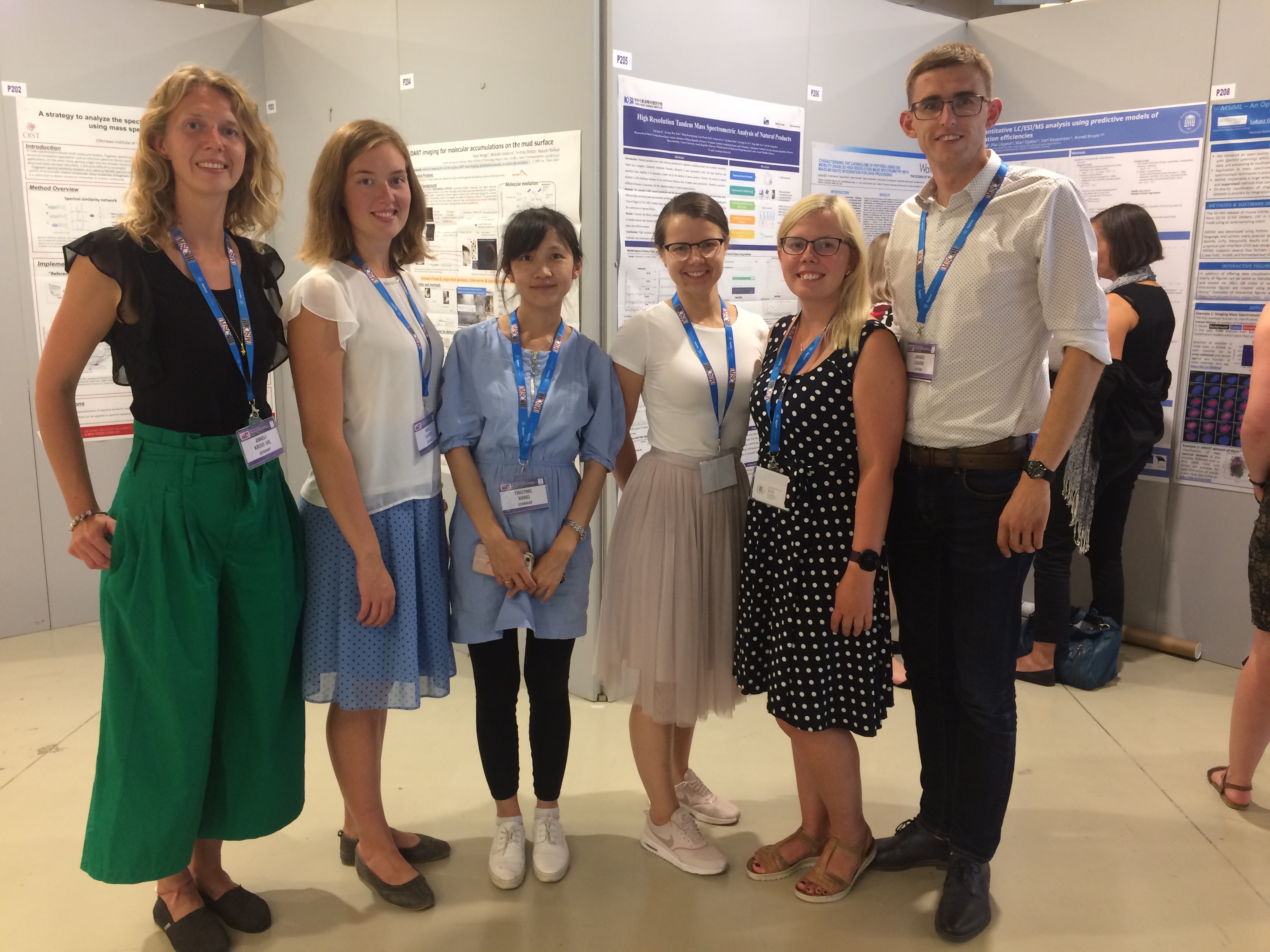
From 26 to 31 of August Florence hosted a vast majority of mass spectrometry scientist in the course of 22nd International Mass Spectrometry Conference. Among these were also our group members researchers Anneli Kruve and Riin Rebane, PhD students Piia Liigand and Jaanus Liigand, MSc student Mari Ojakivi and a visiting PhD student Tingting Wang from the Technical University of Denmark. We had a chance to present altogether 5 posters at the conference. Our posters can be found here. As is the case for IMSC, the topics ranged as wide as it can be for mass spec and always there was something to see and hear. We were happy to see that there was a lot of interest in our work. Congratulations to Anneli, whose poster received Chemistry – A European journal poster award! The conference was accompanied by delicious Italian food and nice warm weather. We enjoyed every second of this highly intensive week and are looking forward to IMSC 2020 in Rio.
Anneli Kruve: It is no secret that I am very keen on non-target screening methods, so I really enjoyed all the talks and posters regarding non-target screening and compound identification. My favorite talk was actually also in the field of compound identification given by Prof. Rober Mistrik in the Thermo lunch seminar. He very nicely explained the Precursor Ion Fingerprinting strategy and explained some of the new tips and tricks which are now combined in the Mass Frontier 8.0. It also very strongly resonated with the perspective I recently wrote about semi-quantitative non-target screening. I also have to mention the plenary lecture by Prof. Marco Leona from Metropolitan Museum of Art, who did not focus specifically on mass spec but gave us a really nice overview of scientific research of art. I constantly kept thinking how beautiful it is to have a background in chemistry: one can, virtually, combine all interest and make a great new whole. Prof. Leona, for example, was combining beautiful artworks, history of humankind, the biology of colorful bugs and plants, and on top of that mass spectrometry. And I definitely also felt honored to receive my best poster prize awarded by Chemistry – A European Journal!
Riin Rebane: It was my first experience of Florence as well as IMSC and when the first one greeted with wonderful food, the second one gave food for thought. It was a thorough overview of the latest advances in mass spectrometry and an insight into different works of scientists from academia as well as industry, therefore, it was certainly a challenge to grasp it all. But despite that, it was also nice to see that sessions towards practical applications of mass spectrometry in for example food or environmental analysis, were so popular that arriving late meant that all seats were already taken by other enthusiasts.
Mari Ojakivi: IMSC 2018 was the first scientific conference that I attended and as a master’s student it was an eye-opening experience. It was very nice to see so many scientists introducing their brilliant work with a mass spec. Seeing all the different applications in forensics, food and environmental science, as well as fundamental research in all the -omics fields made me understand how powerful tool mass spectrometry is. What is more, presenting my own work and seeing other scientists being so interested in it, verified that I am doing good and important science.
Piia Liigand: I thoroughly enjoyed the IMSC 2018 in Florence. It was a nice opportunity to meet and talk to scientists from all over the world. I was also very positively surprised to see so much interest in my poster and I truly enjoyed the discussions I had while presenting my poster. Thanks to these discussions I now have even more understanding of the importance of the science we do and what to do next. I also enjoyed meeting friends from past conferences and catching up on their research in more detail. Of course, the food, wine and general ambiance of Florence was an excellent environment to do all that.
Jaanus Liigand: I enjoyed the IMSC 2018 in Florence as it offered a very wide set of different interesting topics of mass spectrometry field. The inspiring presentations, fruitful discussions, interdisciplinary ideas, and excellent community made it a very enjoyable conference. My favorite session was environmental MS where Prof. Susan Richardson gave in her keynote a very nice overview of the recent developments in this field followed by interesting presentations. Additionally, I enjoyed meeting friends from previous conferences and discussing their and our research. Of course, the historical city – Florence – with the food and wine scenery made the week even more enjoyable.
Tingting Wang: It was a really memorable experience to participate IMSC in Florence, and I enjoyed the atmosphere and all the academic events there. It’s so impressive how wide are the application fields that mass spectrometry can do in the world by looking through a thousand posters. It’s hard to say which presentation or poster was my favorite, but I do pay more attention to the non-target screening strategy applied in food control, environmental, metabolomics, and proteomics study, especially the workshop on the second day about non-target analysis. It was interesting and very informative because unknown screening by high-resolution mass spectrometry is the topic of my PhD project, how to combine target and non-target screening, how to develop a more precise identification and quantification strategy for the non-target even unknowns, and how to prioritize unknowns are the problems I am always facing. It is nice that I could see these similar studies with various workflows from other researchers, and have the chance to listen to their presentations and even talk with those people to get inspiration for my research.
Anneli, Riin, Mari, Jaanus and Piia presenting their posters.
On the 20th -23rd of August 2018 Eliise, Pilleriin and Markus, who regularly use the FT-ICR-MS as part of their research, attended the first EU FT-ICR MS End User School. The school was organized by professor Janne Jänis and took place in the University of Eastern Finland in Joensuu. The school is part of the efforts of the European Network of Fourier Transform Ion Cyclotron Resonance Mass Spectrometry Centres (www.eu-fticr-ms.eu, the materials and slides from the course will also be available on this website under the documents section in the near future) to establish an EU community of end-users and FT-ICR-MS scientists. The objective of this network is to promote and provide resources for the wider application of FT-ICR-MS instruments by European academic, industrial and business institutions. The school was intended for researchers and students who are still relatively new to the machine.
The school consisted mostly of lectures by some of the world’s leading experts on FT-ICR MS. A few examples include prof. Peter O’Connor covering the fundamentals of FT-ICR-MS along with sharing some guidelines to follow in order to get the most out of one’s ICR and Evgeny Nikolaev talking about the dynamically harmonized ICR cell which he invented. In general, many different topics were covered: data acquisition and signal processing, isotopic fine structure and quadrupolar detection, atmospheric pressure ion sources, various applications of the machine etc.
Every day after the lectures some time was given for the attendees to present short talks covering their own research. The students also had the opportunity to present posters which could be viewed during the breaks between lectures. There was a 200€ prize for the best poster which was won by Anika Neuman for her work concerning the comparison of APCI and photoionization for gas analysis with FT-ICR-MS.
On the 21st of August the organizers gave a short tour of the universities FT-ICR-MS lab where they showed their 12 Tesla Bruker APEX-Qe instrument.
The summer school also included a half-day trip to the nearby Valamo monastery and whiskey distillery where a short excursion was accompanied with a wine tasting session and lunch.
All in all the summer school proved to be very beneficial to the attendees as along with gathering several new ideas regarding the most efficient use of the machine, many contacts were established with experts in the field.
This week two PhD students of our group, Rūta Veigure and Max Hecht had a chance to present their research in the 7th European Association for Chemical and Molecular Sciences (EuCheMS) Congress in Liverpool, organized by the European chemistry society. The conference offered a 5 day packed programme and celebrated the organization of different chemists in societies all over the world. For example, the Estonian chemical society is turning 100 years this year.
Rūta Veigure presented a poster on “Widening the range of eluent additives for LC-MS analysis to improve the retention of drug-like molecules”, while Max Hecht delivered a talk on the “The Evolution of Sponge spray for direct Sampling and Analysis by MS”.
Liverpool itself offered a variety of sights and enjoyable experiences, and as being the home-town of Beatles, there was even a chance to enjoy the tribute band “The Bootleg Beatles” during one of the Congress’ evenings.
This is the range of topics addressed on Aug 31, 2018 as PhD dissertations addressing these topics were defended at UT Institute of Chemistry by Sofja Tšepelevitš and Märt Lõkov.
The logIE approach is already applicable in nice clean matrices such as neat solvents. We wanted to see if our approach also works with more difficult matrices, such as bodily fluids and tissues. The results were recently published in Analytica Chimica Acta.
In this study, we took a representative set of 10 compounds, including drugs, e.g., naproxen and lincomycin. As matrices, we used blood, plasma, urine, cerebrospinal fluid, brain and liver tissue homogenates and neat solvent to compare with. We carried out a simple and robust sample pretreatment of protein precipitation. We measured the IEs in a worst-case scenario in flow injection mode without any chromatographic separation.
As with different instrumental setups and solvents, the IEs vary between biological matrices, but the order of the compounds remains roughly the same. These variations between different matrices and variations between a certain biological matrix and neat solvent demonstrate that matrix affects ionization efficiencies and also the prediction models of ionization efficiencies. This, in turn, shows that matrix affects the importance of properties of compounds in the prediction model.
Even though the effects are big and matrix effect is strong we were happy to see that the correlations between IEs measured in the neat solvent and IEs measured in a biological matrix are in good correlation (R2 from 0.7 to 0.9). These good correlations were a promising start to predict IEs in biological matrices similarly to previous predictions in the neat solvent. The most accurate model was obtained for the solvent with a mismatch of 2 times which was also expected since it is the cleanest matrix. But also for liver and brain tissues the mismatch of the model is only 3-fold.
The correlation between predicted and calculated IEs is good with the average mismatch over all biological matrices of 8 times. This means that the accuracy of standard substance free quantitation has been improved by more than an order of magnitude for the set of compounds used in this study.
More details can be found in the paper published in Analytica Chimica Acta. Piia Liigand also gave a talk on the topic in ASMS which can be found here. More papers by our group on the topic of ionization efficiencies can be found here.
We demonstrated the fruitfulness of multiproxy dietary analysis combining plant microfossil, human bone stable isotope and pottery related organic residue analysis. The results reveal that even 800 years ago men and women had different dietary habits: men preferred fish and higher trophic level terrestrial animals (e.g. pork), whilst women declined towards ruminant carcass (a nice steak!) and dairy products.
The paper is one of the few of its kind illustrating ancient food consumption as a highly social phenomenon, and setting an example for microscale dietary analysis in the future.
Results below the limit of quantification (BLQ) are generally not reported or reported without explicit numbers, leaving pharmacokinetic (PK) and pharmacodynamic (PD) studies wishing for more information to improve their model parameters. But the laboratory cannot release actual values BLQ since the quality of that data has never been assessed.
By directing this article towards the pharmacometrician, the analytical scientist and the regulatory personnel, we hope to encourage an inter-disciplinary discussion to improve the situation by finding ways to use BLQ data in PK/PD studies, in order to enhance the quality of the obtained pharmacokinetic models. Several ways were proposed for moving forward, in particular improving/modifying method validation guidelines for enabling to use BLQ data and leaving the decision regarding whether and how to incorporate the BLQ data into a PK/PD model to the data analyst and not the analytical chemist.
Initiated by our group, the pan-European research network of fundamental pH Research UnipHied started in May 2018.
Why is such network needed? As of now, it is not possible to compare pH values of solutions made in different solvents, as every solvent has its own pH scale. This situation is highly unfortunate, since it causes confusion and inaccuracies into many fields, extending far beyond the specific field of acid-base chemistry. Examples are industrial catalytic processes, food chemistry, liquid chromatograpy, etc. The central goal of UnipHied is to overcome this situation by putting the new theoretical concept of the recently introduced unified pHabs scale on a metrologically well-founded basis into practice.
The most important specific objectives of UnipHied are (1) to develop and validate a reliable and universally applicable measurement procedure that enables the measurement of pHabs; (2) to create a reliable method for the experimental or computational evaluation of the liquid junction potential between aqueous and non-aqueous solutions; (3) to develop a coherent and validated suite of calibration standards for standardizing routine measurement systems in terms of pHabs values for a variety of widespread systems (e.g., industrial mixtures, soils/waters, food products, biomaterials).
The first version of the pHabs measurement procedure has been created by Agnes Heering (Suu) in the framework of her PhD thesis. The main experimental difficulty is evaluation of the liquid junction potential (LJP), which will be thoroughly addressed by UnipHied. The first important steps towards this goal have very recently been made and published as two back-to-back papers: Angew. Chem. Int. Ed. 2018, 57, 2344–2347 and Angew. Chem. Int. Ed. 2018, 57, 2348–2352
The key achievement described in the papers is finding an ionic liquid, namely [N2225][NTf2], that can be used as salt bridge electrolyte and has such properties that two out of three main sources of LJP are eliminated.
The partners of the UnipHied network are LNE (France, coordinator), BFKH (Hungary), CMI (Czech Republic), DFM (Denmark), IPQ (Portugal), PTB (Germany), SYKE (Finland), TÜBITAK-UME (Turkey), Freiburg University (Germany), ANBSensors (United Kingdom), FCiencias.ID (Portugal), UT (Estonia).
UnipHied is funded from the EMPIR programme (project 17FUN09) co-financed by the Participating States and from the European Union’s Horizon 2020 research and innovation programme.


 Recently our group had the pleasure of participating in a cutting-edge endeavor: characterizing the acidity of some extremely efficient strongly acidic organocatalysts. In the case of the Mukaiyama aldol reaction, the best of them (1) worked at low ppm to sub-ppm level, (2) gave excellent yields and (3) high enantiomeric selectivity as well as (4) turnover numbers (TON numbers) of hundreds of thousands.