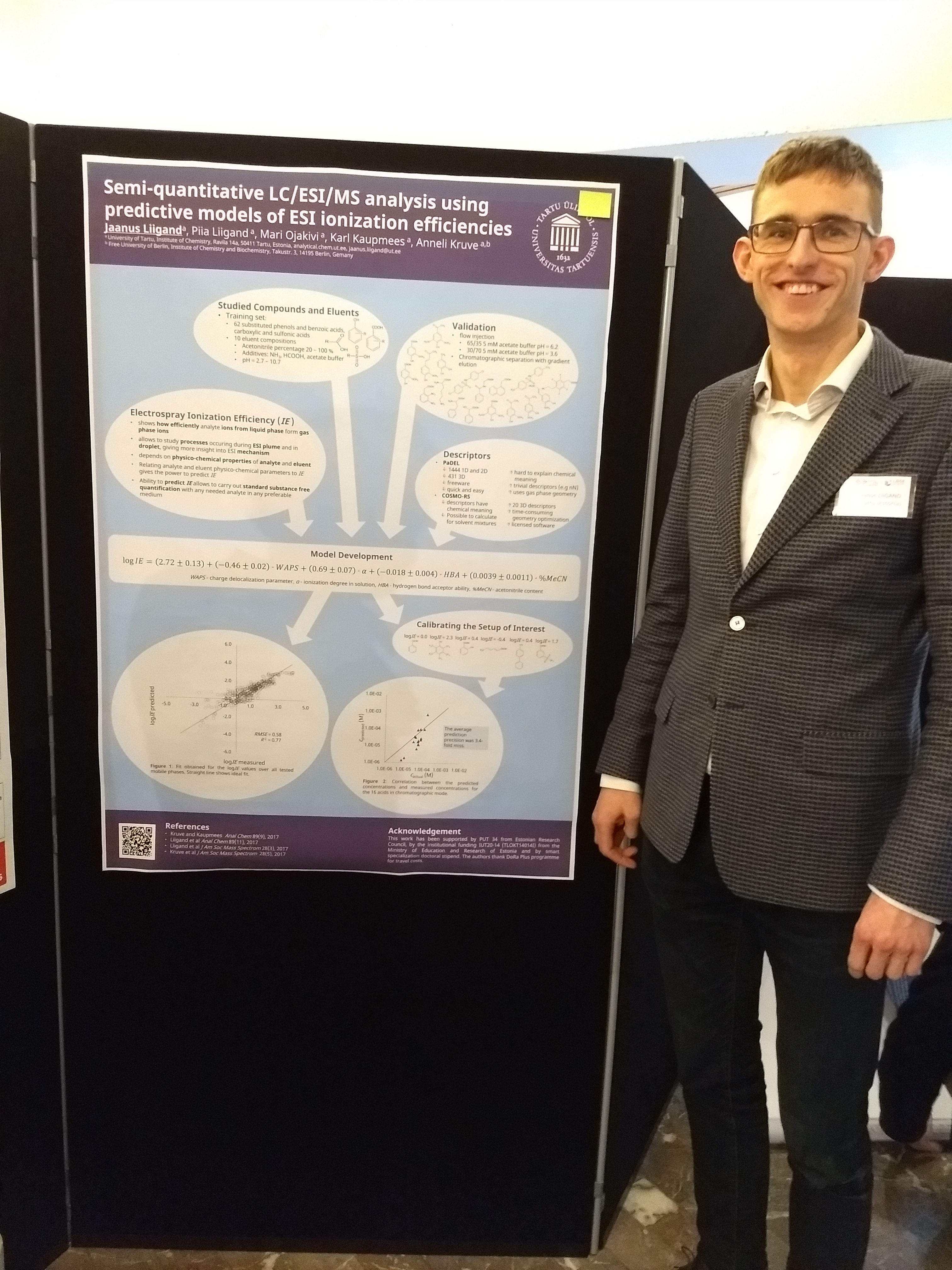
The aim of the conference was to bring together chemists, physicists, geologists, art historians, conservators, archaeologists, etc. to create a wide community and a mutual environment for a fruitful discussion. Four days were filled with wide-ranging presentations, museum visits and interesting discussions with other scientist from the same scientific fields. The work of our cultural heritage group was also introduced with both oral and poster presentations.
On the left picture you can see Eliise standing next to her poster about the comparison of derivatization methods for GC-MS analysis of binding materials in oil paints. The results of this work are going to be published soon.
On the right picture is Pilleriin presenting her work on textile dye analysis. This work has already been submitted.
Every year Estonian University of Life Sciences organises a conference called “Healthy animal and healthy food” where Dr. Riin Rebane made a presentation “Fight against food fraud” which explained the ever-expanding role of analytical chemists in food science. Reasons for food fraud vary, but are almost always for monetary gain and therefore food fraud is in constant progress. One good example is honey analysis, where for decades there has been a change in methods in order to identify whether honey is real or whether it is identified with correct botanical or geographical origin. As a natural product, no two honeys are identical and this makes identification further more challenging for the chemists. One of the possible methods is amino acid analysis since the amino acid content can be like a fingerprint for honeys and in University of Tartu we have analysed few hundreds of Estonian honeys and have seen that that foreign honeys do differ in most cases and also that there is a correlation between the amino acid content and botanical origin. But nevertheless, even this method might not work every time and chemists are looking towards methods such as nuclear magnetic resonance spectroscopy and even DNA-analysis to get better certainty for determining the origin of honey.
The summary based on the presentation was also reported in the newspaper Maaleht.
Dr. Anneli Kruve, a leader of research team focussing on ionization efficiency studies in electrospray, is currently a Humboldt fellow in Freie Universität Berlin and visited the 1st European Mass Spectrometry Conference in Saarbrücken (Germany) this month. She describes some of the highlights of this conference in her blog, you can read the post below.
Last week I had a chance to take part in the European Mass Spectrometry Conference that was hosted by DGMS (German Society for Mass Spectrometry) and SFSM (French Society for Mass Spectrometry). Below I share a few key ideas from this nice conference that took place in Saarbrücken over 5 days.
The conference was opened with a plenary lecture by Prof. Alain van Dorsselaer who summarized the main work he and his group has done on mass spec during the last 30 years. One of the key ideas, that came up several times in his talk referred to the fact that endless possibilities are accompanied by extreme data load. The amount of data in LC/MS/MS is huge and it is very complicated to analyse these massive data sets. Several other scientists, including Prof. Andreas Roempp and his group, also stressed the importance of transparent and open source data analyses and storage that could eventually simplify the data treatment. These ideas strongly resonate with my own ideas of applying more data science tools in primary data treatment in mass spectrometry, as today the data processing is by far limiting the progress in several fields of analytical mass spectrometry. Mostly this is the case for fields, where the science is still in the “discovery” stage; meaning that the scientists aim at finding the important compounds and yet do not know which these compounds could be. Such fields include metabolomics, proteomics, environmental science, etc.
Prof. Philippe Schmitt Kopplin stressed the importance of high throughput in metabolic sample analyses and explained why dissolve-and-shoot approach (flow-injection or infusion combined with MS) is often most practical. Also, he showed several case studies where marker compounds could be reliably identified with this simple approach if accompanied with efficient and accurate data processing. A particularly interesting example was a case study of 170-year-old wine from the bottom of the Baltic Sea.
Prof. Carsten Engelhard showed an extremely clever, almost brilliant, method to analyse nanoparticles with simple dilution & infusion experiment. The infusion of homogeneous solution to ICP-MS instrument causes an almost constant signal with small random variations. However, if the solution of nanoparticles is infused to ICP-MS, most of the time there is no signal (only noise). When one of the nanoparticles enters the plasma a signal suddenly occurs causing a peak in the chronogram. The height of the signal reflects the size of the nanoparticle and the number of peaks per volume indicates the concentration of the nanoparticles.
Prof. Thomas Kraemer introduced us to the world of forensic analyses. Particularly, he focused on MALDI imaging techniques, that allow revealing drug intake or exposure to toxic compounds. For this purpose his lab is using two types of samples, the traditional hair and lately also toenails, to overcome the problem arising for hairless people. Interestingly, the single hair analysis also reveals time-resolved information with high precision; therefore, allowing to distinguish between one-time and long time exposures.
You can check out more posts from our team studying ionization efficiencies kruvelab.com
Currently, more than 450 participants from 70 countries are registered! As was the case in the previous years, the majority of participants are from analytical laboratories. This once again demonstrates the continuing need for training in measurement uncertainty estimation for practising analytical chemists.
The full course material is accessible from the web page https://sisu.ut.ee/measurement/uncertainty. As is usual, some developments and improvements have been made to the course material. in particular, the description of course organisation was improved; more explanations and examples were added on random and systematic effects within short and long-term; the typical requirements for determining repeatability and within-lab reproducibility have been clearly outlined; more explanations on the main principles of modifying a model in a modelling approach have been given, together with an example. Some changes are still in the pipeline.
The course materials include videos, schemes, calculation files and numerous self-tests (among them also full-fledged measurement uncertainty calculation exercises). In order to pass the course, the registered participants have to pass six graded tests and get higher than 50% score from each of them. These tests are available to registered participants via the Moodle e-learning platform.
We currently have more than 100 registered participants from more than 30 countries.
The full course material (as well as the registration link) is accessible from the web page https://sisu.ut.ee/measurement/uncertainty. The course materials include videos, schemes, calculation files and numerous self-tests (among them also full-fledged measurement uncertainty calculation exercises). In order to pass the course the registered participants have to take six graded tests and get higher than 50% score. These tests are available to registered participants via the Moodle e-learning platform. Participants who successfully pass the course will get a certificate from University of Tartu. A digital certificate of completion is free of charge. A certificate of completion on paper can be requested for a fee of 60 euros.
You are welcome to distribute this message to potentially interested people!
Charged droplets occur everywhere in the world. They are created by the oceans (known as sea spray aerosols), near waterfalls and in thunderstorm clouds. Such droplets are expected to play significant role in environmental processes. Similar droplets are also created in electrospray ionization (ESI) source.
Mari Ojakivi joined Mass Spectrometry lab three years ago to conduct her bachelor thesis with us. Mari started studying how different acids, salts, and bases influence the ionization of some amines in charged water droplets. Soon, some extremely interesting results were revealed that allowed to make much wider conclusions about charged droplets.
It became possible to pinpoint, that protonation of the amines is strongly dependent on the type of additives present in the droplets and is virtually independent of the pH of the solution used for “preparing” the droplets. In “normal” solutions the protonation is determined solely by the pH of the solution. This led us to conclude that some of the additives change something about the droplets that other additives do not affect. It turned out, that the factor determining the protonation is the cation present near the surface of the charged droplets. Cations, such as hydronium ion, which are strong acids protonate the compounds, while weak acids, such as ammonium cation, do not. If both types of cations are present in the solution, the protonation is determined by the ion that has higher affinity for the droplets surface. The support for this model was found from the molecular dynamics simulations carried out in Prof. Konermann’s group.
Why is the protonation in charged droplets at all important? Protonation is one of the fundamental properties of compounds; it may catalyze reactions, break up or induce complexation, change conformation of the macromolecules, etc. Therefore, it can be assumed, that the reactions and processes taking place in charged droplets also depend on the protonation.
Her work literally redefines the way the pH of non-aqueous and mixed aqueous solution is understood and measured. The main focus of the experiments was on validating the measurement approach and measuring the unified pH values, i.e. pHabs values, of HPLC mobile phases (eluents). Her work introduces a conceptually new approach of measuring pH of mixed-solvent liquid chromatography (LC) mobile phases and has been published in the Analytical Chemistry journal: Unified pH Values of Liquid Chromatography Mobile Phases. Anal. Chem. 2015, 87, 2623–2630.
Mobile phase pH is very important in LC, but its correct measurement is not straightforward and all commonly used approaches have deficiencies. The new and fundamentally correct approach developed by Agnes enables direct comparison of acidities of solutions made in different solvents, based on chemical potential of the proton in the solutions.
The work by Agnes represents the first experimental realization of the pHabs concept using differential potentiometric measurement for comparison of the chemical potentials of the proton in different solutions (connected by a salt bridge), together with earlier published reference points for obtaining the pHabs values (referenced to the gas phase) or pHabsH2O values (referenced to the aqueous solution). The liquid junction potentials were estimated in the framework of Izutsu’s three-component method.
She determined the pHabs values for a number of common LC and LC-MS mobile phases and formed a self-consistent pHabs scale. This scale enables for the first time direct comparison of acidities of any LC mobile phases: with different organic additives, different buffer components etc. Agnes has developed a possible experimental protocol of putting this new approach into chromatographic practice and has tested its applicability. She has demonstrated that the ionization behavior of bases (cationic acids) in the mobile phases can be better predicted by using the pHabsH2O values and aqueous pKa values than by using the alternative means of expressing mobile phase acidity. Description of the ionization behavior of acids on the basis of pHabsH2O values is possible if the change of their pKa values with solvent composition change is taken into account.
The defence was successful in every respect. Agnes presented very well, answered questions confidently and convincingly demonstrated to everyone that she is really on top of this whole matter.
(Photo: Agnes Heering and prof. Peeter Burk, the chairman of the defence committee, during defence)
We are glad to announce that the 2018 admission is officially open to the 4th intake of the Excellence in Analytical Chemistry (EACH)Erasmus Mundus Joint Master Degree programme!
This international two-year joint master degree programme educates specialists in analytical chemistry well qualified to work in industry (food, pharmaceutical, materials, energy, etc), chemical analysis laboratories (environment, food, health, etc) and research (developing new analysis devices or new analysis methods) worldwide. EACH provides knowledge and practical skills in both fundamental and applied aspects of modern analytical chemistry. Practical internship placement in industry or laboratories is an important part of the training.
The programme is suitable both for students who have finished their bachelor’s studies and want to continue in master’s studies, as well as for working analytical chemistry practitioners wishing to spend couple of years to bring their knowledge and skills to a new level.
The programme is taught by four universities: University of Tartu (UT, coordinator), Estonia; Uppsala University (UU), Sweden; University Claude Bernard Lyon 1 (UCBL), France; and Åbo Akademi University (AAU), Finland. The language of instruction is English, but students will also learn to communicate in one of the languages of the countries involved.
The online application form, admission requirements, deadlines, list of necessary documents, instructions/explanations, as well as contact data for questions are available from the EACH Admission information page.
In this course, students reviewed the principles of fluorescence spectroscopy, were introduced to the impact of photophysical phenomena on fluorescence data, and discussed new directions of fluorescence in analytical chemistry. Techniques in multidimensional fluorescence spectroscopy with chemometric analysis were highlighted, especially in the context of novel applications in environmental and related fields.
The course consisted of lectures, seminars, tutorial sessions and a lab practical. The latter was specifically set up for this course by prof. Pagano and was very much appreciated by students. The analysis that was carried out was determination of caffeine in beverages by fluorescence quenching.
Altogether 23 students (out of them 13 EACH students) participated in the course and their feedback was overwhelmingly positive.
Prof. Pagano is a passionate educator. He was the director of the Laboratory Science Technology program at Rochester Institute of Technology’s National Technical Institute for the Deaf, which is a unique science programme, specifically designed for deaf students. He was named “2012 U.S. Professor of the Year” by the Council for Advancement and Support of Education and the Carnegie Foundation for the Advancement of Teaching.
Besides the EACH Erasmus Mundus JMD, prof. Pagano’s visit was funded as part of a project by the US Fulbright Specialist programme.
(Images: top left, prof. Pagano working with students in the lab; right: prof. Pagano lecturing; bottom left: prof. Pagano setting up lab practical)
On Tuesday, November 28, 2017 the web course LC-MS Method Validation was launched for the second time as a MOOC (Massive Online Open Course). There are 423 registered participants (by more than 100 more than in 2016) from 71 countries, ranging from Bolivia to Indonesia and from Sweden to Tanzania. Image on the left shows the countries where the participants come from.
This is a practice-oriented on-line course on validation of analytical methods, specifically using LC-MS as technique. The course introduces the main concepts and mathematical apparatus of validation, covers the most important method performance parameters and ways of estimating them. The LC-MS validation course is delivered by a team of 8 teachers, each with their own specific area of competence. This way it is expected to offer the best possible knowledge in all the different subtopics of analytical method validation.
The full set of course materials is accessible from the web page https://sisu.ut.ee/lcms_method_validation/. The course materials include videos, schemes, calculation files and numerous self-tests (among them also full-fledged calculation exercises). In order to pass the course the registered participants have to take all tests and get higher than 50% score from each of them. These tests are available to registered participants via the Moodle e-learning platform. Participants who successfully pass the course will get a certificate from the University of Tartu.
It is planned to run this course as MOOC again in autumn 2018.