This week two PhD students of our group, Rūta Veigure and Max Hecht had a chance to present their research in the 7th European Association for Chemical and Molecular Sciences (EuCheMS) Congress in Liverpool, organized by the European chemistry society. The conference offered a 5 day packed programme and celebrated the organization of different chemists in societies all over the world. For example, the Estonian chemical society is turning 100 years this year.
Rūta Veigure presented a poster on “Widening the range of eluent additives for LC-MS analysis to improve the retention of drug-like molecules”, while Max Hecht delivered a talk on the “The Evolution of Sponge spray for direct Sampling and Analysis by MS”.
Liverpool itself offered a variety of sights and enjoyable experiences, and as being the home-town of Beatles, there was even a chance to enjoy the tribute band “The Bootleg Beatles” during one of the Congress’ evenings.
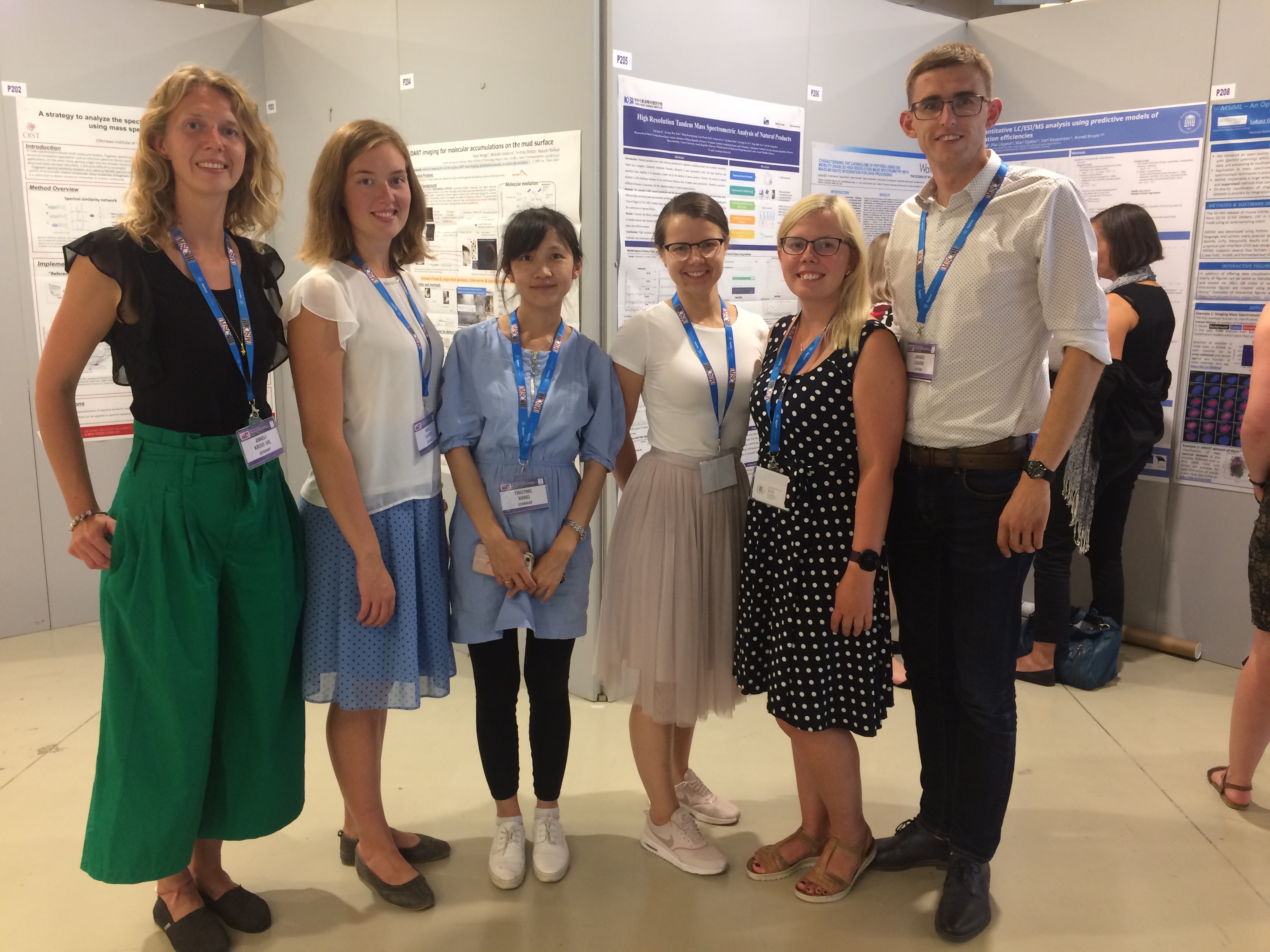
On 3rd-7th June three members of our group focusing on ionization efficiency studies Dr. Anneli Kruve-Viil, PhD students Piia Liigand and Jaanus Liigand, participated in the 66th Annual Conference of American Society for Mass Spectrometry (ASMS) in San Diego, CA. The conference was a huge success. There were altogether about 7500 scientists participating, ca 200 oral presentations and 3300 of posters. We had two oral presentations and one poster presentation.
The conference was kicked off by a presentation by Lisa Shipley from Merck who gave a very informative talk about smart trials and moving to patient-centric clinical trials – most probably the future of clinical trials. It was very inspiring to see how a field that is considered to be relatively conservative is picking up the most modern technical solutions such as clever packages and home-based sample collection.
The first full day of the conference started with a presentation by our PhD student Piia, who gave a talk about achieving more accurate semi-quantitative analysis by predicting electrospray ionization efficiencies. She first gave an overview of the research carried out so far and then, introduced her latest results. She showed that with the help of using ionization efficiencies, concentration estimation in various biological matrices was improved by more than an order of magnitude.
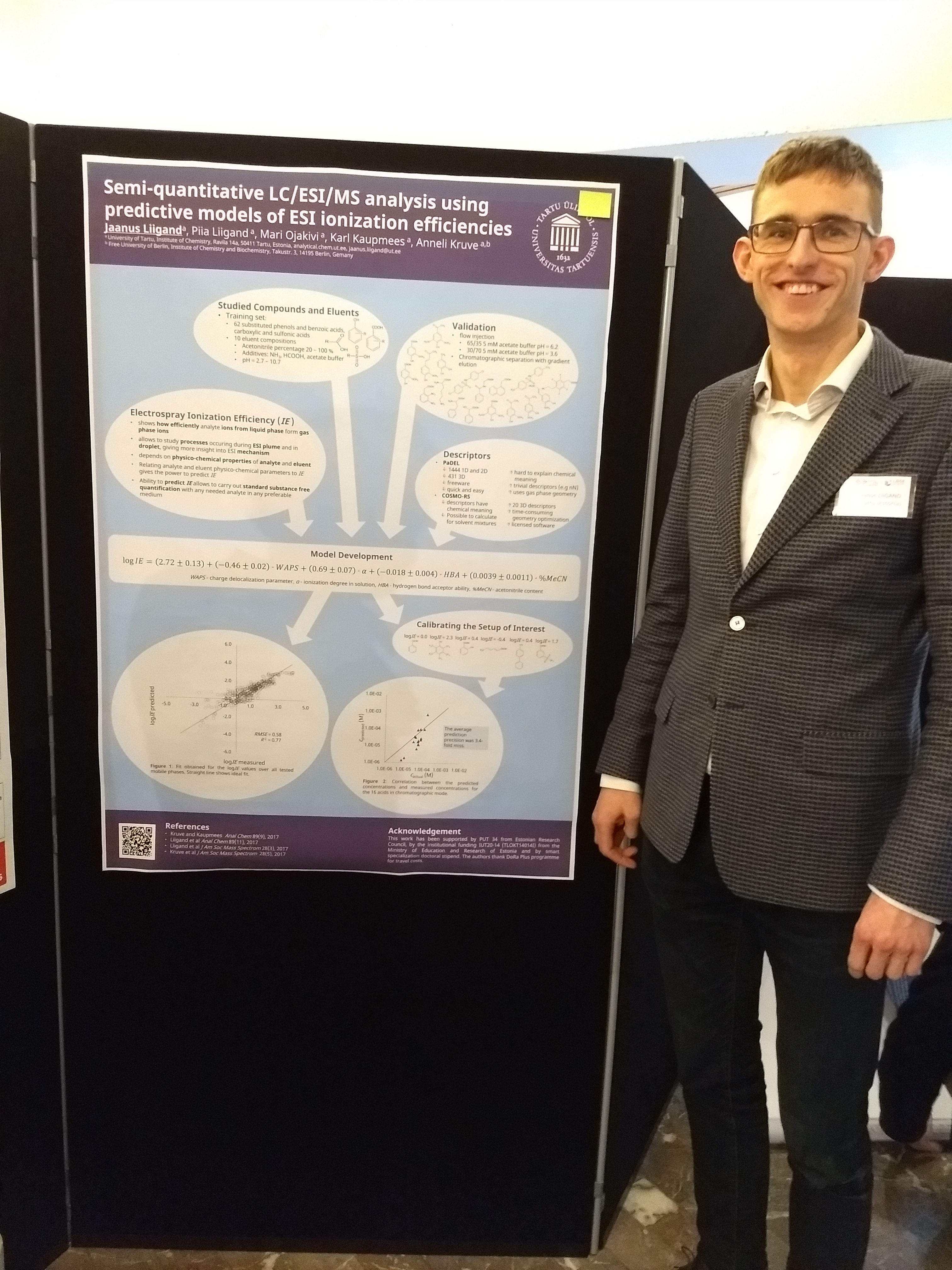
Jaanus Liigand presenting his poster
Jaanus presented a poster on semiquantitative LC/ESI/MS via ionization efficiency prediction. He presented the simple and user-friendly approach of predicting ionization efficiencies using only 2D structures. We are now able to predict ionization efficiencies in both ESI positive and negative mode and in different solvent compositions without time-consuming DFT-COSMO calculations. Additionally, we have shown that using ionization efficiency predictions the validation with LC gradient elution resulted in 2.7-fold mispredicted concentrations compared to 44-fold mispredictions using directly peak areas. We were happy to see that numerous groups were interested in our studies and fruitful discussions about the results did not stop until the end of the poster session.
Dr. Anneli Kruve-Viil giving her talk
Dr. Anneli Kruve-Viil presented some of the latest results obtained in FU Berlin. She talked about using mass spectrometry and ion mobility spectrometry for investigating interlocked nature of catenanes and knots. These results will soon be shared with everyone.
In conclusion, this year’s ASMS was very successful for our group. We saw a lot of interest in our work, met our collaborators and got some new friends and possible future collaborators. We are already looking forward to the next ASMS in Atlanta. We are also grateful for our financial supporters, who made this conference possible to us: instrumentation provided by Estonian Center of Analytical Chemistry (www.akki.ee), Ministry of Education and Research of Estonia by smart specialization doctoral stipend, Graduate School of Functional Materials and Technologies, and Alexander von Humboldt Foundation.
More information about the group focusing on ionization efficiency studies can be found on the webpage kruvelab.com
Our PhD student Jaanus is currently doing research in the group of Prof. Edwin De Pauw at the University of Liege in Belgium and he had a nice opportunity to take part in a 21st annual meeting of Belgian Society for Mass Spectrometry that was held on 29th of March in Liege. The meeting was organized in honour of Prof. Edwin De Pauw to summarize his work as he intended to retire after this year. Luckily for the mass spectrometric community, he will be actively involved in the research at least for four coming years.
Prof. Scott McLuckey opened the day with a presentation about strategies for achieving enzyme-like specificity in the gas-phase fragmentation of peptide and proteins. He showed different strategies how to cleave for example specifically at asparagine or lysine.
Prof. Andrea Sinz presented the results of the development of cleavable cross-linkers. Additionally, she pointed out that although cleavable crosslinkers are available on the market most of the groups determining the protein structures still use the noncleavable crosslinkers and do not take advantage of additional information provided by cleavable crosslinkers.
Dr. Valérie Gabelica presented the results of the studies of nucleic acid noncovalent complexes in native MS. She said that by knowing and studying the fundamentals of ESI processes one gets also a real insight into phenomena seen in different applications (in her case, nucleic acid noncovalent complexes). She also pointed out that unfortunately, scientific community publishes solely positive results which result in biased and non-universal theories.
Jaanus Liigand also had the possibility to present the results of our studies of standard substance free quantitation in LC/ESI/MS analysis and industry showed a great interest in our approach which could be beneficial for their needs (see the poster here).
It was a really nice day full of interesting presentations and discussions.
The aim of the conference was to bring together chemists, physicists, geologists, art historians, conservators, archaeologists, etc. to create a wide community and a mutual environment for a fruitful discussion. Four days were filled with wide-ranging presentations, museum visits and interesting discussions with other scientist from the same scientific fields. The work of our cultural heritage group was also introduced with both oral and poster presentations.
On the left picture you can see Eliise standing next to her poster about the comparison of derivatization methods for GC-MS analysis of binding materials in oil paints. The results of this work are going to be published soon.
On the right picture is Pilleriin presenting her work on textile dye analysis. This work has already been submitted.
Every year Estonian University of Life Sciences organises a conference called “Healthy animal and healthy food” where Dr. Riin Rebane made a presentation “Fight against food fraud” which explained the ever-expanding role of analytical chemists in food science. Reasons for food fraud vary, but are almost always for monetary gain and therefore food fraud is in constant progress. One good example is honey analysis, where for decades there has been a change in methods in order to identify whether honey is real or whether it is identified with correct botanical or geographical origin. As a natural product, no two honeys are identical and this makes identification further more challenging for the chemists. One of the possible methods is amino acid analysis since the amino acid content can be like a fingerprint for honeys and in University of Tartu we have analysed few hundreds of Estonian honeys and have seen that that foreign honeys do differ in most cases and also that there is a correlation between the amino acid content and botanical origin. But nevertheless, even this method might not work every time and chemists are looking towards methods such as nuclear magnetic resonance spectroscopy and even DNA-analysis to get better certainty for determining the origin of honey.
The summary based on the presentation was also reported in the newspaper Maaleht.
Dr. Anneli Kruve, a leader of research team focussing on ionization efficiency studies in electrospray, is currently a Humboldt fellow in Freie Universität Berlin and visited the 1st European Mass Spectrometry Conference in Saarbrücken (Germany) this month. She describes some of the highlights of this conference in her blog, you can read the post below.
Last week I had a chance to take part in the European Mass Spectrometry Conference that was hosted by DGMS (German Society for Mass Spectrometry) and SFSM (French Society for Mass Spectrometry). Below I share a few key ideas from this nice conference that took place in Saarbrücken over 5 days.
The conference was opened with a plenary lecture by Prof. Alain van Dorsselaer who summarized the main work he and his group has done on mass spec during the last 30 years. One of the key ideas, that came up several times in his talk referred to the fact that endless possibilities are accompanied by extreme data load. The amount of data in LC/MS/MS is huge and it is very complicated to analyse these massive data sets. Several other scientists, including Prof. Andreas Roempp and his group, also stressed the importance of transparent and open source data analyses and storage that could eventually simplify the data treatment. These ideas strongly resonate with my own ideas of applying more data science tools in primary data treatment in mass spectrometry, as today the data processing is by far limiting the progress in several fields of analytical mass spectrometry. Mostly this is the case for fields, where the science is still in the “discovery” stage; meaning that the scientists aim at finding the important compounds and yet do not know which these compounds could be. Such fields include metabolomics, proteomics, environmental science, etc.
Prof. Philippe Schmitt Kopplin stressed the importance of high throughput in metabolic sample analyses and explained why dissolve-and-shoot approach (flow-injection or infusion combined with MS) is often most practical. Also, he showed several case studies where marker compounds could be reliably identified with this simple approach if accompanied with efficient and accurate data processing. A particularly interesting example was a case study of 170-year-old wine from the bottom of the Baltic Sea.
Prof. Carsten Engelhard showed an extremely clever, almost brilliant, method to analyse nanoparticles with simple dilution & infusion experiment. The infusion of homogeneous solution to ICP-MS instrument causes an almost constant signal with small random variations. However, if the solution of nanoparticles is infused to ICP-MS, most of the time there is no signal (only noise). When one of the nanoparticles enters the plasma a signal suddenly occurs causing a peak in the chronogram. The height of the signal reflects the size of the nanoparticle and the number of peaks per volume indicates the concentration of the nanoparticles.
Prof. Thomas Kraemer introduced us to the world of forensic analyses. Particularly, he focused on MALDI imaging techniques, that allow revealing drug intake or exposure to toxic compounds. For this purpose his lab is using two types of samples, the traditional hair and lately also toenails, to overcome the problem arising for hairless people. Interestingly, the single hair analysis also reveals time-resolved information with high precision; therefore, allowing to distinguish between one-time and long time exposures.
You can check out more posts from our team studying ionization efficiencies kruvelab.com
The reception of this talk was one of the warmest during the meeting! Several participants came later to say words of thank for offering such a valuable resource to the LC-MS community. There were also some interesting ideas proposed regarding topics that could be covered in the online course. LC-MS and MiC issues, such as validation, are among core competences of the UT Analytical Chemistry research group. The tutorial review, the on-line course, as well as the ValChrom software together form a nice outcome of joining these competences together.
Concerning the topics of the meeting in general, they were remarkably diverse and not so heavily dominated by biomedical MS as is often the case at mass spectrometry meetings. Interesting presentations were given on gas-phase ion processes, different laser techniques in MS (e.g. for analysis of solids without sample preparation), advanced catalysis studies by MS, LC-ICP-DRC-MS for trace element speciation, the possibility of making a high-end LC-HRMS system an “open access” system within an organization, etc.
The presentation outlines the recent results by Pilleriin in creating the method for quick, easy and non-destructive classification and semi-quantitative analysis of textiles using ATR-FT-IR spectroscopy combined with chemometric data analysis methods.
She investigated altogether 89 individual textile materials – Wool, Silk, Cotton, Linen, Cellulose acetate, Lyocell/Tenzel, Viscose, Polyester fibre, Polyamide fibre, Polyacrylic fibre, Elastane and their different combinations – and created a discrimination/classification model using principal component analysis (Image on the right).
Classification of textiles by ATR-FT-IR and principal component analysis, PCA (single-fibre model)
The presentation led to a number of new contacts and invitation to next events. Participants were impressed by the breadth of activities as well as by the very strong team working on these things at UT. In addition, Ivo Leito was interviewed by the Croatian national television.
On Wednesday 12.10.16 the EcoBalt 2016 conference – first time organized in Tartu, Estonia – finished successfully! 42 oral talks and 43 posters were offered to the more than 150 participants from more than 25 countries. The conference featured two tutorial sessions – on measurement uncertainty and on validation of LC/MS analytical methods. The mesmerizing introductory multimedia presentation by Sven Zacek about Estonian nature and the stunning closure talk about “impossible things” by Meelika Hirmo from Let’s Do It! World were certainly among the highlights of the conference.
A number of AMS and EACH students participated in the conference.
We thank all the participants for making EcoBalt 2016 a success!
EcoBalt 2016 was organized by the University of Tartu with Tallinn University of Technology and Estonian Environmental Research Centre.
EcoBalt2016 received financial support from a number of sources. We thank all supporters! Without their help the conference would not have been possible.
For organisation of international events and conferences from Estonian Ministry of Economic Affairs and Infrastructure in cooperation with the Enterprise Estonia tourism development centre from funding provided by the European Union Regional Development Fund.
Second day of the conference was fully supported by Environmental Investment Centre.
The following companies supported the conference: LaboChema, Ramboll, Ordior, Quantum, SyntPot, HNK, Waters, Armgate and LanLab.