Number of participants and countries updated on 22.11.2023!
On Tuesday, November 21, 2023 the web course LC-MS Method Validation was launched for the fifth time as a MOOC (Massive Online Open Course). There are 973 1013 registered participants (the first time ever over 1000) from 107 109 countries, ranging from Chile to China and from Australia to Iceland. And the number is still growing. The image below shows the countries where the participants come from.
This is a practice-oriented on-line course on validation of analytical methods, specifically using LC-MS as technique. The course introduces the main concepts and mathematical apparatus of validation, covers the most important method performance parameters and ways of estimating them. The LC-MS validation course is delivered by a team of 7 teachers, each with their own specific area of competence. This way it is expected to offer the best possible knowledge in all the different subtopics of analytical method validation.
The full set of course materials is accessible from the web page https://sisu.ut.ee/lcms_method_validation/. The course materials include videos, schemes, calculation files and numerous self-tests (among them also full-fledged calculation exercises). In order to pass the course, the registered participants have to take all tests and get higher than 50% score from each of them. These tests are available to registered participants via the Moodle e-learning platform. Participants who successfully pass the course will get a certificate from the University of Tartu.
Opening day of the IBSA 10th meeting at the Estonian National Museum (Photo: Peeter Paaver)
Although archaeology has been inherently interdisciplinary from its early years, recent decades have seen changes referred to as the third scientific revolution in archaeology. Innovative methods enable us to answer previously unanswered questions and pose new ones about the past.
Biomolecular archaeology brings together archaeologists, historians, biologists, and chemists. From September 13th to 15th, the tenth International Symposium of Biomolecular Archaeology (ISBA10) took place at the Estonian National Museum in Tartu. The conference provided a comprehensive overview of the field, covering various research topics, from the domestication of different species to ancient diseases and migrations, as well as the methods employed. The conference abstracts are available here.
The material heritage studied through biomolecular archaeology methods is an irreplaceable resource. Therefore, it must be treated sustainably – obtaining maximum information with minimal damage. For example, it is possible determine the species of a bone to simply by rubbing its surface with an eraser (ZooMS). Still, we must continually justify the use of human remains as research resources, and ask whether the scientists’ perspective aligns with the institutions curating collections, as Rita Peyroteo-Stjerna reminded us. When analysing ancient materials, it is important to leave a mark. The field of biomolecular archaeology is increasingly recognizing the need for data standardization and accessibility, as demonstrated by James Fellows Yates in his presentation on a community-based approach to data integration.
Ester Oras putting up her poster (Photo: Peeter Paaver)
Genetics, one sub-field of biomolecular archaeology, is rapidly evolving. It no longer focuses solely on major migrations. New technologies offer insights into ancient diseases, the environment, and even the presence of people where their remains are absent. For example, today we can obtain information about people from ancient chewing-gums or worn jewellery. Also, social structure and kinship is analysed in collaboration with archaeologists.
The molecules of lipids, proteins, and carbohydrates have been preserved in various ancient objects as burnt food crust or by being absorbed into pots, in animal and human bones, and other tissues, as well as in plants. While stable isotope analysis of bulk collagen provides a general picture of the diet, stable isotopes of individual amino acids allow distinguishing between terrestrial and aquatic origin of proteins.
Biomolecular archaeology cannot be the domain of nerds quietly working in the lab. Both keynote speakers at the conference, Anne Stone and Carl Heron, provided a broader insight into the developments of biomolecular archaeology. The former focused on one catalyst of the revolution, ancient DNA research, the significance of which for society was highlighted by the Nobel Prize awarded to Svante Pääbo in 2022. Carl Heron provided an excellent framework for the history of biomolecular archaeology and urged the community to think more about bringing scientific results to the public.
Over 400 participants attended the ISBA 10th meeting (Photo: Peeter Paaver).
The conference was organized by: the University of Tartu and the Geenikeskus Foundation.
The organization of the conference was supported by: the Collegium for Transdisciplinary Studies in Archaeology, Genetics, and Linguistics of the University of Tartu, the Faculty of Arts and Humanities, the Faculty of Science and Technology; the International Society for Biomolecular Archaeology (ISBA); the city of Tartu; the European Union through the PaleoMIX (No 101079396) and cGEM (No 810645) projects.
The eighth edition of the online course LC-MS Method Validation is open for registration (registration link is here)! The course will be offered as a Massive Open On-line Course (MOOC) during Nov 21, 2024 – Feb 02, 2024.
This is a practice-oriented on-line course on validation of analytical methods, specifically using liquid chromatography-mass spectrometry (LC-MS) as technique, mostly (but not limited to) using the electrospray (ESI) ion source. The scope of the course is sufficiently broad, so that it will be useful also to chromatography practitioners using other detector types. The course introduces the main concepts and mathematical apparatus of validation, covers the most important method performance parameters and ways of estimating them. More information about the course can be found in Course introduction page.
Participation in the course is free of charge. Receiving digital certificate (in the case of successful completion) is also free of charge. Printed certificate (to be sent by post) is available for a fee of 60 EUR. Registration is possible until the start of the course. The course materials are available from the above address all the time and can be used via web by anyone who wishes to improve the knowledge and skills in analytical method validation (especially when using LC-ESI-MS).
We are also glad to announce, that the course has been added into the BIPM (Bureau International des Poids et Mesures) e-learning platform. The BIPM is the most important international metrology organization established by the Metre Convention, through which Member States act together on matters related to measurement science and measurement standards. BIPM is also the home of the International System of Units (SI) and the international reference time scale (UTC). The Institute of Chemistry of University of Tartu is a designated institute by the BIPM since 2010.
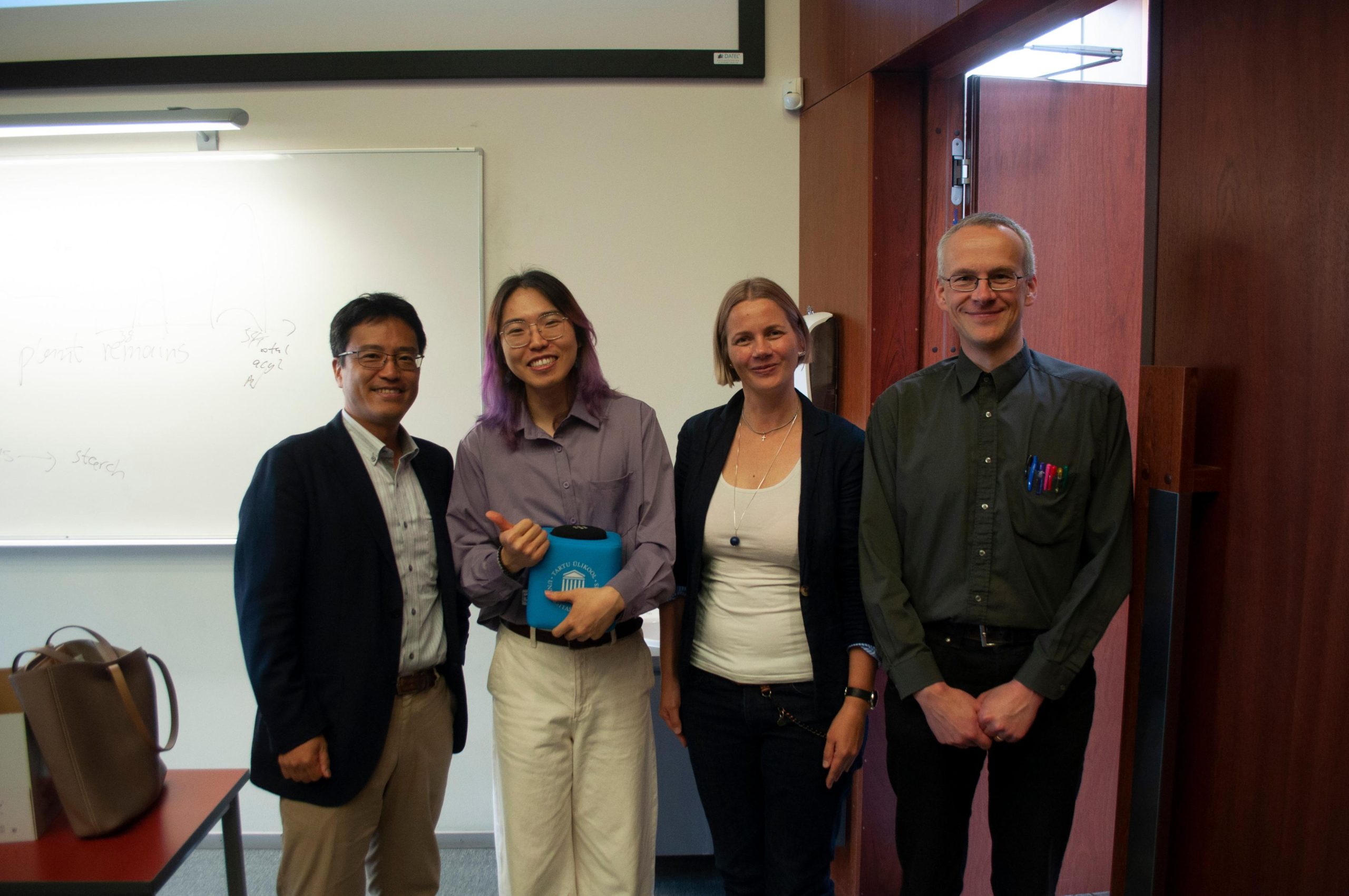
From left to right: opponent Dr. Shinya Shoda, Dr. Shidong Chen, supervisors Dr. Ester Oras and Prof. Ivo Leito
Shidong’s PhD work is aimed at discovering plant exploitation in the ancient eastern Baltic area with a focus on two types of plant-derived materials: resinous materials and dietary plants. The main innovations are developing multi-methodological approaches and interpreting multi-proxy datasets with chemometric and statistical methods.
For identifying the composition of resinous adhesives, ATR-FT-IR analysis was conducted in combination with a PCA-based DA classification model for further compositional and spatial/temporal classification. This method can help simplify IR spectra interpretation and reduce the need for GC-MS analysis.
For identifying dietary plants, a multi-method approach was applied by plant micro fossil analysis and EA-IRMS combined with ORA. EA-IRMS can provide preliminary origins of samples with plant and/or animal bases. Plant micro fossil analysis and ORA in complementary can identify the species of plant remains. Correspondence analysis further compares and indicates the agreement of the three methods and visualizes the correlations between the multi-proxy data.
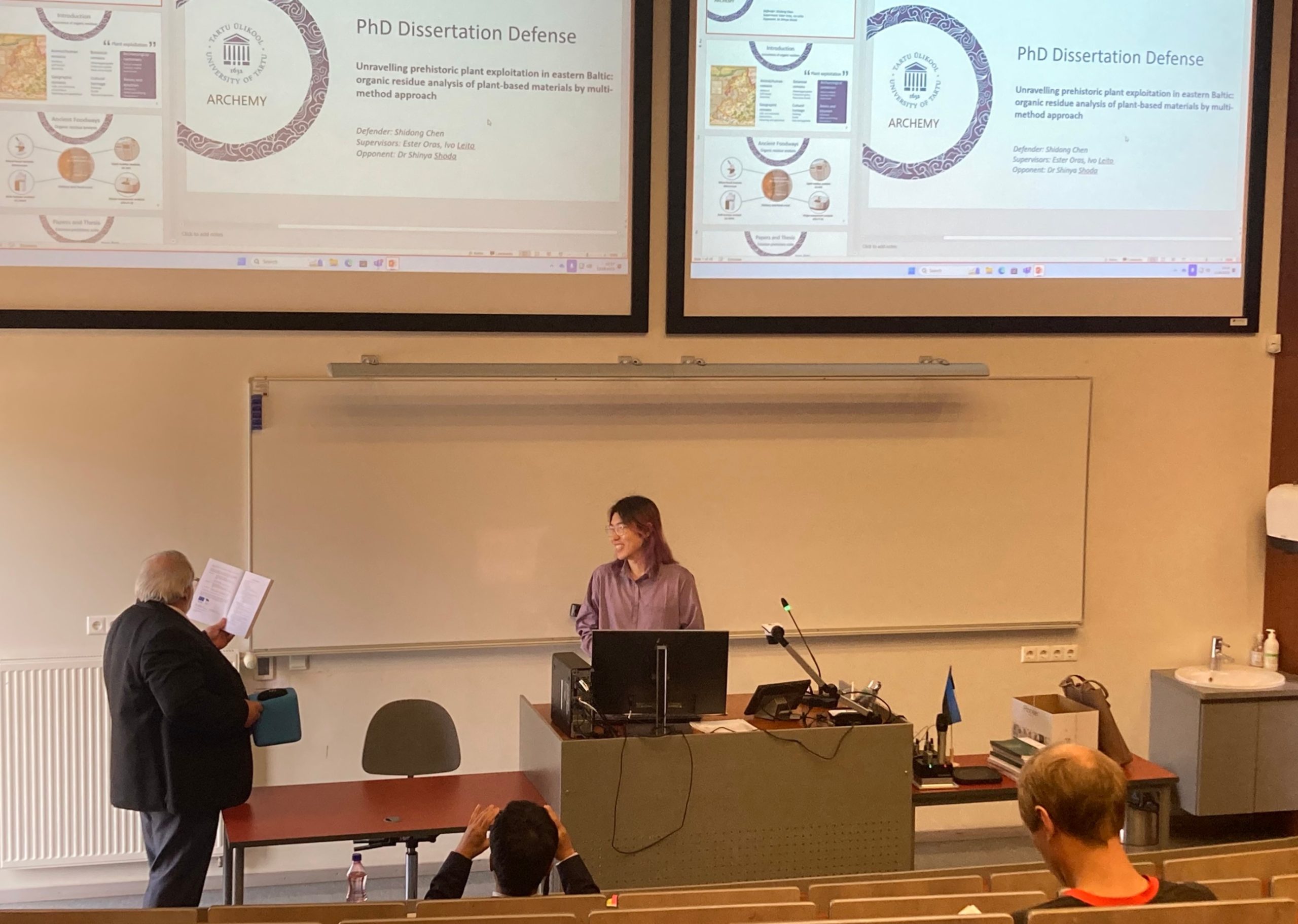
Dr. Shidong Chen moments before the presentation
The plant exploitation in prehistoric easter Baltic shows different patterns with dedicated multi-method case studies on several Stone Age, Bronze Age, and Iron Age sites. In the Stone Age, plant exploitation was more technological (adhesives and resinous compounds) than dietary-related. The plant consumption for dietary purposes became more abundant in the Bronze Age. The major changes happened with the Iron Age displaying a more diverse plant-based diet with more inclusion of C3 cereals (e.g., wheat and barley), yet the spread and cultivation of C4 millet may not have emerged in this region.
Shidong is currently working at ARCHEMY lab as a lab technician at the University of Tartu. He will continue his journey discovering ancient food ways from pots and bones.
Last Wednesday, August 30th, 2023, a moment that marks the culmination of years of hard work and determination of Ernesto de Jesus Zapata Flores – an AMS alumnus. He successfully defended his PhD thesis titled Derivatization Reagents used in negative mode electrospray LC-MS. The opponent was Associate Professor Jeffrey Hawkes from the University of Uppsala, Sweden.
In the vast application of derivatization reagents in RPLC-UV and RPLC-MS positive mode, Ernesto’s thesis delved into the question: What about LC-MS negative mode? Why don’t we compare both modes and see the best of both worlds?
Later on, the method applying two azobenzene-based reagents, which were called AzoB and AzoC (synthesized in our lab), has been fully developed specifically for LC-QqQ. The “gourmet” part that Ernesto has brought to the table of the analytical chemistry community was the study of (2) MS/MS fragmentations of all three reagents with different amino compounds in both ionization modes.
Moreover, his thesis has demonstrated comprehensive research about (3) optimization for the derivatization process and the ion source, (4) the confirmation of reaction yields, and (5) the correlation between ionization efficiency and LOD/LOQ of derivatives. Finally, applications of the validated method (7) for real-world samples (different beverages: beers, Kali, juices) and (8) neutral loss scan have been showcased.
10 out of 10 – that should be given for Ernesto’s dedication on the road to becoming an expert in LC-MS derivatization. Congratulations, Ernesto! We eagerly await your next academic steps. Hopefully, all your goals will be achieved.
Dr. Signe Vahur, during her vacation to Washington DC, USA, had the possibility to visit the Smithsonian’s Museum Conservation Institute (MCI) labs.
The MCI is the center for specialized technical collection research and conservation for all Smithsonian museums and collections. MCI combines knowledge of materials and the history of technology with state-of-the-art instrumentation and scientific techniques to provide technical research studies and interpretation of artistic, anthropological, biological, and historical objects (webpage: https://mci.si.edu/).
Dr. Asher Newsome, a physical scientist at MCI, kindly showed her the research labs equipped with different analytical instruments (e.g., chromatographs (GC, LC), mass spectrometers, spectrometers (FT-IR, Raman, SEM-EDS)) and labs for conserving paintings, textiles, and paper items. He introduced some of his research work, and they had a good discussion of various analysis options for cultural heritage materials.
This visit was very beneficial and raised new collaboration possibilities in the future.
During June 4-8, 2023, Signe Vahur and Anu Teearu-Ojakäär attended the 71st ASMS Conference on Mass Spectrometry and Allied Topics, held in Houston, USA.
Signe and Anu presenting their poster
At the ASMS conference, Signe and Anu presented their poster “MALDI-MS for the analysis of cultural heritage materials” during the Monday (June 5) poster session.
On Wednesday evening (June 7), Signe was an invited panelist (along with Dr G. Asher Newsome from Smithsonian Museum Conservation Institute, USA; Prof Paul Haynes from Macquarie University, Australia; Dr Aleksandra Popowich from the Metropolitan Museum of Art, USA; Assoc Prof Enrico Cappellini from University of Copenhagen, Denmark; and Assoc Prof Troy Wood from University of Buffalo, USA) in the workshop “Art, Museums, and Archaeology” and had a very interesting discussion with approximately 70 attendees.
Altogether, the ASMS 2023 conference had more than 6300 attendees from all over the World. During four days there were 384 oral presentations (that ran in 8 parallel panels) and 4 presentations by invited speakers; 2939 poster presentations (more than 700 posters per day) and 178 corporate members presenting their products – instruments, labware, sample preparation, software solutions, etc. In addition, there were 50 evening workshops, 49 breakfast seminars, and 16 daily corporate hospitality suits.
All in all, the 71st ASMS Conference was a great experience with a lot of new connections, great discussions, and networking opportunities. Thank you to the organisers of the 71st ASMS Conference for delivering such a high-level event!
Signe talking during the panel sessionSigne in the main conference hall
Dr. Andre Leesment (on the right) after his PhD defence with his supervisor Prof. Ivo Leito (on the left).
Experiments for measuring acidity of medicines, catalysts, and other chemicals are almost always performed under monophasic conditions. However, many of them are lipophilic compounds, and in biphasic systems they prefer the nonpolar organic phase, where their properties are much different from their properties in an aqueous phase. Yet the interactions with the organic phase are completely ignored in a typical acidity measurement. It’s like seeing only half of the picture. Why is such an incomplete approach being used for something this important?
Until recently, there was no theoretical basis or experimental method to conduct measurements of acidity under more relevant conditions. Andre’s PhD thesis focuses on providing the tools to measure acidity, and by extension, many other properties of molecules in biphasic systems in a more realistic and accurate way. Hopefully, these tools lead to a more effective drug development, catalyst research, etc.
In this work, a new group of bases with benzophenoneiminyl (bpi) moiety was synthesized and characterized. A convenient one-pot approach was employed to synthesize the starting compound tris(benzophenoneimino)phosphane (P(bpi)3): benzophenone imine was deprotonated using MeMgCl, followed by its reaction with PBr3 in diglyme. This method offers an alternative for preparing other (amino)phosphanes as well when lithio-intermediates and/or protonated phosphanes are not viable options. P(bpi)3 was subsequently utilized to synthesize a variety of related phosphonium cations and phosphazenes.
Crystals from synthesis
The stability of the resulting phosphonium ylides was assessed through their deprotonation. In certain cases, the bulky substances demonstrated the ability to form P-N heterocycles with adjacent P and N atoms and P=C double bonds which are quite rare and only some representatives of this type of heterocycles have been reported before. The basicities of benzophenone imine, P(bpi)3, phosphonium ylides, and phosphazenes were evaluated experimentally (in MeCN) or computationally (in MeCN, THF, and gas-phase). Additionally, representative X-ray crystallography (XRD) structures were presented and discussed. Although the bpi-compounds are not as strong as many existing bases, they still exhibit considerable basicity and could be employed as reagents to overcome common challenges such as solubility, ion-pairing, lack of UV-Vis properties, and other issues.
Eventually, altogether 993 people registered from 99 countries. From them, 523 participants actually started the course (i.e. tried at least one graded test at least once). The overall completion rate was 34%. The participation rate was this year 53%. So, it seems that we may be recovering from the COVID pandemic! The completion rate of the participants who started the studies was 64% with 333 successfully finished participants. This result is quite stable during the 10 runs and can be considered good for a MOOC, especially for one that has quite difficult calculation exercises, which need to be done correctly with a limited number of attempts for completing the course. All statistics during the 10 years can be found in the table below.
The participants were very active and asked lots of questions. The questions were often very much to the point and addressed things that are really important to analysts in their everyday work. The course has several forums (general and by topic) and during the course period the overall number of forum posts was over 450 (!) (overall number of posts, both from participants and from teachers) and the forums are still active and posts are still coming in.
We want to thank all participants for helping to make this course a success!
We plan to repeat this course again in Spring 2024.