The full course material (as well as the registration link) is accessible from the web page. The course materials include videos, schemes, calculation files, and numerous self-tests (among them also full-fledged measurement uncertainty calculation exercises) and examples. Almost all areas of analytical chemistry are addressed, ranging from simple volumetric operations and titrations to sophisticated instrumental analysis, such as determining pesticide residues by LC-MS. Efforts are made in the course to address also such uncertainty sources encountered in chemical analysis that are difficult to quantify, e.g. uncertainty due to possible interference effects (incomplete selectivity).
In order to pass the course, the registered participants have to take six graded tests and get a higher than 50% score in every graded test. These tests are available to registered participants via the Moodle e-learning platform.
Participants who successfully pass the course will get a certificate from the University of Tartu. A digital certificate of completion is free of charge. A certificate of completion on paper can be requested for a fee of 60 euros.
You are welcome to distribute this message to potentially interested people!
On Tuesday, November 23, 2021 the web course LC-MS Method Validation was launched for the sixth time as a MOOC (Massive Online Open Course).
There are 854 registered participants (the largest number ever in this course) from 97 countries. Both numbers are the largest we have had! The countries range from Philippines to Paraguay and from Sweden to Sri Lanka. Image on the left shows the countries where the participants come from.
This is a practice-oriented on-line course on validation of analytical methods, specifically using LC-MS as technique. The course introduces the main concepts and mathematical apparatus of validation, covers the most important method performance parameters and ways of estimating them. The LC-MS validation course is delivered by a team of 8 teachers, each with their own specific area of competence. This way it is expected to offer the best possible knowledge in all the different subtopics of analytical method validation.
The full set of course materials is accessible from the web page https://sisu.ut.ee/lcms_method_validation/. The course materials include videos, schemes, calculation files and numerous self-tests (among them also full-fledged calculation exercises). In order to pass the course the registered participants have to take all tests and get higher than 50% score from each of them. These tests are available to registered participants via the Moodle e-learning platform. Participants who successfully pass the course will get a certificate from the University of Tartu.
EACH is an international two-year joint master degree programme that educates specialists in analytical chemistry well qualified to work in industry (food, pharmaceutical, materials, energy, etc.), chemical analysis laboratories (environment, food, health, etc.), and research (developing new analysis devices or new analysis methods) worldwide. EACH provides knowledge and practical skills in both fundamental and applied aspects of modern analytical chemistry. Practical internship placement in industry or laboratories is an important part of the training.
The programme is suitable both for students who have finished their bachelor’s studies and want to continue in master’s studies, as well as for working analytical chemistry practitioners wishing to spend a couple of years to bring their knowledge and skills to a new level.
The programme is taught by four universities: University of Tartu (UT, coordinator), Estonia; Uppsala University (UU), Sweden; University Claude Bernard Lyon 1 (UCBL), France; and Åbo Akademi University (AAU), Finland. The language of instruction is English, but students will also learn to communicate in one of the languages of the countries involved.
The online application form, admission requirements, deadlines, list of necessary documents, instructions/explanations, as well as contact data for questions are available from the EACH Admission information page.
The course will be offered as a Massive Open On-line Course (MOOC) during Nov 24, 2020 to Feb 05, 2021.
This is a practice-oriented on-line course on validation of analytical methods, specifically using liquid chromatography-mass spectrometry (LC-MS) as technique, mostly (but not limited to) using the electrospray (ESI) ion source. The course will also be of interest to chromatographists using other detector types. The course introduces the main concepts and mathematical apparatus of validation, covers the most important method performance parameters and ways of estimating them. The course is largely based on the two-part tutorial review:
The course materials assembled by the members of our group include video lectures, texts, tables, schemes, practical exercises, and numerous tests for self-testing. In spite of being introductory, the course intends to offer sufficient knowledge and mathematical skills for carrying out validation for most of the common LC-MS analyses in routine laboratory environment. The real-life analysis situations for which there are either examples or self-tests are for example determination of pesticides in fruits and vegetables, perfluoroalkyl acids in water, antibiotics in blood serum, glyphosate, and AMPA in surface water, etc. It is important to stress, that for successfully carrying out validation, practical experience – both in analytical chemistry as such and also specifically in validation – is crucial and this can be acquired only through hands-on laboratory work, not via an on-line course.
Participation in the course is free of charge. Receiving a digital certificate (in the case of successful completion) is also free of charge. Printed certificate (to be sent by post) is available for a fee of 60 EUR. Registration is possible until the start of the course. The course material is available from the above address all the time and can be used via the web by anyone who wishes to improve the knowledge and skills in analytical method validation (especially when using LC-ESI-MS).
Each year the Estonian Information Technology Foundation for Education (HITSA) recognizes the e-courses crested by Estonian educational institutions, that have demonstrated high quality in their online teaching. The main aim of this award is to improve the level of e-courses and to endorse those, that have shown excellence in their teaching.
The awarded quality label certifies the high level of the e-course and recognizes the authors for achieving excellent results in the implementation of e-learning to their teaching process. The importance of e-courses grows year by year. This was especially seen this spring when the majority of teaching and studying had to be done via the web because of the Covid-19 situation.
This year our LC-MS Method Validation web course was honored to receive the quality label. Altogether 511 people from 77 countries registered to the course last autumn. The LC-MS Method Validation MOOC will start again in autumn 2020.
Congratulations on this well-deserved recognition to Ivo, Anneli, Riin, Maarja-Liisa, Hanno, Koit, Karin, Irja, and Asko from our analytical chemistry group!
The EACH programme is an Erasmus Mundus Joint Master Degree programme coordinated by our group. It has become one of the leading master’s degree programmes focusing on analytical chemistry within its short existence. The programme is run in cooperation by four top European universities: in addition to the coordinating university, the University of Tartu (first-year university), also Uppsala University (Sweden), Åbo Akademi University (Finland) and University Claude Bernard Lyon 1 (France) are involved as second-year and specialisation institutions.
The paper gives a comprehensive overview about the EACH programme, including a detailed overview of what EACH is, what kind of topics are taught during the first study-year at the University of Tartu, what is the nature of the different study-tracks (specialisation during second study-year either in Sweden, Finland or France), what extra activities, such as internship and winter school the EACH programme offers. The paper also gives an explanation on why it is necessary to have such a programme like EACH, and how to be a part of the EACH experience.
One section in the paper is dedicated to the impact of the EACH programme – with the four years that the programme has accepted students, it has reached a lot of countries and the employability rate of the graduates is almost 90%.
This Autumn, the fifth intake of EACH students is starting their studies
at the University of Tartu, expanding the blue areas on the map presented above
even more.
For more information on the EACH programme, please see the programme’s webpage and also the newly published paper.
In this course, students reviewed the principles of fluorescence spectroscopy, were introduced to the impact of photophysical phenomena on fluorescence data, and discussed new directions of fluorescence in analytical chemistry. Techniques in multidimensional fluorescence spectroscopy with chemometric analysis were highlighted, especially in the context of novel applications in environmental and related fields. The course consisted of lectures, seminars, tutorial sessions and two lab practicals. The latter were specifically set up for this course by prof. Pagano and were very much appreciated by students.
The first practical was about discovering the fundamental concepts of fluorescence (excitation and emission spectra, Stokes shift, Vavilov’s rule, fluorescence lifetime, etc). The second practical was about analysis of caffeine in beverages using salicylic acid as a fluorescent chemosensor. This analysis utilizes the ability of caffeine to quench the fluorescence of salicylic acid and introduces students to the fluorescence quenching, Stern-Volmer equation and inner filter effects.
Altogether 30 students (out of them 14 EACH students) participated in the course and their feedback was overwhelmingly positive.
Prof. Pagano is a passionate educator. He was the initiator of the Laboratory Science Technology program at Rochester Institute of Technology’s National Technical Institute for the Deaf, which is a unique science programme, specifically designed for deaf students. He was named “2012 U.S. Professor of the Year” by the Council for Advancement and Support of Education and the Carnegie Foundation for the Advancement of Teaching.
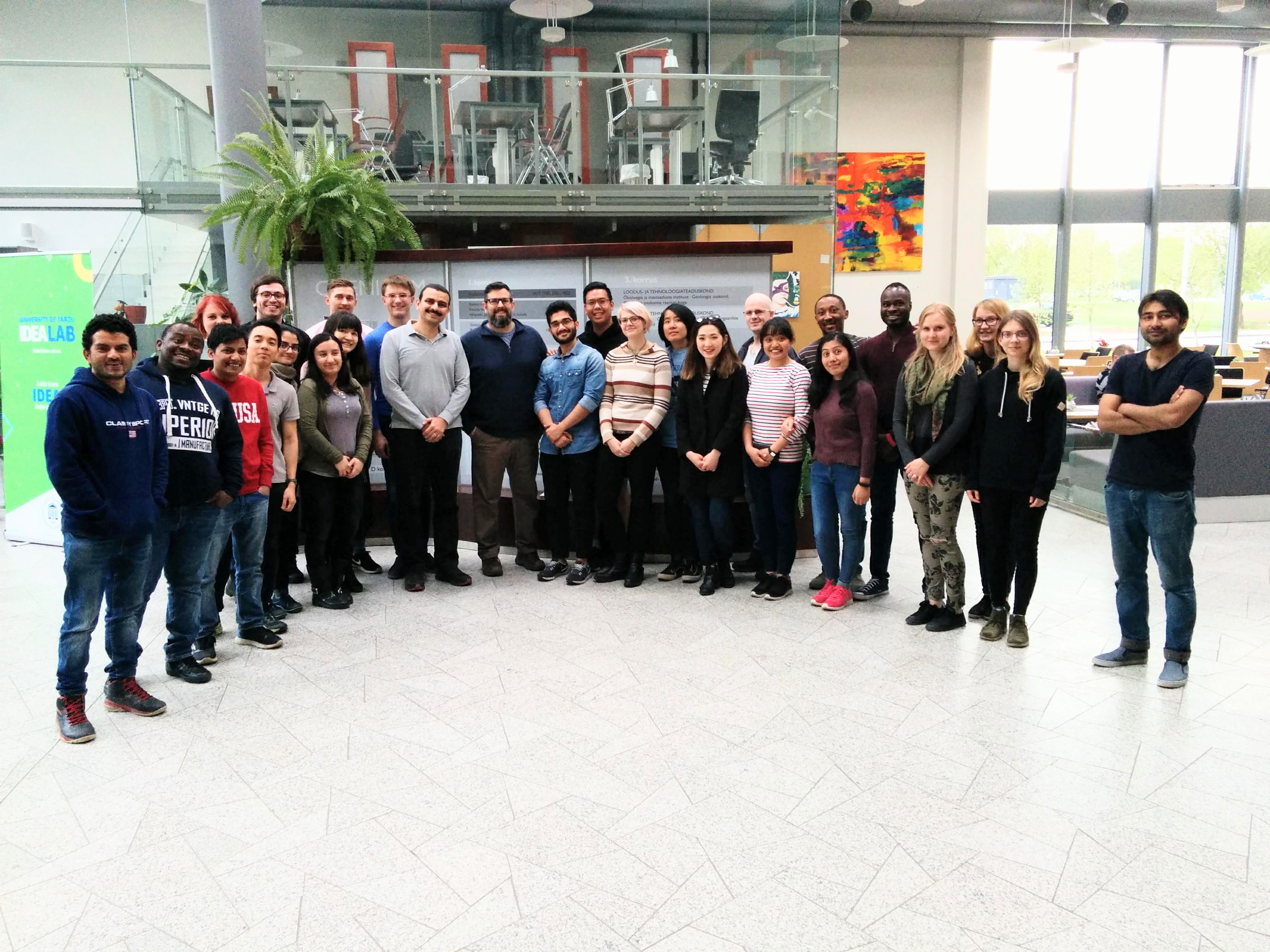
(Images: top left, group photo of prof. Pagano with course participants; right: prof. Pagano with students in lab)
The focus of the talk was sample preparation and how is it included in the EACH programme. A key feature of the presentation was a question to the participants as for what else could/should the EACH programme contain in terms of sample preparation, especially keeping in mind emerging techniques. Another one was a call to come to teach at EACH as visiting scholar. During the subsequent coffee breaks a number of people approached Ivo and interesting ideas were proposed as to what to include into the programme’s set of covered sample preparation approaches (dialysis, different microextraction techniques, sonication, etc). Several people also expressed interest to contribute to the programme as visiting scholars.
Call of applications to the EACH visiting scholar scheme is constantly open at the EACH Visiting scholars page and submitting of application is non-binding, so it is encouraged also if you are not yet sure whether you will come.
We are thankful to all participants for their feedback and ideas!
From 24th to 25th of November our group had a traditional biannual seminar in Pühajärve Spa hotel. The seminar is a nice opportunity to learn about what the group members are doing and which challenges they are tackling. The presentations covered a broad domain of analytical chemistry from fundamental acid-base studies to bioanalyses and analyses of cultural heritage.
Ambient ionization and fluoroalcohols to improve bioanalysis
The first session was focusing on the bioanalytics. Max, a PhD fellow doing an internship in London right now, presented the results of drug analyses from a music festival. Next to strongly varying drug dose, the problem is the strongly varying dissolution of corresponding dose. Next two presentations presented by Rūta, a PhD fellow, and Krit, her undergraduate student introduced fluoroalcohols as novel LC eluent additives and their effect on retention mechanism and electrospray sensitivity. It was really interesting how strongly and unexpectedly differently some fluoroalcohols may change the retention mechanism.
The reliability of fluorescence measurement
The second session focused on acid-base and coordination chemistry. Alo, a PhD fellow, presented his improvements and challenges in the synthesis of bambusuril derivatives. Elisabeth, a master student, introduced 19F NMR measurements of pKa of fluorinated compounds in acetonitrile. Sigrid, a PhD fellow, gave a lecture on how to measure correct fluorescence spectra accounting all effects that may affect the spectra. She showed the importance of concentration and the inner filter effects correction on fluorescence spectrum. Andre, a PhD fellow, wrapped up the seminar with the presentation of his results in gas phase acidity measurements.
Did I get real cashmere scarf from the market?
The third session was focusing on the analysis of cultural heritage. Eliise, a PhD fellow, presented the comparison of four most applied derivatization procedures for analysis of binders in GC. Pilleriin, a PhD fellow, presented her results of textile analyses and a model developed to classify unknown textiles using ATR-FT-IR spectroscopy. Markus, a master student, presented his work on coupling LC with nano-ESI FT-ICR-MS. Juhan, an undergraduate student, introduced his work on acid-base measurements of fluorophoric pH sensor molecules.
After inspiring presentation and fruitful discussions, we had a nice opportunity to relax in the spa and sauna. Additionally, group members discussed with Prof. Leito and Associate Prof. Herodes the SR-15 report from IPCC.
Is open science in terms of metadata really possible?
Next day was kicked off by Astrid, a PhD fellow, who compared the measurement of binding constants using isothermal calorimetry and NMR. Next, Piia, a PhD fellow, introduced her results on using the data from the literature to test, validate and improve the electrospray ionization efficiency prediction model. The take-home message from Piia’s presentation was the need for data integrity on results one is reporting and clear explanations on how one obtained these results. Additionally, a machine-readable format of the structure is a great help to simplify data mining from literature. Next, Jaanus, a PhD fellow introduced the results from a collaboration with a visiting PhD fellow Tingting Wang from DTU, Denmark. He showed the results of standard substance free quantification in the example of pesticides in food matrices. Ernesto, a PhD fellow, introduced his doctoral project on designing and describing the anionic derivatization reagents in LC/MS.
What’s causing this smell?
The second day was wrapped up by Associate Prof. Koit Herodes. He showed us a case study on the analysis of smell of ruined goods. Finally, he presented the current edition of validation software our group is developing to simplify and automate the validation in LC/MS analyses.
Thanks to all participants for interesting and inspiring presentation and for fruitful discussions.
The last part of the talk is devoted to the Eurachem 2018 General Assembly and Workshop that will take place in Tartu on May 20-21, 2018. The topic of the workshop is “Validation of targeted and non-targeted methods of analysis”.


 The full course material (as well as the registration link) is accessible from the web page. The course materials include videos, schemes, calculation files, and numerous self-tests (among them also full-fledged measurement uncertainty calculation exercises) and examples. Almost all areas of analytical chemistry are addressed, ranging from simple volumetric operations and titrations to sophisticated instrumental analysis, such as determining pesticide residues by LC-MS. Efforts are made in the course to address also such uncertainty sources encountered in chemical analysis that are difficult to quantify, e.g. uncertainty due to possible interference effects (incomplete selectivity).