On Aug 15, 2022 Ivo Leito gave a presentation Acidities of Fluorocompounds at the 20th European Symposium on Fluorine Chemistry taking place in Berlin (Germany) during Aug 12-19, 2022.
Fluorination, especially polyfluorination is a powerful means for acidifying molecules. So, many fluorine-containing compounds are acidic (Scheme on the left) and some are remarkably strong acids, e.g. the well-known trifluoromethanesulfonic acid CF3SO3H or the bis(trifluoromethane)sulfonimide (CF3SO2)2NH.
The first part of the presentation gave a brief overview of the acidity of molecules, expressed as pKa values, acidity scales (pKa scales) on the example of the acetonitrile pKa scale and discussed two important pKa measurement methods: UV-Vis and NMR spectrometry.
The second part of the presentation specifically addressed the relative pKa measurement method based on 19F NMR for accurate measurement of pKa values of fluorocompounds (Scheme on the right). The presentation demonstrated that 19F NMR has a number of advantages, compared to most other methods: accurate concentrations of acids not needed, method is tolerant to impurities in compounds, several compounds can be measured simultaneously, solvent or titrant signals do not hinder measurements and deuterated solvents are not needed. Using multiple relative measurements against several reference compounds with known acidities, it is possible to obtain highly reliable pKa values.
On the 3.-6. of July, a Joint International Conference of the “Functional Materials and Nanotechnologies and Nanotechnology and Innovation in the Baltic Sea Region” FM&NT – NIBS 2022 was held in Riga, Latvia at the House of Science, Academic Centre of the University of Latvia. Our project was represented by Dr. Rünno Lõhmus and PhD student Käthi Niman.
The focus of the conference was dedicated to four main topics: Nanomaterials and technologies, Functional Materials, Green Energy and Environment, and Bioengineering materials and biotechnologies. Several lectures were held in both a larger auditorium and in parallel sessions in smaller groups. On the 4th of July, a poster session on the mentioned topics took place. Altogether there were 79 oral and 120 poster presentations. On July 5th, a panel discussion was held on the topic “From lab to fab. What it takes to make a business out of university research.”, which gave an interesting insight into what it takes to create a start-up in the scientific field.
Over the course of four days, several interesting developments in the field of nanotechnologies, functional materials, and biosensors were introduced, which might prove of use in the field of cultural heritage conservation. From thin film and colored glass solar panels to graphene-based sensors, several topics discussed in the numerous presentations sparked ideas of potential use in art and architecture conservation and restauration. As an example, in one oral presentation, given by Dr. Kestutis Staliunas, laser application widening possibilities were discussed. More in detail, in the talk “Nanostructures for intracavity spatial filtering in microlasers,” the authors proposed an interesting idea to exploit photonic microstructures (such as photonic crystals and micro-modulated thin films) to enhance the quality of spatial quality of emitted radiation in microlasers.
The conference was very useful and created many personal contacts for future potential collaboration.
From the 28th of June to the 1st of July 2022, Dr Signe Vahur, Dr Anu Teearu-Ojakäär from our UT Analytical Chemistry Cultural Heritage Investigation group, and PhD student Shidong Chen from the Archemy group attended the 5th international inArt2022 conference in Paris, France.
Anu, Shidong, and Signe
InArt is a conference where professionals from different disciplines (for example, chemistry, archaeology, conservation, biology, etc.) can present and discuss the analysis results using a limited amount of samples or non-invasive approaches and conservation strategies of cultural heritage objects. The conference included altogether 47 oral presentations and three poster sessions with 135 posters, different visit options (starting with the National Centre for Research and Restoration in French Museums (C2RMF) to a walking tour in the historical centre of Paris), and dinner at the hotel The Westin Paris.
Investigations from Fayum mummy portraits to street art
Four days were filled with a wide range of interesting presentations, from hyperspectral imaging and material instrumental analysis of different cultural heritage (paintings, sculptures, manuscripts, etc.) and archaeological objects to investigations of chemical and physical degradation mechanisms of various materials.
Some of the most interesting talks included the presentation by Prof Francesca Modugno (from the University of Pisa) about the SuPerStAr project dedicated to the studying and preservation of street art and Dr Lucile Brunel-Duverger (from French Museums Research and Restoration Center) about the analysis of madder lake dyes in the Fayum portraits (from 1st to 4th century A.D). Also should be highlighted the presentations by Dr Maria Filomena Guerra (from French Museums Research and Restoration Center) on the analysis of objects covered with gold leaf and foil from the Egyptian Middle Kindom period, Dr Laura Pagnin (from the Polytechnic University of Milan) about data fusion of Py-GC-MS and FT-IR data to determine degradation in modern paints, and also Loïc Forma (from The National Heritage Institute in Paris) who talked about how to protect cultural heritage objects from vibrational damages. There were many eye-catching poster presentations, however worth mentioning is the poster made by Dr Louise Chassouant and her colleagues on the chemical and palaeobotanical study of Roman amphorae. In their research, they developed a multidisciplinary approach (applied in archaeometry techniques) to analyse the original content of the amphorae (e.g. components of wine, oils, etc.) and determine the waterproof resin coating components in the internal surface.
The highlights of our recent results
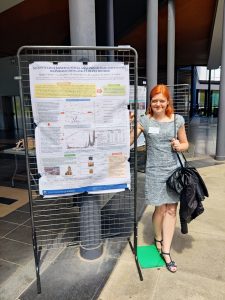
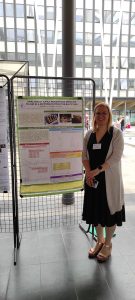
Signe presenting her poster
Anu presenting her poster
Shidong presenting his poster
At the inArt2022 conference, we had three poster presentations from which we could present our research topics and results. Signe presented her poster “Quantitative mineralogical analysis of clay-containing materials using ATR-FT-IR-PLS method”, where an easy and quick quantitative method for determining the mineralogical composition of clays in different sizes and amounts of cultural heritage (i.e. pottery, sculptures, construction materials, etc.) samples using ATR-FT-IR spectroscopy with partial least squares (PLS) analysis is presented. Anu presented her poster „ Analysis of Early Modern Age medicine found in a shipwreck from the Baltic Sea“. In this study, ATR-FT-IR, pyGC-MS, and MALDI-FT-ICR-MS techniques were combined to determine the chemical composition of materials (like pine tar, essential oil, etc.) in the pharmacy jar found on a 16th-century shipwreck in the Baltic Sea. Shidong presented his poster “Classification of Archaeological Adhesives from Eastern Europe and Urals by ATR-FT-IR Spectroscopy and Chemometric Analysis”. This study showed that ATR-FT-IR-DA classification is a rapid and reliable pre-scanning method for analyzing archaeological adhesives (e.g. birch bark tar), which is especially suitable for small samples.
Overall, the inArt2022 conference gave our cultural heritage and archaeology objects researchers the possibility to introduce their scientific work results, hear presentations of investigation of different materials, obtain valuable tips for further research and have interesting discussions with other scientists.
Every year students vote for their favorite teachers in all of the institutes at the University of Tartu.
We are pleased to announce that this year Dr. Koit Herodes was selected as the best teacher from the Institute of Chemistry!
Koit is an Associate Professor in our Chair of Analytical Chemistry. He is an expert in several analytical techniques, including chromatography and mass spectrometry. His current courses include Analytical Chemistry, Practical Chemical Analysis, Liquid Chromatography and Mass Spectrometry, Master Seminar in Measurement Science, and LC-MS Methods Validation. He teaches students of the Estonian chemistry and high school teacher curricula but also the students of the international EACH and AMS programs. Since 2001 he has supervised numerous BSc, MSc, and PhD students.
Recently, a collaborative study on the Solid-State Composite reference electrodes was published in the journal of Membranes 2022, 12, 569. Slim Blidi, EACH alumnus and the first author of this publication, provides here a short overview of this novel research.
Potentiometric measurements using conventional electrodes do have some drawbacks when used. This is especially true for the conventional liquid-filled reference electrodes. They are non-robust in use and are maintenance-intensive due to the necessity of refilling the inner solution and keeping the liquid junction clog-free.
By eliminating the liquid component from the electrode structure, Solid-State Composite (SSC) reference electrodes are a viable alternative to conventional reference electrodes. Prepared by either injection molding or chemical polymerization, they are based on a silver/silver chloride reference element enclosed in a polymeric matrix (e.g. polyvinyl acetate) mixed with an inorganic salt (potassium chloride). The composite is the inorganic salt storage material while being in contact with the sample solution.
In this study, a set of the SSC reference electrodes was prepared and their performance was tested in different synthetic solutions to assess the possible influence of pH, solution composition, as well as the concentration and mobility of ions. Using potentiometry and electrochemical impedance spectroscopy methods over a period of several months, stability tests were also performed to evaluate the suitability of the studied SSC reference electrodes for continuous, prolonged, and intensive usage. Concentrations of K+, Na+, Ca2+, and Cl– ions and pH values were measured in river water samples at different temperatures using the SSC reference electrodes.
better than commercial liquid-filled reference electrodes in terms of calibration range and actual measurements. It is safe to say that SSC reference electrodes represent the future of potentiometric measurements applied to environmental samples as they are cheap to manufacture and easy to maintain.
I am extremely grateful to my supervisors at Åbo Akademi: Dr. Kim Granholm, Dr. Zekra Moussavi, and Dr. Tomasz Sokalski for their valuable guidance and moral support during the experimental work as well as to the EACH programme for this life-changing experience.
Ester Oras, the PI of our Archemy research group, was awarded L’Oreal-UNESCO “For Women in Science” Young Talents Program Baltics (Estonia) with the support of the Estonian Academy of Sciences and the Estonian National Commission for UNESCO scholarship.
Ester and her team work in biomolecular archaeology and employ modern omics methods – lipidomics, proteomics, and genomics – to reveal ancient dietary practices and diseases. By analysing centuries and millennia old ceramic vessels and human remains with topnotch laboratory techniques, Ester aims to show how past foodways affected the health of ancient populations, and reveal how historically developed dietary practices influence our overall wellbeing in the past as well as today. Ester says herself: “I want to give colour and taste to the past and bring the history closer to us today.”
L’Oréal-UNESCO For Women in Science Young Talents Programme aims to support and encourage young women researchers who represent the future of science in STEM fields. The Baltic regional programme opened first in Latvia in 2004 and widened to Lithuania and Estonia in 2017, with altogether 10 Young Talents recognised from Estonia so far.
Eventually, altogether 851 people registered from 103 countries. 405 participants actually started the course (i.e. tried at least one graded test at least once). The overall completion rate was 28%. This, as well as the participating rate was the lowest (48%) we have seen. However, the completion rate of the participants who started the studies was 59% with 239 successfully finished participants. Although lower than we have previously see, this result can still be considered very good for a MOOC, especially for one that has quite difficult calculation exercises, which need to be done correctly with limited number of attempts for completing the course. All statistics during the 9 years can be found in the table below.
The participants were very active and asked lots of questions. The questions were often very much to the point and addressed things that are really important to analysts in their everyday work. The course has several forums (general and by topic) and during the course period the overall number of forum posts was over 500 (!) (overall number of posts, both from participants and from teachers) and the forums are still active and posts are still coming in.
We want to thank all participants for helping to make this course a success!
We plan to repeat this course again in Spring 2023.
From left: Dr Signe Vahur, artist Kaido Ole, and Dr Hilkka Hiiop
On the 15th of April, Dr Signe Vahur, Dr Hilkka Hiiop, and their Bachelor student Selene Margaret Pruuden visited Estonian painting artist Kaido Ole.
Kaido Ole has been one of the most well-known and awarded contemporary Estonian painters since 1989 and a long-time teacher and professor at the Estonian Academy of Arts. Ole’s work has a unique point of view, and his paintings are characterised by humour, self-irony and a critical sense of the absurd. Kaido Ole likes to use bright colours and different painting materials (oil paints, acryl paints, alkyd paints, etc.). More about Kaido’s creations can be seen on his webpage.
Our cultural heritage workgroup investigates different traditional materials and now more and more also modern synthetical and polymeric materials. Kaido Ole supports our modern materials research topic with his know-how as an artist and kindly shares his painting materials. In the future, we can investigate these materials also with our laser-pen probe-MS.
This collaboration is very new, and we are very excited to pursue this research. Thank you, Kaido!
This week, Nieves Maria Flores March successfully defended her Master’s thesis named the “Organic Constituents of Atmospheric Aerosols in a Hemi-boreal Forest” and was awarded the highest grade – “A”!
In this project (supervised by Prof. Heikki Junninen), Nieves studied the chemical composition of organic aerosols collected from an Estonian Hemi-boreal forest during winter, spring, and summer. This research is important because atmospheric aerosols play a significant role in climate change and human health. However, the impact of boreal forests is difficult to characterize because of the chemical diversity of aerosol samples.
To get a better understanding of the chemical composition, Nieves applied two analytical methods – gas chromatography – mass spectrometry (GC-MS) and nuclear magnetic resonance (NMR) to the forests samples. For data analysis, she used a molecular networking technique to tentatively identify the possible compounds. She concluded, that the developed set of methods has great potential to perform fast screening of the chemical composition of atmospheric aerosols.
The GC-MS and NMR analyses were performed in collaboration with our Chair of Analytical Chemistry and we are happy to say that this joint and fruitful project will also continue in the future.
Currently, 843 participants from 103 countries are registered – the largest number of countries the course has ever had! In the map presented on the left, the yellow color marks the countries from where participants come. True, the map is coarse and some countries are small. Therefore, not all countries are visible. We are very happy, that we have one participant also from Ukraine this year. Slava Ukraini!
The full course material is accessible from the web page https://sisu.ut.ee/measurement/uncertainty. The course materials include videos, schemes, calculation files and numerous self-tests (among them also full-fledged measurement uncertainty calculation exercises). In order to pass the course, the registered participants have to pass six graded tests and get higher than 50% score from each of them. These tests are available to registered participants via the Moodle e-learning platform.
This course is run under the umbrella of the Estonian Center of Analytical chemistry (https://www.akki.ee/) and forms a part of the measurements and chemical analysis related master programmes at UT: Applied Measurement Science (https://ams.ut.ee/) and Excellence in Analytical Chemistry (https://www.analyticalchemistry.eu/).


 On Aug 15, 2022 Ivo Leito gave a presentation Acidities of Fluorocompounds at the 20th European Symposium on Fluorine Chemistry taking place in Berlin (Germany) during Aug 12-19, 2022.
 The second part of the presentation specifically addressed the relative pKa measurement method based on 19F NMR for accurate measurement of pKa values of fluorocompounds (Scheme on the right). The presentation demonstrated that 19F NMR has a number of advantages, compared to most other methods: accurate concentrations of acids not needed, method is tolerant to impurities in compounds, several compounds can be measured simultaneously, solvent or titrant signals do not hinder measurements and deuterated solvents are not needed. Using multiple relative measurements against several reference compounds with known acidities, it is possible to obtain highly reliable pKa values.