From January 2021 to December 2025, the cultural heritage investigation workgroup, led by Dr. Signe Vahur, is working on a novel and exciting PRG project called “Development of laser-based pen-type probe-MS system for the analysis of cultural heritage objects” funded by the Estonian Research Council. This highly interdisciplinary PRG1198 project combines researchers from chemistry, physics, material science, archaeology, conservation, and heritage science.
If you’re a BSc, MSc, PhD student, or a postdoc in life sciences interested in working on this project, don’t hesitate to contact (signe.vahur@ut.ee)!
On this webpage, we will regularly post pictures, short texts and news about the project! Your comments and good advice is more than welcome!
Every year the Katritzky scholarship is rewarded to a first-year chemistry MSc student at the Institute of Chemistry, University of Tartu. The scholarship was established in memory of Professor Alan Roy Katritzky, the Honorary Doctor of the University of Tartu. We are glad to announce that this year the scholarship was awarded to a member of our Analytical Chemistry Chair – Silvia Hiie Aabloo!
Silvia Hiie Aabloo
Silvia is doing her MSc project in the Cultural Heritage workgroup, supervised by Dr. Anu Teearu-Ojakäär and Dr. Signe Vahur. Her research revolves around the study of matrix materials used in the matrix-assisted laser desorption/ionization (MALDI) analysis. MALDI is a suitable ionization technique for the analysis of large and poorly soluble molecules, which has been used somewhat for the analysis of cultural heritage objects. However, research is still needed to find suitable matrix materials for different cultural heritage materials. An interview with Silvia after receiving the scholarship can be found here (in Estonian).
On the 3.-6. of July, a Joint International Conference of the “Functional Materials and Nanotechnologies and Nanotechnology and Innovation in the Baltic Sea Region” FM&NT – NIBS 2022 was held in Riga, Latvia at the House of Science, Academic Centre of the University of Latvia. Our project was represented by Dr. Rünno Lõhmus and PhD student Käthi Niman.
The focus of the conference was dedicated to four main topics: Nanomaterials and technologies, Functional Materials, Green Energy and Environment, and Bioengineering materials and biotechnologies. Several lectures were held in both a larger auditorium and in parallel sessions in smaller groups. On the 4th of July, a poster session on the mentioned topics took place. Altogether there were 79 oral and 120 poster presentations. On July 5th, a panel discussion was held on the topic “From lab to fab. What it takes to make a business out of university research.”, which gave an interesting insight into what it takes to create a start-up in the scientific field.
Over the course of four days, several interesting developments in the field of nanotechnologies, functional materials, and biosensors were introduced, which might prove of use in the field of cultural heritage conservation. From thin film and colored glass solar panels to graphene-based sensors, several topics discussed in the numerous presentations sparked ideas of potential use in art and architecture conservation and restauration. As an example, in one oral presentation, given by Dr. Kestutis Staliunas, laser application widening possibilities were discussed. More in detail, in the talk “Nanostructures for intracavity spatial filtering in microlasers,” the authors proposed an interesting idea to exploit photonic microstructures (such as photonic crystals and micro-modulated thin films) to enhance the quality of spatial quality of emitted radiation in microlasers.
The conference was very useful and created many personal contacts for future potential collaboration.
From the 28th of June to the 1st of July 2022, Dr Signe Vahur, Dr Anu Teearu-Ojakäär from our UT Analytical Chemistry Cultural Heritage Investigation group, and PhD student Shidong Chen from the Archemy group attended the 5th international inArt2022 conference in Paris, France.
Anu, Shidong, and Signe
InArt is a conference where professionals from different disciplines (for example, chemistry, archaeology, conservation, biology, etc.) can present and discuss the analysis results using a limited amount of samples or non-invasive approaches and conservation strategies of cultural heritage objects. The conference included altogether 47 oral presentations and three poster sessions with 135 posters, different visit options (starting with the National Centre for Research and Restoration in French Museums (C2RMF) to a walking tour in the historical centre of Paris), and dinner at the hotel The Westin Paris.
Investigations from Fayum mummy portraits to street art
Four days were filled with a wide range of interesting presentations, from hyperspectral imaging and material instrumental analysis of different cultural heritage (paintings, sculptures, manuscripts, etc.) and archaeological objects to investigations of chemical and physical degradation mechanisms of various materials.
Some of the most interesting talks included the presentation by Prof Francesca Modugno (from the University of Pisa) about the SuPerStAr project dedicated to the studying and preservation of street art and Dr Lucile Brunel-Duverger (from French Museums Research and Restoration Center) about the analysis of madder lake dyes in the Fayum portraits (from 1st to 4th century A.D). Also should be highlighted the presentations by Dr Maria Filomena Guerra (from French Museums Research and Restoration Center) on the analysis of objects covered with gold leaf and foil from the Egyptian Middle Kindom period, Dr Laura Pagnin (from the Polytechnic University of Milan) about data fusion of Py-GC-MS and FT-IR data to determine degradation in modern paints, and also Loïc Forma (from The National Heritage Institute in Paris) who talked about how to protect cultural heritage objects from vibrational damages. There were many eye-catching poster presentations, however worth mentioning is the poster made by Dr Louise Chassouant and her colleagues on the chemical and palaeobotanical study of Roman amphorae. In their research, they developed a multidisciplinary approach (applied in archaeometry techniques) to analyse the original content of the amphorae (e.g. components of wine, oils, etc.) and determine the waterproof resin coating components in the internal surface.
The highlights of our recent results
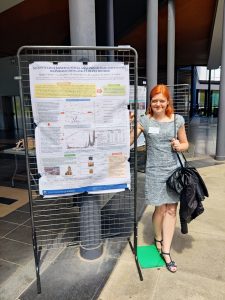
Signe presenting her poster
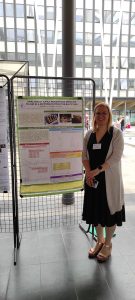
Anu presenting her poster
Shidong presenting his poster
At the inArt2022 conference, we had three poster presentations from which we could present our research topics and results. Signe presented her poster “Quantitative mineralogical analysis of clay-containing materials using ATR-FT-IR-PLS method”, where an easy and quick quantitative method for determining the mineralogical composition of clays in different sizes and amounts of cultural heritage (i.e. pottery, sculptures, construction materials, etc.) samples using ATR-FT-IR spectroscopy with partial least squares (PLS) analysis is presented. Anu presented her poster „ Analysis of Early Modern Age medicine found in a shipwreck from the Baltic Sea“. In this study, ATR-FT-IR, pyGC-MS, and MALDI-FT-ICR-MS techniques were combined to determine the chemical composition of materials (like pine tar, essential oil, etc.) in the pharmacy jar found on a 16th-century shipwreck in the Baltic Sea. Shidong presented his poster “Classification of Archaeological Adhesives from Eastern Europe and Urals by ATR-FT-IR Spectroscopy and Chemometric Analysis”. This study showed that ATR-FT-IR-DA classification is a rapid and reliable pre-scanning method for analyzing archaeological adhesives (e.g. birch bark tar), which is especially suitable for small samples.
Overall, the inArt2022 conference gave our cultural heritage and archaeology objects researchers the possibility to introduce their scientific work results, hear presentations of investigation of different materials, obtain valuable tips for further research and have interesting discussions with other scientists.
From left: Dr Signe Vahur, artist Kaido Ole, and Dr Hilkka Hiiop
On the 15th of April, Dr Signe Vahur, Dr Hilkka Hiiop, and their Bachelor student Selene Margaret Pruuden visited Estonian painting artist Kaido Ole.
Kaido Ole has been one of the most well-known and awarded contemporary Estonian painters since 1989 and a long-time teacher and professor at the Estonian Academy of Arts. Ole’s work has a unique point of view, and his paintings are characterised by humour, self-irony and a critical sense of the absurd. Kaido Ole likes to use bright colours and different painting materials (oil paints, acryl paints, alkyd paints, etc.). More about Kaido’s creations can be seen on his webpage.
Our cultural heritage workgroup investigates different traditional materials and now more and more also modern synthetical and polymeric materials. Kaido Ole supports our modern materials research topic with his know-how as an artist and kindly shares his painting materials. In the future, we can investigate these materials also with our laser-pen probe-MS.
This collaboration is very new, and we are very excited to pursue this research. Thank you, Kaido!
From left: Aleksei, Signe (in front), Victor, Tõiv
We are glad to say that we have obtained the first promising results with the development of the laser-MS system!
We have done various testing with an existing laser to select suitable laser wavelengths and parameters as well as tested different configurations with mass spectrometers. The latest progress shows that the research project is on the right track.
Victor working with the laser-MS system
A big help to these experiments has been Victor Augusto Xavier Da Silveira who joined our project this year. He is a Master’s student of the Excellence in Analytical Chemistry (EACH) programme with a background in chemical engineering and has been a technician of mass spectrometric devices.
Victor, you have done excellent work, thank you for that!
Today it was announced that the president of Estonia, Alar Karis, has honored 148 Estonians or our friends from abroad with national awards, also known as decorations.
It is a great pleasure to announce that the Order of Merit of the White Star was awarded to Prof. Hilkka Hiiop, a valued member of our workgroup! She has been acknowledged for bringing the conservation of cultural heritage into the focus of Estonian society.
The press release can be found here (in Estonian). But to translate some of the words of our president: “On the eve of Independence Day, the Republic of Estonia thanks people with its decorations whose perseverance, selflessness, dedication, ingenuity, or creation are an example to many others and have made Estonia better, more caring, more noticed, and more entrepreneurial.”
Yesterday, on November 18, 2021, Dr. Signe Vahur made a presentation about our cultural heritage investigation workgroup at the Annual Conference of the University of Tartu Museum called “100 years of Tullio Ilomets”.
This summer (July 13, 2021) would have been the 100th birthday of the legendary chemist, scientific historian, and cultural heritage protector and investigator docent Tullio Ilomets. This conference was dedicated to him, and different people who worked with him, were his students or were influenced by him made presentations. Dr. Signe Vahur was his student and thanks to his motivation and influence, we now have our cultural heritage workgroup.
The conference can be watched from here (it is in Estonian).
Additionally, small samples from two paint case study samples relevant to the history of Estonia – crucifix from Karja church and cupboard from Ruhnu island – were analyzed to obtain information about the materials in the paint samples. Finally, the improved quantitative method was used to quantify fatty acids present in yeast cells.
Yesterday, on the 7th of May, Associate Professor emeritus of physics Matti Laan gave a highly interdisciplinary lecture about laser cleaning in the field of cultural heritage.
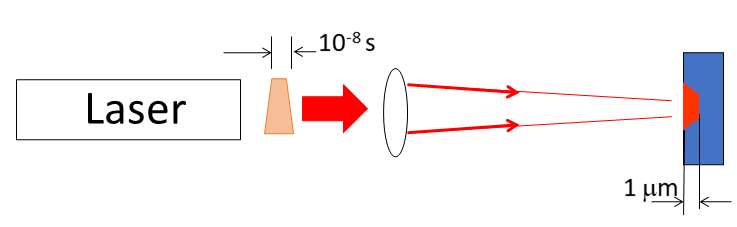
On this project, Dr. Laan (presenting his lecture in the picture on the right) worked with the late Associate Professor emeritus of chemistry Tullio Ilomets. Dr. Laan gave an exciting lecture about different lasers (e.g., Nd:YAG, XeCl, Er:YAG) and which of them is most suitable for laser cleaning of various artefacts (such as paintings or sculptures). For this laser ablation is used, which removes any undesired material (including ageing products and materials from previous conservation works) layer by layer.
Most of the listeners participated via the Zoom platform – over 70 physics, chemists, conservators, material scientists, and people from other disciplines joined in this interdisciplinarity lecture. The lecture was organised by our Cultural Heritage workgroup, Institute of Physics, and The Estonian Academy of Arts in the framework of Dr. Signe Vahur’s PRG1198. The recording (in Estonian) can be found here.