The conference was held with the participation of 190 scientists from 36 countries representing the 5 continents during 22-26 July 2019 in the University of Alicante, Alicante, Spain. One of our group members, Dr. Ali Ghiami-Shomami, presented a poster during this conference. The presented topic, “DFT and TD-DFT Studies of Some Aminoacridines as Matrices in MALDI-MS”, is an effort towards exploring the factors influencing matrix performance in MALDI-MS technique using computational chemistry and in collaborations with our experimentalists. Some visitors appreciated the work and found it interesting. They emphasized that the MALDI-MS technique is very tricky and therefore, finding some insights about it from computational chemistry is valuable. More information about the conference can be found here: www.dft2019.es
The 9th Workshop and Meeting of the Users’ Group for Mass Spectrometry and Chromatography (MaSC ) for the study of cultural heritage objects took place on June 3-7, 2019 in Ottawa, the capital of Canada. One of our group members – PhD fellow Eliise Tammekivi – also participated in the workshop and gave an oral presentation at the meeting.
Practical instructions for the analysis of dyes, resins and volatile organic compounds (VOCs)
Jennifer Poulin analyzing amber with Thermal Separation Probe (TSP)
Dr. Gregory D. Smith presenting a device that can turn even a small sample into a fine powder.
The workshop of MaSC 2019 took place in the Canadian Conservation Institute (CCI) and Parks Canada, where the Thermal Separation Probe (TSP) was presented as a novel device for thermal desorption and „slow pyrolysis“ analyses in gas chromatography-mass spectrometry (GCMS) by the leading researchers in the study of cultural heritage materials. With the instructions from Jennifer Poulin (CCI) the participants were able to conduct the analysis of dyes and identify natural resins by the help of AMDIS software. With instructor Dr. Gregory D. Smith (Indianapolis Museum of Art at Newfields) participants could perform evolved gas analysis of museum exhibition materials once again with TSP and GCMS.
Topics from fish oil in paintings to the interpretation of highly complex GCMS data
The Meeting of MaSC 2019 took place in the National Gallery of Canada. Presentations were given by the world’s leading analysts about the GCMS analysis of art and historical artifacts. For example, Kate Fulcher (British Museum) talked about the complications of identifying black liquids applied to ancient Egyptian coffins and Corina Rogge (The Museum of Fine Arts Houston) about the utilization of fish oil containing house paints to artists’ paintings in economically difficult times. Additionally, Michael Schilling and Henk van Keulen presented the wonderful advantages of using AMDIS software and ESCAPE for the identification of compounds in complex and small cultural heritage samples. Also, it was Eliise’s first full talk at an international conference, where she presented our groups’ work on the topic „Quantitative analysis of binders in cultural heritage objects“. Specifically, she presented the comparison of four common derivatization procedures in the field of cultural heritage for the quantitative GCMS analysis of oils. For the opportunity to attend the workshop and meeting she would like to thank the organizers of MaSC 2019 and Dora Pluss scholarship (Archimedes).
At the end of June, on 25-27th, two PhD fellows from our group Pilleriin and Eliise attended FT-ICR-MS short course, this time locating in Rome, Italy. Three-days course included both lectures from FT-ICR experts like Jevgeny Nikolaev, Maria Elisa Crestoni, Simonetta Fornarini, and hands-on lab practices. The central theme for the short-course was ion-molecule reactions. During these days, attendees were able to see how ion-molecule reaction experiments are conducted in the University of Sapienza, also get tutorial on how to process all of this extensive data from this process. The FT-ICR used in Sapienza is a 4.7 T Bruker Apex II instrument.
EU_FT-ICR-MS summer school and short course series is altogether a four-year-long project, which aim is to bring together all the scientist using FT-ICR all over Europe and promote the usage of this instrument. During this program 2018-2021, it is also possible to submit your project to use any of the FT-ICR instruments provided in this community.
Between the 16th to 20th of June our group presented itself in HPLC 2019 in Milan. It was a 5-daylong and intense learning opportunity with more than 300 speakers and around 500 posters.
Topics ranged from fundamentals of HPLC, miniaturization to different omics, pharmaceutical analysis and innovative technologies (can HPLC have a FID as a detector?). For the first time, a whole section was dedicated to 3D printing technologies – a technique that is used to build 3 dimensional separation modules: for example, fascinating talks on using 3D printing to do liquid chromatography in 3 dimensions.
The conference gala dinner was held at the beautiful central courtyard of University of Milan under relieving cool evening sky opposing the hot temperatures of the day. HPLC 2019 also had two new additions that hopefully will become annual traditions: Separation Science Slam and HPLC Tube, offering an opportunity for scientists to express their love for their work in modern ways. The competitions were extremely creative and both the audience and participants were thoroughly enjoying the events. Participants from our analytical chemistry chair gave multiple contributions to the conference.
Ecstasy content in tablets is uneven
Max giving his talk
Max Hecht, MSc, presented an oral presentation on the evaluation of MDMA (also known as ecstasy and ‘Molly’) content in 412 tablets and dissolution properties in 247 tablets, collected in the UK in the time period of 2001-2018. It was found that there are no physical tablet characteristics which correlate to dissolution rate classification, hence no way of users knowing a priori whether tablets were more likely to be fast or slow-releasing. Further, large within-batch variation in the dose and also dissolution rate was observed, giving the combined result of increasing significantly the danger of over-dosing.
Standard substance free quantification in LC/ESI/MS
Anneli giving her talk
Dr. Anneli Kruve presented the recent work of her group on standard substance free quantification of metabolites in green tea samples. In the metabolomics studies, the standard substances for all detected and identified metabolites are hardly ever available. The peak areas obtained from LC/HRMS analysis are also generally usable as different compounds ionize with vastly different ionization efficiencies; the differences may reach 100 million times. With the aid of ionization efficiency predictions, this shortcoming can be overcome and the absolute concentrations estimated. The current prediction accuracy for the green tea metabolites is 1.7 times, which allows comparison of different tea samples and also the identification of the samples with different origin. Importantly, the standard substance free quantitation allows transferring quantitative data from one lab to another. Anneli has also summarized the current status of standard substance free quantitation for the last issue of LCGC. You can find out more about it from kruvelab.com and quantem.co.
Ruta Veigure, MSc, showed that fluoroalcohols, such as perfluoropinacol
(PP) and 1,1,1,3,3,3-hexafluoro-2-methyl- 2-propanol (HFTB), are very useful
alternatives to common eluent additives in RP HPLC-MS analysis, acting, among other
effects, as weak ion-paring reagents. Novel eluent additives influenced elution
of protonated bases by significantly improving analyte’s retention on C18
stationary phase as well as reduce the retention of acidic analytes, which are
deprotonated. A comparison was performed to commonly used ammonium acetate and
ammonium bicarbonate mobile phase additives. Her research will be rather
influential for the analysis of pharmaceuticals, from whom the majority are basic.
Revolutionalizing pH measurements
Prof. Ivo Leito presented a poster introducing a conceptually new approach of measuring pH of mixed-solvent liquid chromatography (LC) mobile phases: the pHabs approach. The new approach is based on the recently introduced unified pH scale (pHabs scale), which enables direct comparison of acidities of solutions made in different solvents or solvents mixtures based on chemical potential of the proton in the solutions. The viewers praised the fact that real numerical values are now available showing how different the conventional pH values are from pHabs, as well as the educative aspect of the whole endeavour. Some visitors were eager to start immediately applying pHabs in their own work.
This work is part of a larger endeavor – to promote a wider usage the unified pH scale (pHabs) by the research and technology communities, which is currently in progress via the UnipHied.
The UnipHied project is funded from the EMPIR programme (project 17FUN09) co-financed by the Participating States and from the European Union’s Horizon 2020 research and innovation programme.
Ivo presenting his poster
Asko presenting his poster
Automate what can be automated in method validation
Dr. Asko Laaniste introduced the progress on ValChrom, a software for the automation of chromatographic method validation. The development of ValChrom is ongoing and feedback is being gathered from potential users in different fields of chromatography in order to adapt to real needs (contact at valchrom@ut.ee). Feedback from viewers cemented the understanding of the problem that often validation is done in spreadsheets and textual software, that are prone to error. Viewers of the poster approved the endeavour for aiming to help small and medium-sized laboratories that do not have an affordable alternative. They were equally excited to promote the software further to their colleagues in the validation department.
Often paints contain oils that bind together the components (pigments, fillers, etc) of the paint. Analysis of these oils requires derivatization, but which derivatization method is the best for a quantitative approach?
The work on this topic began with the need of our cultural heritage group to have a routine method for the determination of fatty acid composition of oils with gas chromatography (GC). The analysis of oils with GC requires derivatization and for this a wide variety of procedures have been applied. It turned out there are only few comparisons of derivatization methods in the literature and all are quite limited by scope. For that reason, it was decided to explore this important topic comprehensively and, importantly, in the terms of absolute (not relative) quantification.
A member of our group – PhD student Eliise Tammekivi – implemented four common and well-known derivatization procedures to perform the absolute quantification of fatty acids with GC-MS and GC-FID. The four compared derivatization methods were: (1) methylation with m-(-trifluoromethyl)phenyltrimethylammonium hydroxide (TMTFTH), (2) two-step derivatization with sodium ethoxide (NaOEt) and N,O-bis(trimethylsilyl)trifluoroacetamide (BSTFA), (3) two-step derivatization with KOH and BSTFA and (4) acid-catalyzed methylation (ACM).
This study has now been completed and the results have been published in the journal Analytical Methodsby E. Tammekivi, S. Vahur, O. Kekišev, I. D. van der Werf, L. Toom, K. Herodes and I. Leito. In the publication, a comprehensive and wide-scale quantitative comparison of the four derivatization methods is presented. The results demonstrate that methylation with TMTFTH is the least work-intensive and most accurate derivatization method – both in terms of reproducibility and derivatization efficiency (yield). For further information see: Analytical Methods, 2019, 11, 3514 – 3522
From 1st to 6th of June, two PhD fellows Piia Liigand and I presented our recent results at 67th ASMS annual conference in Atlanta, USA.
100% renewable energy utopia or reality?
The conference was kicked off with a plenary lecture by Prof. Mark Z. Jacobson on the topic of “Transitioning the World Energy for All Purposes to Stable Electricity Powered by 100% Wind, Water, and Sunlight”. He introduced how global, country wise, neighbourhood and individual energy production and preservation are feasible based on 100% renewable energy. I found fascinating the example of Prof. Jacobson himself as he has built his own house that uses and produces 100% renewable energy needed for maintaining the house and charging his electric car.
From simple ambient ionization techniques to “fishoil” from canola
The conference consisted of four days full of exciting talks which covered the fundamentals of mass spectrometry to application in diverse fields from cannabis analysis to proteomics. It was very encouraging to hear about the journey of Prof Dr Sarah Trimpin, this year Biemann medal awardee and her studies of very simple ionization techniques. I found exciting the results of a group from CSIRO, Australia. They applied mass spectrometry in food safety analysis, but even more fascinating was the genetically modified canola which can produce omega-3 fatty acids in large amounts to prevent overfishing to obtain omega-3-rich fish oil.
Quantem provides unification of ionization efficiencies from literature and standard substance free quantification in LC/ESI/MS
The conference ended with the gala dinner in Georgia aquarium. The sea life, especially whale sharks and beluga whales, were astonishing. It was great to meet old friends and get to know new ones. We thank the ASMS team for a very nice conference in Atlanta and hope to meet next year in Houston at 68th ASMS annual conference. Additionally, we thank Graduate School of Functional materials and technologies and Kristjan Jaak scholarship for travel costs.
Our group was the main organiser of the Eurachem 2019 Scientific workshop Validation of targeted and non-targeted methods of analysis, which took place in Dorpat Conference Centre in Tartu during May 20-21, 2019. This workshop also marks the 30th anniversary of Eurachem.
Approximately 160 people attended the workshop, which is the largest number of participants in the history of Eurachem workshops! The participants were from 42 countries of the member countries in Eurachem as well as Asia, North America, South America and Middle East. The farthest participants were from Fiji, the Philippines, Uruguay and Brazil.
The workshop was held with 13 oral presentations from established researchers, young scientists as well as industries. Together with 22 posters all presentations reflected the current and potential future developments related to methods validation. The workshop addressed the current status of analytical method validation in general and specifically validation of the non-targeted methods (i.e. ones where the analyte is not defined beforehand). With the speaker permissions, all presentations will shortly be available at the Eurachem website. In addition to presentations, each day a Working Group session was organised with 3 topics in parallel (Image on the left: Welcome by Dr Marina Patriarca, the Eurachem chair).
Non-targeted methods are an especially noteworthy part of the programme, because their validation involves specific issues and their validation is significantly less developed than validation of targeted methods (i.e. the “normal” analytical methods, where the analyte is known beforehand). At the same time non-targeted methods are becoming increasingly important in environmental protection, food safety, different omics areas, etc. (Image on the right: Prof. Jon Benskin from Stockholm University presenting an introduction to non-targeted analysis)
All sessions raised new issues and challenges, especially related to non-target method validation. The workshop clearly was also very inspirational for Eurachem from the point of view of preparing new guideline materials – especially the topics related to non-targeted analysis are still essentially not covered by official guidance documents.
Some example topics of the workshop: Validation of targeted methods: where are we? Validation of non-targeted methods – differences from targeted methods. Detection of a multitude of (unknown) components in complex samples: criteria for identification. Managing the huge amounts of complex data from non-targeted methods. Recent instrumental developments. Software tools for validation. (Image on the left: Dr. Koit Herodes presenting the ValChrom validation software)
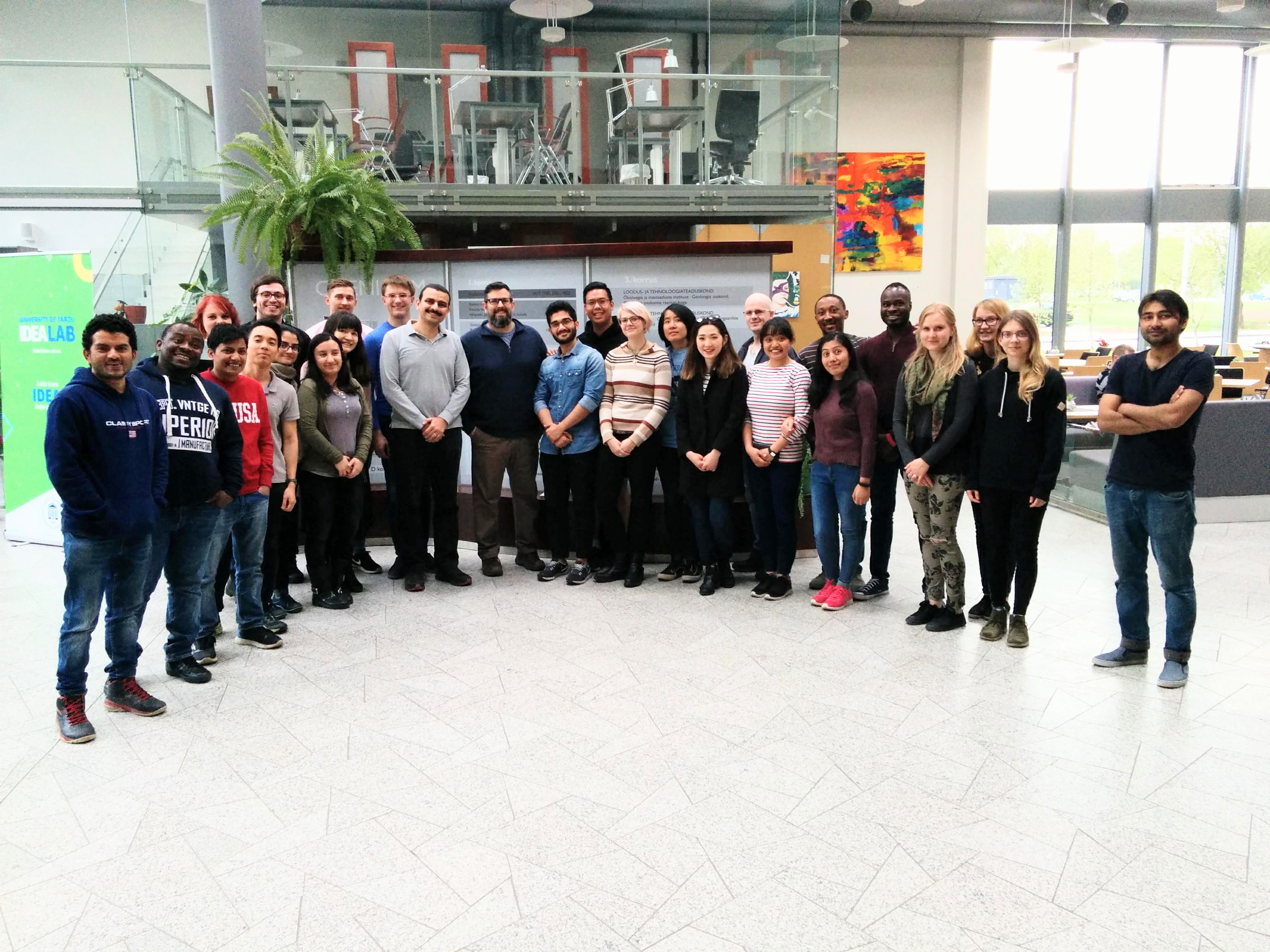
The workshop certaily had a significant educational value and we are pleased by the large number of student participants: altogether close to 50! The international master’s programmes Excellence in Analytical Chemistry and Applied Measurement Science were both heavily represented: the majority of students of those programmes participated in the workshop (Image on the left: EACH and AMS students at the workshop).
The workshop was jointly organized by Eurachem and ECAC (University of Tartu, Tallinn University of Technology and the Estonian Environmental Research Centre).
PhD Fellow Max Hecht and Dr Karin Kipper with collaborators looked into the variability in content and dissolution profiles of MDMA tablets collected in the UK and published the results recently in Drug Testing and Analysis.
Ecstasy comes in all shapes, sizes and colours. 3,4-methylenedioxy-met(h)amf(/ph)etamine (MDMA) is the chemical name for a recreational drug taken for its empathogenic “high”, that alters the sensation of energy, empathy and pleasure. MDMA is mainly consumed in the form of tablets.
The trends in dose
To identify the risks associated with MDMA consumption, researchers from the UK and the University of Tartu analysed the drug dose of 412 tablets and, for the first time, studied the dissolution aspects of another 242 tablets collected in the UK in the time period between 2001-2018. Like in other European countries, the MDMA content in tablets is steadily increasing in the last decade, with some recent tablets containing unprecedented high doses.
The variability in dissolution
Dissolution testing is commonplace in the quality control and batch production of tablets in pharmaceutical laboratories and for bioequivalence testing. For MDMA, different dissolution rates were observed, ranging from fully dissolved in 30 min – the fast group, to up to 2 h until the whole content of the drug is completely released (slow group). No significant differences in a dose per tablet could be found between slow and fast releasing groups. As well as there was no association of colour, logo or shape with the dose or dissolution group.
In conclusion, this means that, while it always is a gamble to take Ecstasy, the ever-present danger of overdosing is also on the rise. You are welcome to read our freshly published article for more details.
From 7th to 10th of May 2019 four members of our UT Analytical Chemistry group – Dr Signe Vahur, Dr Anu Teearu-Ojakäär, PhD students Pilleriin Peets and Eliise Tammekivi – attended the 7th international TechnArt conference in Bruges, Belgium.
The biggest conference of analytical techniques of cultural heritage
TechnArt is a place to present and discuss the newest results of the usage of analytical techniques in the field of cultural heritage. It is the biggest conference among its kind as it was also seen in TechnArt 2019, where the number of participants was about 400! The conference included three parallel oral presentation sessions, two poster sessions with 270 posters, a visit and dinner at the Halve Maan Brewery and an excursion with a boat trip in the historical city centre of Bruges, that has been listed as a UNESCO world heritage.
From Girl with a Pearl Earring to warship Mary Rose
Some of the most interesting talks included the presentation by Dr Abbie Vandivere from The Hague about the analysis of the painting Girl with a Pearl Earring (Johannes Vermeer, approx. 1665) and the difficult conservation of the remains of the warship Mary Rose (warship of the English navy under the command of King Henry VIII, sank in 1545) by Dr Eleanor Schofield from the Mary Rose Trust/Imperial College. Another interesting topic was addressed by Dr Lucia Toniolo who gave a talk on the conservation and monitoring issues of historical architecture, also addressing the hazard of climate change. However, with four days and three parallel oral sessions filled with presentations by the top scientists and conservators of the world, it is almost impossible to highlight all of the interesting and inspiring talks.
Overall, TechnArt 2019 gave the members of our Cultural Heritage group the possibility to introduce their scientific work results, hear the inspiring lectures and have fruitful discussions in the magical historic city of Bruges.
In this course, students reviewed the principles of fluorescence spectroscopy, were introduced to the impact of photophysical phenomena on fluorescence data, and discussed new directions of fluorescence in analytical chemistry. Techniques in multidimensional fluorescence spectroscopy with chemometric analysis were highlighted, especially in the context of novel applications in environmental and related fields. The course consisted of lectures, seminars, tutorial sessions and two lab practicals. The latter were specifically set up for this course by prof. Pagano and were very much appreciated by students.
The first practical was about discovering the fundamental concepts of fluorescence (excitation and emission spectra, Stokes shift, Vavilov’s rule, fluorescence lifetime, etc). The second practical was about analysis of caffeine in beverages using salicylic acid as a fluorescent chemosensor. This analysis utilizes the ability of caffeine to quench the fluorescence of salicylic acid and introduces students to the fluorescence quenching, Stern-Volmer equation and inner filter effects.
Altogether 30 students (out of them 14 EACH students) participated in the course and their feedback was overwhelmingly positive.
Prof. Pagano is a passionate educator. He was the initiator of the Laboratory Science Technology program at Rochester Institute of Technology’s National Technical Institute for the Deaf, which is a unique science programme, specifically designed for deaf students. He was named “2012 U.S. Professor of the Year” by the Council for Advancement and Support of Education and the Carnegie Foundation for the Advancement of Teaching.
(Images: top left, group photo of prof. Pagano with course participants; right: prof. Pagano with students in lab)




 The workshop was held with 13 oral presentations from established researchers, young scientists as well as industries. Together with 22 posters all presentations reflected the current and potential future developments related to methods validation. The workshop addressed the current status of analytical method validation in general and specifically validation of the non-targeted methods (i.e. ones where the analyte is not defined beforehand). With the speaker permissions, all presentations will shortly be available at the
  Non-targeted methods are an especially noteworthy part of the programme, because their validation involves specific issues and their validation is significantly less developed than validation of targeted methods (i.e. the “normal” analytical methods, where the analyte is known beforehand). At the same time non-targeted methods are becoming increasingly important in environmental protection, food safety, different omics areas, etc. (Image on the right: Prof. Jon Benskin from Stockholm University presenting an introduction to non-targeted analysis)
 Some example topics of the workshop: Validation of targeted methods: where are we? Validation of non-targeted methods – differences from targeted methods. Detection of a multitude of (unknown) components in complex samples: criteria for identification. Managing the huge amounts of complex data from non-targeted methods.
  The workshop certaily had a significant educational value and we are pleased by the large number of student participants: altogether close to 50! The international master’s programmes