The Institute of Chemistry received an award for its consistent and systematic efforts over the past three years to improve the quality of education.
One of the main goals was to develop students’ skills in specific subjects by changing teaching methods and involving students more actively in learning. For that, seminars were organized together with the teachers, which led to the realization that also the subjects of the lectures needed to be adjusted and coordinated with each other. Student feedback was used to improve courses, and the online learning platforms were updated. In parallel, the entire curriculum was revised.
Chemistry Master program director Edith Viirlaid and Vice-Rector Aune Valk
According to the Vice-Rector Aune Valk, the award recognized the Institute’s systematic and integrative approach to improving the quality of education. She emphasized the importance of consistent work for keeping the students engaged by active learning and motivating the students by making education more interactive and relevant to future careers. She also highlighted that there has already been a positive response from the students who appreciated the improvements.
In the University of Tartu, the award for improving the quality of education acknowledges a university institute, college, or department for their successful planning and implementation of activities that enhance the quality of learning. It is important that these initiatives include the collaboration between the faculty and students. Here is the original post in Estonian.
The full course material (as well as the registration link) is accessible from the web page. The course materials include videos, schemes, calculation files, and numerous self-tests (among them also full-fledged measurement uncertainty calculation exercises) and examples. Almost all areas of analytical chemistry are addressed, ranging from simple volumetric operations and titrations to sophisticated instrumental analysis, such as determining pesticide residues by LC-MS. Efforts are made in the course to address also such uncertainty sources encountered in chemical analysis that are difficult to quantify, e.g. uncertainty due to possible interference effects (incomplete selectivity), analyte losses, etc.
In order to pass the course, the registered participants have to take six graded tests and get a higher than 50% score in every graded test. These tests are available to registered participants via the Moodle e-learning platform.
Participants who successfully pass the course will get a certificate from the University of Tartu. A digital certificate of completion is free of charge. A certificate of completion on paper can be requested for a fee of 60 euros.
You are welcome to distribute this message to potentially interested people!
The analytical chemistry scientists (Dr Signe Vahur, Dr Anu Teearu-Ojakäär, Prof Ivo Leito) together with physicists (Dr Rünno Lõhmus, Dr Aleksei Treshchalov, Prof Jaak Kikas) from the Institute of Physics at the University of Tartu and conservation scientists at the Estonian Academy of Arts (Prof Hilkka Hiiop, MSc Käthi Niman), have published a new tutorial review article, “Laser-based analytical techniques in cultural heritage science – Tutorial review“ in the journal of Analytica Chimica Acta. The article is available here: https://doi.org/10.1016/j.aca.2023.342107.
Graphical abstract in the journal of Analytica Chimica Acta (https://doi.org/10.1016/j.aca.2023.342107)
This comprehensive collaboration article is significant for the cultural heritage investigation workgroup and the PRG1198 project team, which is currently developing a new laser-based MS system.
The main focus of this tutorial review is to give a simple and accessible overview of the physical background of different lasers, their parameters, and examples of applications in analytical techniques useful for the identification of components of various complex materials from a cultural heritage point of view. Besides conservators and cultural heritage scientists, this review may also interest researchers and students of other fields (e.g., material science, physics, chemistry, forensics, etc.) who wish to know more about lasers.
We are delighted to announce that the prestigious ERC Consolidator Grant 2023 was awarded to a former member of our Analytical Chemistry group, Associate Professor Anneli Kruve at Stockholm University!
Anneli Kruve
The European Research Council (ERC) Consolidator Grant is aimed to support early-career researchers to consolidate their own independent research team or program over the next five years. We are very proud that this year one of the awardees was Anneli Kruve, Associate Professor at Stockholm University and head of the Mass Spectrometry Laboratory. In her research, she combines analytical chemistry with modeling and machine learning. The goal of the ERC funding is to support the research of her group on developing broader and more accurate methods to characterize and measure toxic chemicals in environmental samples.
Only a few percent of chemicals that cause the toxic activity of environmental samples are currently known. In this project, Anneli and her group will combine high-resolution mass spectrometry and machine learning to find novel toxic chemical structures, which enables focusing the toxicity research on chemicals that truly matter. Understanding the emission and transformation processes of toxic chemicals is a necessary step to decrease the chemical risks in the environment.
More information about the research performed by Anneli’s group can be found on the Kruve lab webpage.
Our Archemy group has recently published two major collaborative articles about the arrival and spread of early farming in NE Baltic.
Based on pottery lipid residue and dietary stable isotope analysis combined with zooarchaeological data and archaeobotanical studies, it was shown that farming arrived in the NE Baltic with migrating Corded Ware cultures in the early 3rd millennium cal BCE, but here this new subsistence strategy relied on stockbreeding rather than crop cultivation.
Early farmers in the NE Baltic were exploiting both domesticated and wild species, whilst the introduction of domesticates had little if any impact on local hunter-fisher-gatherer communities who remained true to their forager lifeways. There was no clear transition from foraging to farming in the 3rd millennium cal BCE NE Baltic, instead we see separated communities and parallel worlds of local foragers and incoming early farmers practicing mixed economy. However, the lipid residue data in the wider Baltic context shows several regional variations in the arrival and spread of early farming practices.
Read full articles here:
Oras, E., Tõrv, M., Johanson, K, Rannamäe, E. et al. 2023. Parallel worlds and mixed economies: multi-proxy analysis reveals complex subsistence systems at the dawn of early farming in the northeast Baltic. R. Soc. open sci. 10230880230880. http://doi.org/10.1098/rsos.230880
Lucquin, A., Robson, H. Oras, E. et al. 2023. The impact of farming on prehistoric culinary practices throughout Northern Europe. PNAS. 120 (43) e2310138120. https://doi.org/10.1073/pnas.2310138120
This year, the laureate of the Ann Mihkelson’s scholarship is Elisabeth Parman!
The scholarship was founded in 2011 by Anu Ebbe Mihkelson and its purpose is to support female scientists and doctoral students, especially chemists, with their research or supervision of master’s and doctoral students. We are happy to announce that this year, the scholarship was awarded to a young researcher from our Chair of Analytical Chemistry group – junior researcher/doctoral student Elisabeth Parman.
Number of participants and countries updated on 22.11.2023!
On Tuesday, November 21, 2023 the web course LC-MS Method Validation was launched for the fifth time as a MOOC (Massive Online Open Course). There are 973 1013 registered participants (the first time ever over 1000) from 107 109 countries, ranging from Chile to China and from Australia to Iceland. And the number is still growing. The image below shows the countries where the participants come from.
This is a practice-oriented on-line course on validation of analytical methods, specifically using LC-MS as technique. The course introduces the main concepts and mathematical apparatus of validation, covers the most important method performance parameters and ways of estimating them. The LC-MS validation course is delivered by a team of 7 teachers, each with their own specific area of competence. This way it is expected to offer the best possible knowledge in all the different subtopics of analytical method validation.
The full set of course materials is accessible from the web page https://sisu.ut.ee/lcms_method_validation/. The course materials include videos, schemes, calculation files and numerous self-tests (among them also full-fledged calculation exercises). In order to pass the course, the registered participants have to take all tests and get higher than 50% score from each of them. These tests are available to registered participants via the Moodle e-learning platform. Participants who successfully pass the course will get a certificate from the University of Tartu.
Opening day of the IBSA 10th meeting at the Estonian National Museum (Photo: Peeter Paaver)
Although archaeology has been inherently interdisciplinary from its early years, recent decades have seen changes referred to as the third scientific revolution in archaeology. Innovative methods enable us to answer previously unanswered questions and pose new ones about the past.
Biomolecular archaeology brings together archaeologists, historians, biologists, and chemists. From September 13th to 15th, the tenth International Symposium of Biomolecular Archaeology (ISBA10) took place at the Estonian National Museum in Tartu. The conference provided a comprehensive overview of the field, covering various research topics, from the domestication of different species to ancient diseases and migrations, as well as the methods employed. The conference abstracts are available here.
The material heritage studied through biomolecular archaeology methods is an irreplaceable resource. Therefore, it must be treated sustainably – obtaining maximum information with minimal damage. For example, it is possible determine the species of a bone to simply by rubbing its surface with an eraser (ZooMS). Still, we must continually justify the use of human remains as research resources, and ask whether the scientists’ perspective aligns with the institutions curating collections, as Rita Peyroteo-Stjerna reminded us. When analysing ancient materials, it is important to leave a mark. The field of biomolecular archaeology is increasingly recognizing the need for data standardization and accessibility, as demonstrated by James Fellows Yates in his presentation on a community-based approach to data integration.
Ester Oras putting up her poster (Photo: Peeter Paaver)
Genetics, one sub-field of biomolecular archaeology, is rapidly evolving. It no longer focuses solely on major migrations. New technologies offer insights into ancient diseases, the environment, and even the presence of people where their remains are absent. For example, today we can obtain information about people from ancient chewing-gums or worn jewellery. Also, social structure and kinship is analysed in collaboration with archaeologists.
The molecules of lipids, proteins, and carbohydrates have been preserved in various ancient objects as burnt food crust or by being absorbed into pots, in animal and human bones, and other tissues, as well as in plants. While stable isotope analysis of bulk collagen provides a general picture of the diet, stable isotopes of individual amino acids allow distinguishing between terrestrial and aquatic origin of proteins.
Biomolecular archaeology cannot be the domain of nerds quietly working in the lab. Both keynote speakers at the conference, Anne Stone and Carl Heron, provided a broader insight into the developments of biomolecular archaeology. The former focused on one catalyst of the revolution, ancient DNA research, the significance of which for society was highlighted by the Nobel Prize awarded to Svante Pääbo in 2022. Carl Heron provided an excellent framework for the history of biomolecular archaeology and urged the community to think more about bringing scientific results to the public.
Over 400 participants attended the ISBA 10th meeting (Photo: Peeter Paaver).
The conference was organized by: the University of Tartu and the Geenikeskus Foundation.
The organization of the conference was supported by: the Collegium for Transdisciplinary Studies in Archaeology, Genetics, and Linguistics of the University of Tartu, the Faculty of Arts and Humanities, the Faculty of Science and Technology; the International Society for Biomolecular Archaeology (ISBA); the city of Tartu; the European Union through the PaleoMIX (No 101079396) and cGEM (No 810645) projects.
The eighth edition of the online course LC-MS Method Validation is open for registration (registration link is here)! The course will be offered as a Massive Open On-line Course (MOOC) during Nov 21, 2024 – Feb 02, 2024.
This is a practice-oriented on-line course on validation of analytical methods, specifically using liquid chromatography-mass spectrometry (LC-MS) as technique, mostly (but not limited to) using the electrospray (ESI) ion source. The scope of the course is sufficiently broad, so that it will be useful also to chromatography practitioners using other detector types. The course introduces the main concepts and mathematical apparatus of validation, covers the most important method performance parameters and ways of estimating them. More information about the course can be found in Course introduction page.
Participation in the course is free of charge. Receiving digital certificate (in the case of successful completion) is also free of charge. Printed certificate (to be sent by post) is available for a fee of 60 EUR. Registration is possible until the start of the course. The course materials are available from the above address all the time and can be used via web by anyone who wishes to improve the knowledge and skills in analytical method validation (especially when using LC-ESI-MS).
We are also glad to announce, that the course has been added into the BIPM (Bureau International des Poids et Mesures) e-learning platform. The BIPM is the most important international metrology organization established by the Metre Convention, through which Member States act together on matters related to measurement science and measurement standards. BIPM is also the home of the International System of Units (SI) and the international reference time scale (UTC). The Institute of Chemistry of University of Tartu is a designated institute by the BIPM since 2010.
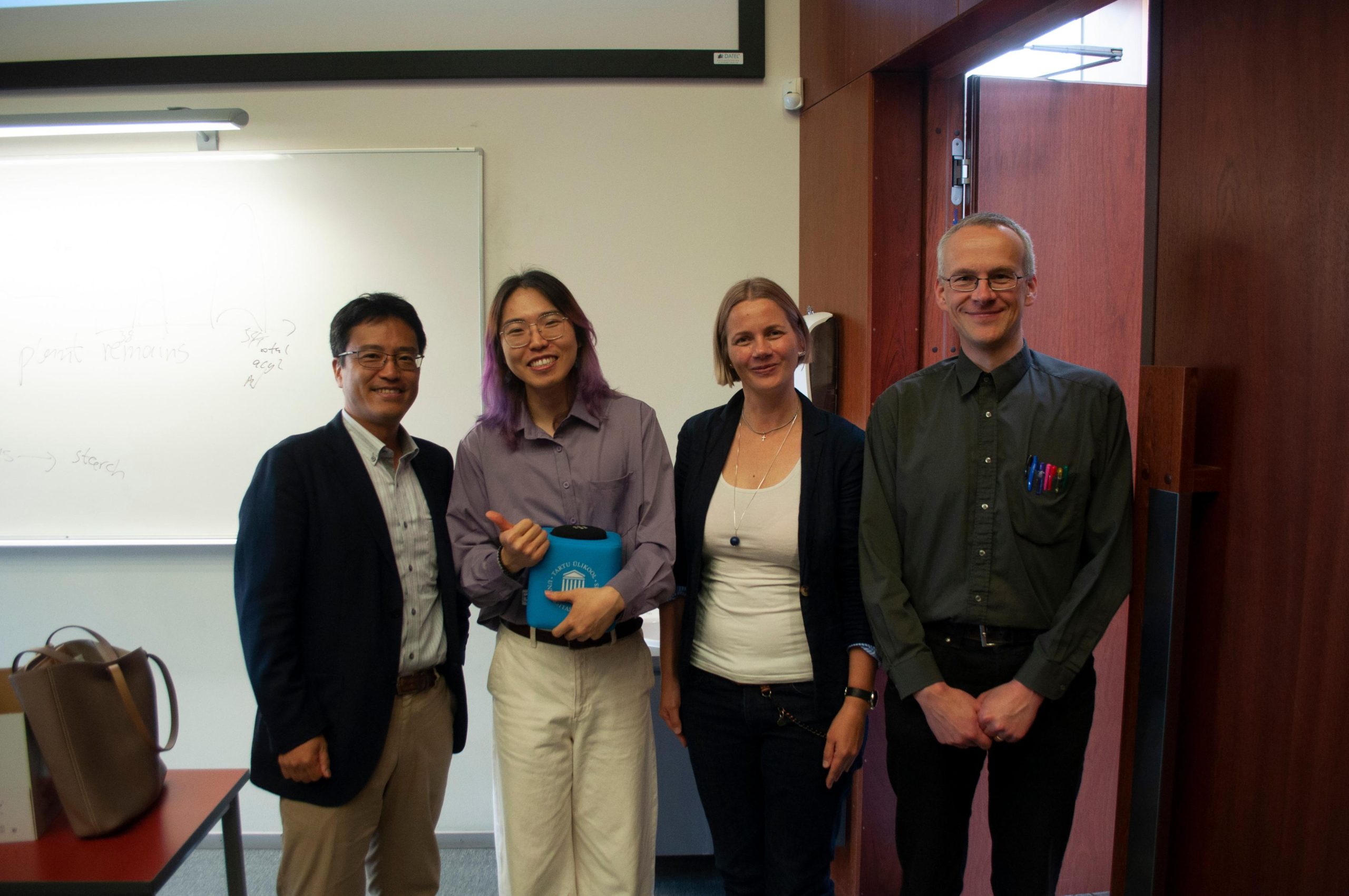
From left to right: opponent Dr. Shinya Shoda, Dr. Shidong Chen, supervisors Dr. Ester Oras and Prof. Ivo Leito
Shidong’s PhD work is aimed at discovering plant exploitation in the ancient eastern Baltic area with a focus on two types of plant-derived materials: resinous materials and dietary plants. The main innovations are developing multi-methodological approaches and interpreting multi-proxy datasets with chemometric and statistical methods.
For identifying the composition of resinous adhesives, ATR-FT-IR analysis was conducted in combination with a PCA-based DA classification model for further compositional and spatial/temporal classification. This method can help simplify IR spectra interpretation and reduce the need for GC-MS analysis.
For identifying dietary plants, a multi-method approach was applied by plant micro fossil analysis and EA-IRMS combined with ORA. EA-IRMS can provide preliminary origins of samples with plant and/or animal bases. Plant micro fossil analysis and ORA in complementary can identify the species of plant remains. Correspondence analysis further compares and indicates the agreement of the three methods and visualizes the correlations between the multi-proxy data.
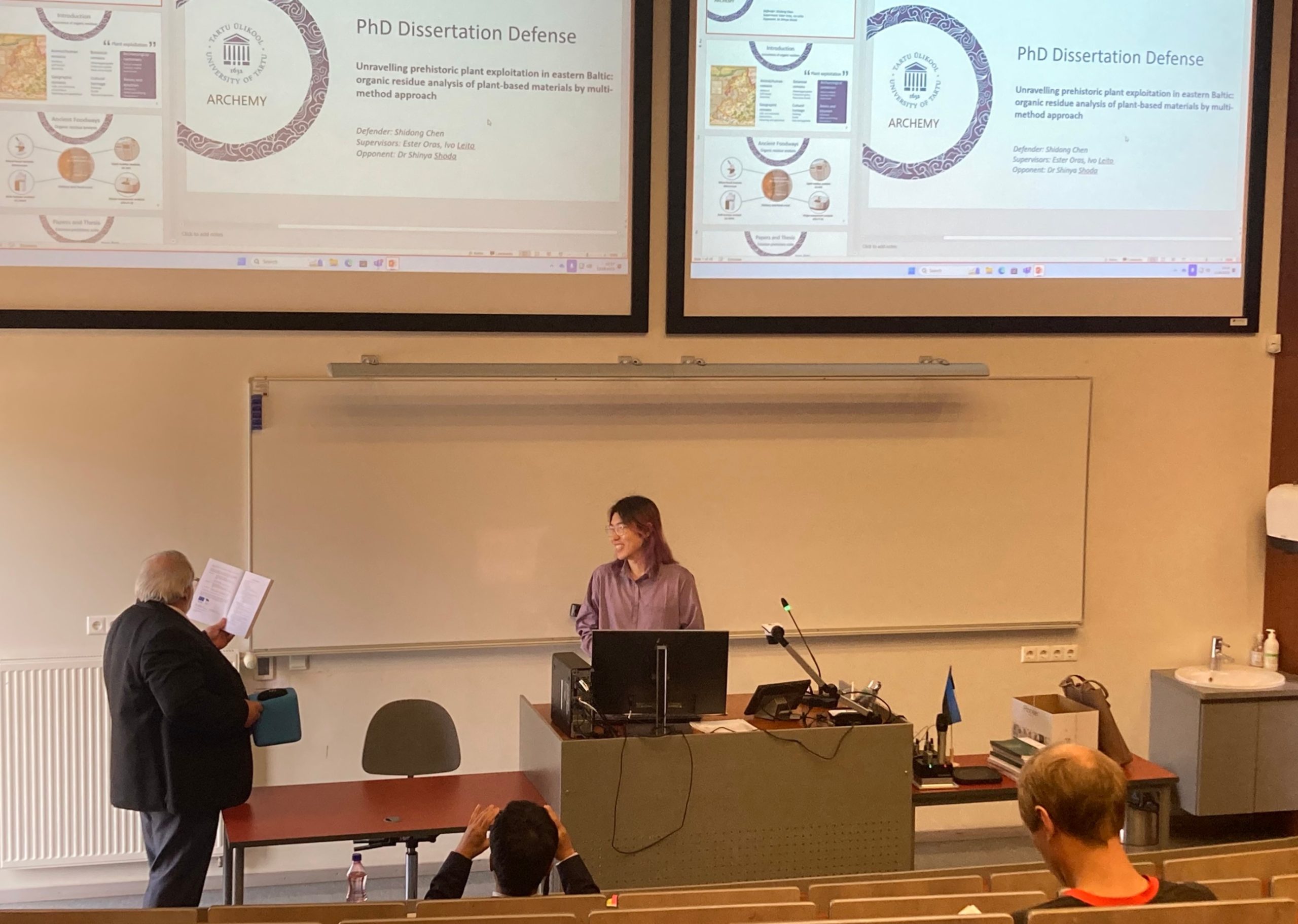
Dr. Shidong Chen moments before the presentation
The plant exploitation in prehistoric easter Baltic shows different patterns with dedicated multi-method case studies on several Stone Age, Bronze Age, and Iron Age sites. In the Stone Age, plant exploitation was more technological (adhesives and resinous compounds) than dietary-related. The plant consumption for dietary purposes became more abundant in the Bronze Age. The major changes happened with the Iron Age displaying a more diverse plant-based diet with more inclusion of C3 cereals (e.g., wheat and barley), yet the spread and cultivation of C4 millet may not have emerged in this region.
Shidong is currently working at ARCHEMY lab as a lab technician at the University of Tartu. He will continue his journey discovering ancient food ways from pots and bones.