

 In a recent minireview, published in Eur. J. Org. Chem. an important part of our group’s acid-base chemistry research has been summarized: the pKa values of bases (pKaH values) determined over the years in acetonitrile have now been rigorously united into a single scale, whereby all the involved ΔpKa values have been considered for deriving the absolute pKaH values of the bases involved. Altogether 279 basic compounds are included in the scale from all major groups of organic bases (amines, pyridines, imidazoles, anilines, amidines, guanidines, phosphazenes, etc) and are linked with altogether 682 ΔpKa measurements. The full scale can be downloaded by clicking on the picture on the left. The minireview also presents possibilities to predict the pKa values of bases in other media – namely water, DMSO and THF – on the basis of MeCN pKaH values. It is expected that this minireview will be a useful tool for future researchers who need pKa values of bases in nonaqueous solvents for planning their studies or for interpreting research results.
Our acid-base research at 19th European Symposium on Fluorine Chemistry 2019
 On 26.08.19 at 19th European Symposium on Fluorine Chemistry 2019 Ivo Leito gave a talk Acidities of molecules and media: the united pKa-pHabs scale in 1,2-dichloroethane.

For the first time in a low-polarity solvent, the scale has a dual nature, being both a pKa scale of the involved acids (i.e. describing acidity of molecules) and at the same time a pH scale, describing the acidity of the solutions (media).
The scale spans 28 orders of magnitude (pH or pKa units) and is composed of 87 acids of diverse nature. The scale is linked to the unified acidity (pHabs) scale and expressed in values, which makes the acidities of the solutions directly comparable to the conventional aqueous pH scale. This in turn makes the scale a useful tool in future studies of acid-driven processes (reaction mechanisms, catalysis, strong oxidants, etc) in low-polarity media.
This work has been published in: Chem. Sci., 2017, 8, 6964-6973. A unified view to Brønsted acidity scales: do we need solvated protons?.
It is part of a larger endeavor – to promote a wider usage the unified pH scale by the research and technology communities, which is currently in progress via the UnipHied.
 The project is funded from the EMPIR programme (project 17FUN09) co-financed by the Participating States and from the European Union’s Horizon 2020 research and innovation programme.
Eurachem 2019 workshop successfully finished!
 Our group was the main organiser of the Eurachem 2019 Scientific workshop Validation of targeted and non-targeted methods of analysis, which took place in Dorpat Conference Centre in Tartu during May 20-21, 2019. This workshop also marks the 30th anniversary of Eurachem.
 Approximately 160 people attended the workshop, which is the largest number of participants in the history of Eurachem workshops! The participants were from 42 countries of the member countries in Eurachem as well as Asia, North America, South America and Middle East. The farthest participants were from Fiji, the Philippines, Uruguay and Brazil.
 The workshop was held with 13 oral presentations from established researchers, young scientists as well as industries. Together with 22 posters all presentations reflected the current and potential future developments related to methods validation. The workshop addressed the current status of analytical method validation in general and specifically validation of the non-targeted methods (i.e. ones where the analyte is not defined beforehand). With the speaker permissions, all presentations will shortly be available at the Eurachem website. In addition to presentations, each day a Working Group session was organised with 3 topics in parallel (Image on the left: Welcome by Dr Marina Patriarca, the Eurachem chair).
 Non-targeted methods are an especially noteworthy part of the programme, because their validation involves specific issues and their validation is significantly less developed than validation of targeted methods (i.e. the “normal” analytical methods, where the analyte is known beforehand). At the same time non-targeted methods are becoming increasingly important in environmental protection, food safety, different omics areas, etc. (Image on the right: Prof. Jon Benskin from Stockholm University presenting an introduction to non-targeted analysis)
All sessions raised new issues and challenges, especially related to non-target method validation. The workshop clearly was also very inspirational for Eurachem from the point of view of preparing new guideline materials – especially the topics related to non-targeted analysis are still essentially not covered by official guidance documents.
 Some example topics of the workshop: Validation of targeted methods: where are we? Validation of non-targeted methods – differences from targeted methods. Detection of a multitude of (unknown) components in complex samples: criteria for identification. Managing the huge amounts of complex data from non-targeted methods. Recent instrumental developments. Software tools for validation. (Image on the left: Dr. Koit Herodes presenting the ValChrom validation software)
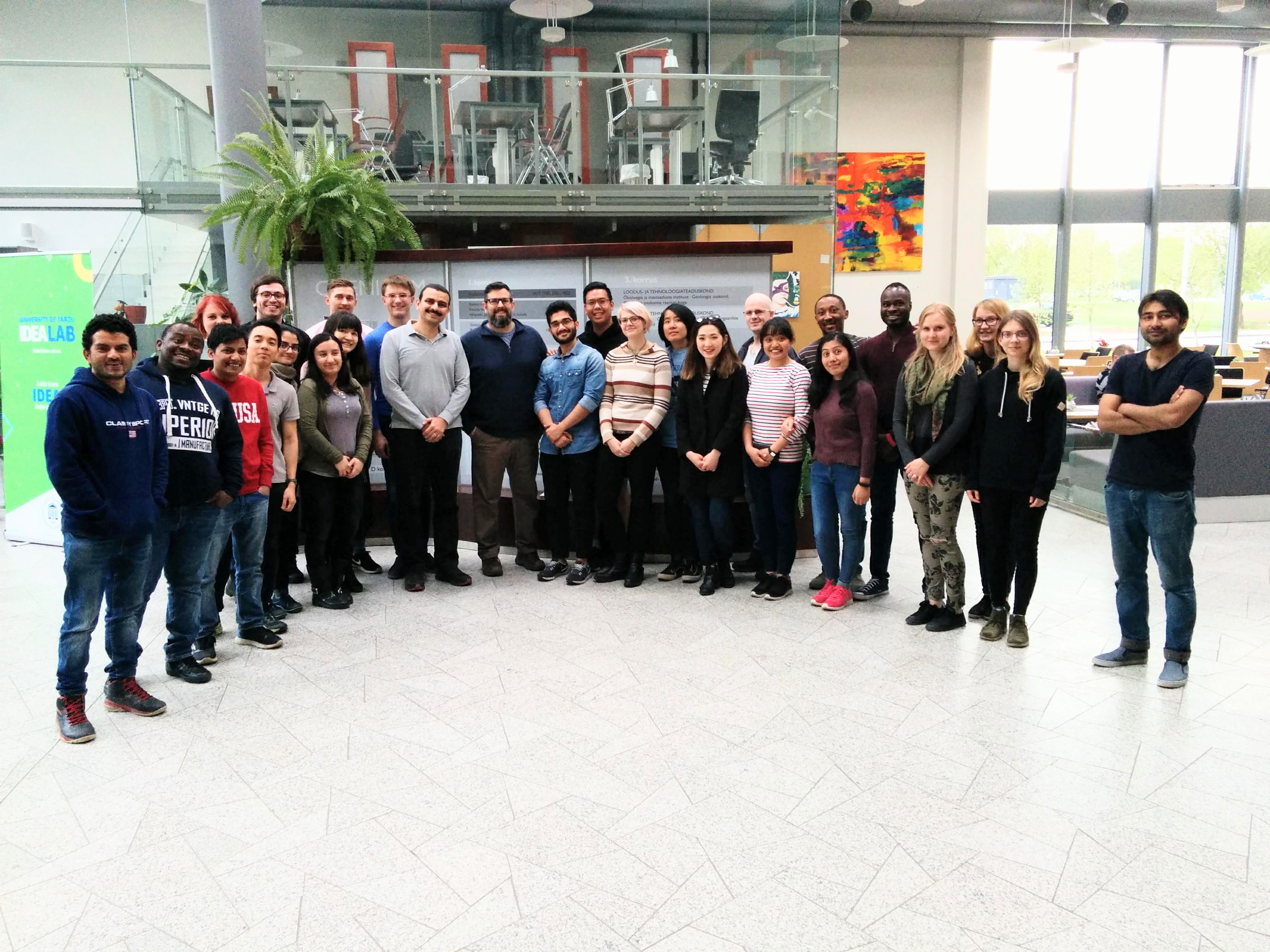
 The workshop certaily had a significant educational value and we are pleased by the large number of student participants: altogether close to 50! The international master’s programmes Excellence in Analytical Chemistry and Applied Measurement Science were both heavily represented: the majority of students of those programmes participated in the workshop (Image on the left: EACH and AMS students at the workshop).
The workshop was jointly organized by Eurachem and ECAC (University of Tartu, Tallinn University of Technology and the Estonian Environmental Research Centre).
Fluorescence spectroscopy course by EACH visiting scholar Todd Pagano
 During Apr 22 to May 4 we had the pleasure to host visiting scholar, prof. Todd Pagano from the Rochester Institute of Technology (RIT), USA. He conducted, for the second time, a two week-intensive course Principles and applications of fluorescence spectroscopy.
In this course, students reviewed the principles of fluorescence spectroscopy, were introduced to the impact of photophysical phenomena on fluorescence data, and discussed new directions of fluorescence in analytical chemistry. Techniques in multidimensional fluorescence spectroscopy with chemometric analysis were highlighted, especially in the context of novel applications in environmental and related fields. The course consisted of lectures, seminars, tutorial sessions and two lab practicals. The latter were specifically set up for this course by prof. Pagano and were very much appreciated by students.
 The first practical was about discovering the fundamental concepts of fluorescence (excitation and emission spectra, Stokes shift, Vavilov’s rule, fluorescence lifetime, etc). The second practical was about analysis of caffeine in beverages using salicylic acid as a fluorescent chemosensor. This analysis utilizes the ability of caffeine to quench the fluorescence of salicylic acid and introduces students to the fluorescence quenching, Stern-Volmer equation and inner filter effects.
Altogether 30 students (out of them 14 EACH students) participated in the course and their feedback was overwhelmingly positive.
Prof. Pagano is a passionate educator. He was the initiator of the Laboratory Science Technology program at Rochester Institute of Technology’s National Technical Institute for the Deaf, which is a unique science programme, specifically designed for deaf students. He was named “2012 U.S. Professor of the Year” by the Council for Advancement and Support of Education and the Carnegie Foundation for the Advancement of Teaching.
(Images: top left, group photo of prof. Pagano with course participants; right: prof. Pagano with students in lab)
ESI outcompetes other ion sources in LC-MS trace analysis
 Choosing the best possible ion source is a very important step in liquid chromatography-mass spectrometry (LC/MS) method development. In a recent paper, ESI outcompetes other ion sources in LC-MS trace analysis Anal. Bioanal. Chem. 2019 Asko Laaniste from the UT Analytical chemistry group carried out a large scale survey of different LC/MS ion sources (and their different working modes) as applied to pesticide analysis. He compared electrospray ionisation (ESI) source, thermally focused/heated electrospray (HESI), atmospheric pressure photoionisation (APPI) source with and without dopant, and multimode source in ESI mode, atmospheric pressure chemical ionisation (APCI) mode, and combined mode using both ESI and APCI, i.e. altogether seven different ionisation modes for the analysis of 40 pesticides (see list below).
 The lowest limits of detection (LoDs) were obtained by ESI and HESI. The widest linear ranges were observed with the conventional ESI source without heated nebulizer gas. ESI source was significantly less affected by matrix effect than the HESI source. APPI ranked second (after ESI) by not being influenced by matrix effect; therefore, it would be a good alternative to ESI if low LoDs are not required.
It was somewhat unexpected that ESI outperformed HESI. This may be caused by the instability of the additional heated gas (sheath gas) in HESI that is used in addition to the nebulising gas.
In conclusion, as a broad generalisation, Asko’s results show that although several new ion sources have been introduced during the last decade, the conventional ESI performs at least equally to these new ion sources in the case of polar to medium polarity pesticides. ESI with thermal focusing (HESI) performed more or less equally with ESI in terms of LoD. At the same time, HESI had significantly poorer intermediate precision of matrix effect values for most compounds. Thus, for trace analysis, ESI is still the ion source of choice.
(Full list of pesticides: pymetrozine, thiamethoxam, methiocarb-sulfoxide, chloridazon, imidacloprid, acetamiprid, methiocarb-sulfone, thiacloprid, imazalil, thiophanate-methyl, metribuzin, pyrimethanil, fenpropimorph, spiroxamine, propoxur, triasulfuron, bupirimate, paclobutrazol, methiocarb, azoxystrobin, epoxiconazole, myclobutanil, fenhexamid, fluquinconazole, flusilazole, mepanipyrim, bitertanol, propiconazole, triazophos, methoxychlor, ditalimfos, tebufenozide, benalaxyl, pyrazophos, buprofezin, indoxocarb, trifloxustrobin, quinoxyfen, pirimiphos-ethyl, hexythiazox)
(Image top left: Asko Laaniste preparing solutions; Image right: Comparison of accuracy of LC-MS analysis using different ion sources)
How to make maximum use of the available pKa data in non-aqueous solvents?
 On 11.04.2019 Ivo Leito gives a presentation titled “How to make maximum use of the available pKa data in non-aqueous solvents?” at 26th Croatian Meeting of Chemists and Chemical Engineers (26HSKIKI), in Šibenik (Croatia). The presentation discusses the principles of acid-base behaviour in solvents and on how to estimate the pKa values of compounds in solvents where direct experimental data are not available.
Guests from Mülheim learning our pKa measurement method
 Starting from last week the Analytical chemistry group of University of Tartu has the pleasure to host Dr Monika Lindner and Hendrik van Thienen from the group of professor Benjamin List – a worldwide known guru in the field of strongly acidic catalysts working at the Max-Planck-Institut für Kohlenforschung (Mülheim, Germany).
The purpose of their stay is to learn our pKa measurement method and set it up in Mülheim. This is the logical continuation of our group’s collaboration with the List group – the pKa values of a number of their catalysts have been measured here at Tartu (see Nature Chemistry 2018, 10, 888-894 and Angew. Chem. Int. Ed. 2017, 56, 1411-1415) – and we are glad that our pKa measurement method thereby gains even wider acceptance than it has now. We wish Monika and Hendrik all the success in learning the measurements!
(On the photo, from left: Märt Lõkov, Monika Lindner and Hendrik van Thienen)
UT Analytical chemistry at Suprachem 2019: From receptor synthesis to ion-selective electrode
 During 24-26.02.2019 the Suprachem 2019 conference took place at University of Würzburg (Germany). The UT Analytical chemistry chair was represented by two posters: Optimization of the reaction pathway for the synthesis of substituted 1,3-bis(carbazolyl)urea anion receptors by Alo Rüütel and Mihkel Ilisson and From receptor-anion binding ladder to ion-selective electrode by Kerli Martin, Sandip A. Kadam, Ulriika Mattinen, Johan Bobacka and Ivo Leito.

Synthesis of 1,3-bis(carbazolyl)urea based anion receptors
The presentation from Alo and Mihkel focused on optimization of the synthesis route of anion receptors (ionophores) based on the 1,3-bis(carbazolyl)urea building block, augmented with additional amide functionalities (see the poster). The developed synthesis route is very valuable for the synthesis of a wide variety of analogous receptors (ionophores) that have previously been demonstrated to bind carboxylates with high affinity (see K. Martin et al, Eur. J. Org. chem. 2017, 5231-5237).
First solid contact acetate electrodes using receptor molecules
 Kerli Martin et al present the first practical application of such receptors: a solid-contact acetate-selective electrodes. For acetate anion the electrodes show linearity over the activity range of 10-4.50 – 10-1.10 with a sub-Nernstian slope of -51.3 mV per decade and a detection limit of 10-5.00. The anion-selectivity pattern of these electrodes deviates markedly from the pattern found in DMSO solution and from the Hofmeister pattern. The selectivity coefficients of SCN–, I–, NO3– and Br– decrease by 3-5 orders of magnitude when adding the studied ionophore to the membrane. The selectivity coefficients of hydrophilic anions such as Cl–, F–, HPO42–, and SO42– are significantly lower than in case of the ionophore-free control membrane. All in all, it is clear that a lot of work is still needed for improving the selectivity of the electrode.
This work has been accepted for publication: K. Martin et al Electroanalysis 2019 (the link will work soon).
The combined contributions from our group stood out from the majority (the conference altogether had 27 oral and 111 poster presentations) by a clear line of development from fundamental research (receptor design) to highly practical application (ion-selective electrode).
(Photos: above left: Mihkel Ilisson explaining his work to Dr Diane Smith from Wiley; right: Poster by Kerli Martin et al)
New type of pKa – biphasic pKa in octanol water system
 It is not frequent that a new quantitative measure of some physicochemical characteristic is introduced. Recently our group managed to do exactly that by introducing a novel approach – termed as biphasic pKa values – of measuring the acidity/basicity of lipophilic compounds embedded in water-immiscible media (membranes or solutions) at equilibrium with aqueous solution.
In this approach, the H+ ion activity is determined in the aqueous phase, while the concentration ratio of protonated and deprotonated forms of acid/base is measured in the lipophilic phase with any suitable technique. The approach has been demonstrated on the example of biphasic pKa values of some lipophilic indicator bases in the octanol: water system, measured using UV-Vis spectrophotometry. The counterion identity and concentration, as well as the overall ionic strength in the aqueous phase, are included in the standard state definition.
This work has been published S. Selberg, S. Tshepelevitsh, I. Leito Croat. Chem. Acta 2018, 91, (4) and will form a part of the PhD thesis of Sigrid Selberg.
Biphasic pKa values are envisaged to be useful for characterizing lipophilic indicators, synthetic receptors, phase transfer catalysts and other implements that are used in hydrophobic media (e.g. in sensor membranes) in contact with water.
This work is part of a larger endeavor – to promote a wider usage the unified pH scale (pHabs) by the research and technology communities, which is currently in progress via the UnipHied.
The UnipHied project is funded from the EMPIR programme (project 17FUN09) co-financed by the Participating States and from the European Union’s Horizon 2020 research and innovation programme.
(On photo: Sigrid Selberg)
Eurachem 2019 workshop: Validation of targeted and non-targeted methods of analysis
Our group is proud to be the leading organiser of the 2019 Eurachem General Assembly and the accompanying scientific workshop “Validation of targeted and non-targeted methods of analysis”!
The Workshop will take place in Tartu (Dorpat conference centre) on May 20th and 21st. The programme of the workshop, as well as registration and abstract submission are available at the event website:
https://eurachem2019.akki.ut.ee/
The workshop addresses the current status of analytical method validation in general and specifically validation of the non-targeted methods (i.e. ones where the analyte is not defined beforehand). Non-targeted methods are an especially noteworthy part of the workshop programme, because their validation involves specific issues (since analyte is not known it is not possible to make validation experiments with it) and is significantly less developed than validation of targeted methods (i.e. the “normal” analytical methods, where the analyte is known beforehand). At the same time non-targeted methods are becoming increasingly important in environmental protection, food safety, different omics areas, etc.
 Some example topics of the workshop are: Validation of targeted methods: where are we? Validation of non-targeted methods – differences from targeted methods. Detection of a multitude of (unknown) components in complex samples: criteria for identification. Managing the huge amounts of complex data from non-targeted methods. Software solutions for validation.
Compact overview of the workshop can be found in the 2nd circular.
These events mark the 30th anniversary of Eurachem and are jointly organized by Eurachem and ECAC (University of Tartu, Tallinn University of Technology and the Estonian Environmental Research Centre).
We are hoping to see many of you in Tartu in May!