As a result of a recent development in our group, it is now, for the first time, possible to rigorously measure acidity of acids in biphasic systems (aqueous phase at equilibrium with a water-immiscible phase) by using biphasic pKa values (pKaow values). This work has now been published in Analytical Chemistry2022, 94, 4059–4064.
In this work, the octanol-water biphasic pKaow values have been determined for 35 acids of various structures and chemical properties (carboxylic acids, phenols, diphenylamines, imides, different CH acids) using UV-Vis and NMR (1H, 13C, or 31P) spectrometry.
Biphasic pKa values enable quantifying acid dissociation in biphasic systems in a more realistic and rigorous way than the conventional “mono-phasic” pKa values. The latter completely ignores a large part of the picture – partitioning of the neutrals and the ions between the two phases and ion-pairing in the low-polarity phase. In contrast, pKaow values account for these effects. The ratio of the acid and its conjugate base is measured in the 1-octanol phase, using UV-Vis and/or NMR spectrometric method. The activity of H+ is measured in the aqueous phase with a conventional pH-meter. The pKaow values are obtained at different concentrations and extrapolated to zero concentration.
Biphasic systems are present in many biological and technological systems and processes: cell membranes, solvent extraction, phase-transfer catalysis, sensor membranes, etc. In all such systems, acid-base properties of the participating compounds would be best described using biphasic rather than “mono-phasic” pKa values.
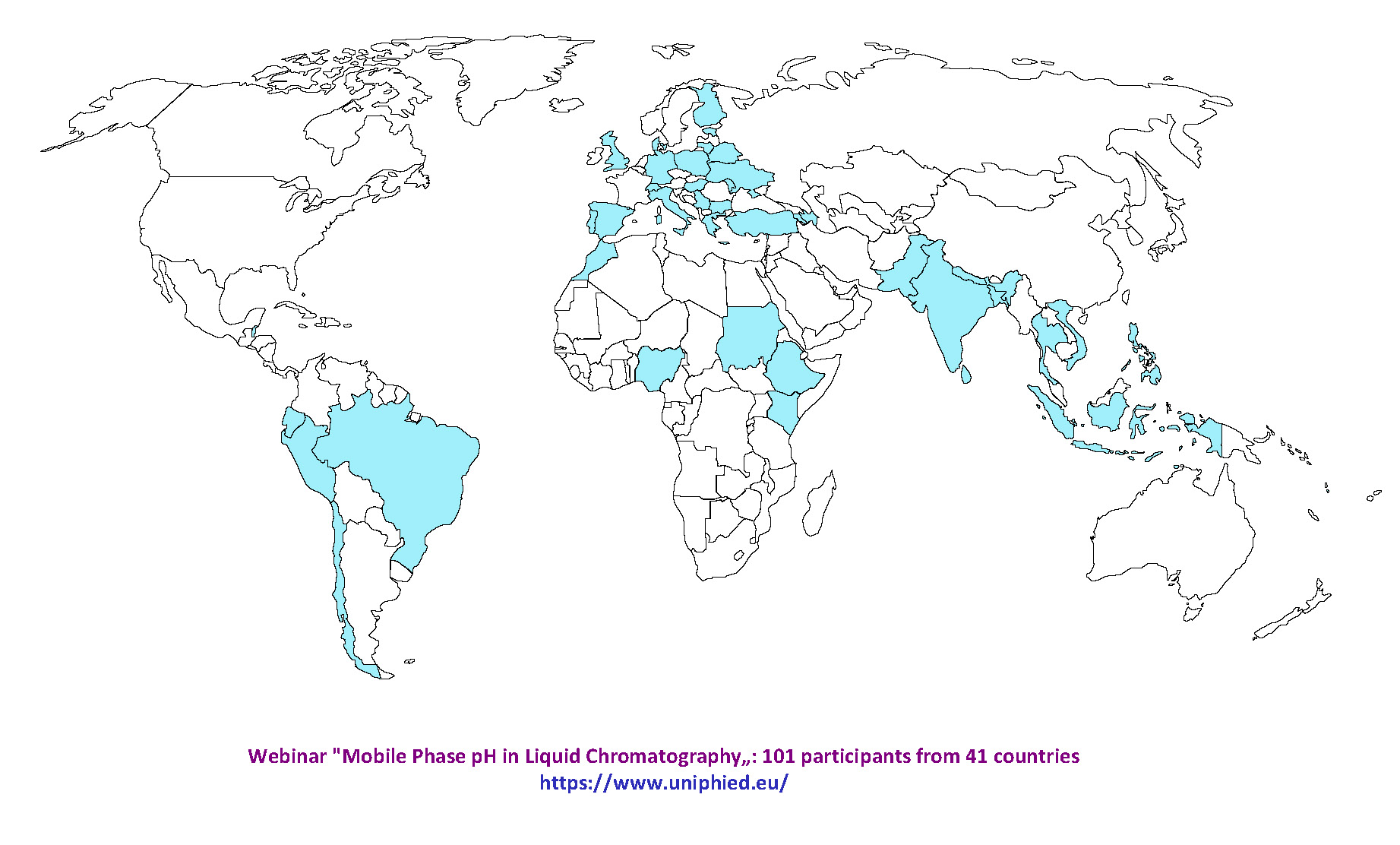
On Apr 29, 2021 the webinar “Mobile Phase pH in Liquid Chromatography” took place. Altogether 101 people participated from 41 countries, ranging from Portugal to Philippines and from Peru to Nepal.
It is well known that in liquid chromatography, mobile phase pH is an important parameter, significantly affecting the retention of acidic and basic analytes. Yet, mobile phase pH is tricky to measure because mobile phases are usually aqueous-organic mixtures and in the case of gradient elution mobile phase composition gradually changes during elution. The topics covered during the webinar were:
— Different possibilities to express pH in liquid chromatography (LC)
— Unified pH (pHabs): the concept and measurements methods
— The applications and limitations of different pH expressions in LC
Numerous questions were asked by the participants that indicated the importance of the topic and the need for a more robust conceptual framework for handling the topic of pH in liquid chromatography. Contributing to this, via the pHabs concept, is one of the aims of the UnipHied project.
The webinar was organized in the framework of the PRG690 project from the Estonian Research Council and the UnipHied project (www.uniphied.eu), which is funded from the EU’s EMPIR programme, co-financed by the Participating States and from the European Union’s Horizon 2020 research and innovation programme. Additional support from: EU Regional Development Fund (TK141 “Advanced materials and high-technology devices for energy recuperation systems”) and Estonian Center of Analytical Chemistry (www.akki.ee)
It is well known that in liquid chromatography, mobile phase pH is an important parameter, significantly affecting the retention of acidic and basic analytes. Yet, mobile phase pH is tricky to measure because mobile phases are usually aqueous-organic mixtures and in the case of gradient elution mobile phase composition gradually changes during elution.
Mobile phase pH is the topic of an upcoming webinar “Mobile Phase pH in Liquid Chromatography”, which we will organise on 29.04.2021 at 13:00 – 16:00 (Central European time: France, Germany, …) via the Zoom platform. Registration to the webinar is now open at this registration link.
The topics that we plan to cover are:
— Different possibilities to express pH in liquid chromatography (LC)
— Unified pH (pHabs): the concept and measurements methods
— The applications and limitations of different pH expressions in LC
The webinar is organised in the framework of the project 17FUN09 “UnipHied”, which is funded from the EU’s EMPIR programme, co-financed by the Participating States and from the European Union’s Horizon 2020 research and innovation programme.
The equilibrium acidity scale (pKa scale) in acetonitrile (MeCN) has been supplemented by numerous new compounds and new ΔpKa measurements and has been published in Eur. J. Org. Chem. 2021, 1407–1419 (Open access). The pKa scale now contains altogether 231 acids – over twice more than published previously – linked by 566 ΔpKa measurements and spans between the pKa values of hydrogen iodide (2.8) and indole (32.57), covering close to 30 orders of magnitude. The acids have wide structural variety, ranging from common families – phenols (e.g. picric acid, alizarin, polyhalogenophenols), carboxylic acids (e.g. acetic, benzoic, retinoic and sorbic acid), sulfonic acids, hydrogen halides) to highly special molecules (chiral BINOL catalysts, bis(benzoxazole-2-yl)methanes, polyfluorinated compounds) and superacids (fluorinated sulfonimides, cyanoform, tetracyanopropenes).
Measurement results acquired over the last 15 years were added to the scale and new least squares treatment was carried out. The treatment yielded revised pKa values for the compounds published previously, with the root mean square difference between revised and previous values 0.04, demonstrating very good stability of the scale.
Correlation equations were developed for estimating pKa values for the studied types of compounds in water, DMSO, DMF and 1,2-dichloroethane on the basis of pKa values in acetonitrile. These equations enable predicting pKa values with an average error around or less than 1 pKa unit, which is a sufficient accuracy for many applications.
The scale is expected to be a useful tool for the widest possible research areas in organic chemistry, electrochemical power sources, catalysis, etc.
Recently the UnipHied consortium published a new article – Symmetric Potentiometric Cells for the Measurement of Unified pH Values. Symmetry2020, 12, 1150, where we compared the performance of different cells and instruments used to measure acidities on the unified pH scale (pHabs). The advantage of the unified pH scale is that it enables expressing the acidities of any systems – non-aqueous, solutions, colloidal systems, etc – via pHabsH2O values, which are directly comparable to the conventional pH values of the aqueous pH scale.
This is the first time unified acidities have been measured outside of our group. Nine partners from Europe – national metrology institutes and universities – have set up systems to measure pHabs and validated them with standard aqueous buffers.
The results show that the method is robust and does not depend on the cell nor the instrument (pH meter, potentiostat, or electrometer). The inherent symmetry of the cell design helps to reduce the experimental workload and improve the accuracy of the obtained results.
The next step is to measure unified acidities of non-aqueous systems, which could be used by routine laboratories to calibrate their pH electrodes.
The UnipHied project is funded from the EMPIR programme (project 17FUN09) co-financed by the Participating States and from the European Union’s Horizon 2020 research and innovation programme.
The collections of experimental acidity and basicity data in non-aqueous media measured by our group are now up to date on our Chair of Analytical Chemistry webpage.
Both tables include the compounds name, CAS number and SMILES code. The acidity collection contains 190 compounds, where the compounds available experimentally measured pKa in acetonitrile (MeCN) and pKip in 1,2-dichloroethane (DCE) are given. The pKa in DCE is calculated/estimated based on pKip value.
The basicity data collection includes 353 compounds and their pKip in tetrahydrofuran (THF) and in DCE. The pKa values in MeCN were re-evaluated taking into account all (close to 700) measurements of 279 bases. Therefore, these pKa values can be considered the most reliable pKa values measured in MeCN available!
For the first time in a low-polarity solvent, the scale has a dual nature, being both a pKa scale of the involved acids (i.e. describing acidity of molecules) and at the same time a pH scale, describing the acidity of the solutions (media).
The scale spans 28 orders of magnitude (pH or pKa units) and is composed of 87 acids of diverse nature. The scale is linked to the unified acidity (pHabs) scale and expressed in values, which makes the acidities of the solutions directly comparable to the conventional aqueous pH scale. This in turn makes the scale a useful tool in future studies of acid-driven processes (reaction mechanisms, catalysis, strong oxidants, etc) in low-polarity media.
It is part of a larger endeavor – to promote a wider usage the unified pH scale by the research and technology communities, which is currently in progress via the UnipHied.
The project is funded from the EMPIR programme (project 17FUN09) co-financed by the Participating States and from the European Union’s Horizon 2020 research and innovation programme.
Between the 16th to 20th of June our group presented itself in HPLC 2019 in Milan. It was a 5-daylong and intense learning opportunity with more than 300 speakers and around 500 posters.
Topics ranged from fundamentals of HPLC, miniaturization to different omics, pharmaceutical analysis and innovative technologies (can HPLC have a FID as a detector?). For the first time, a whole section was dedicated to 3D printing technologies – a technique that is used to build 3 dimensional separation modules: for example, fascinating talks on using 3D printing to do liquid chromatography in 3 dimensions.
The conference gala dinner was held at the beautiful central courtyard of University of Milan under relieving cool evening sky opposing the hot temperatures of the day. HPLC 2019 also had two new additions that hopefully will become annual traditions: Separation Science Slam and HPLC Tube, offering an opportunity for scientists to express their love for their work in modern ways. The competitions were extremely creative and both the audience and participants were thoroughly enjoying the events. Participants from our analytical chemistry chair gave multiple contributions to the conference.
Ecstasy content in tablets is uneven
Max giving his talk
Max Hecht, MSc, presented an oral presentation on the evaluation of MDMA (also known as ecstasy and ‘Molly’) content in 412 tablets and dissolution properties in 247 tablets, collected in the UK in the time period of 2001-2018. It was found that there are no physical tablet characteristics which correlate to dissolution rate classification, hence no way of users knowing a priori whether tablets were more likely to be fast or slow-releasing. Further, large within-batch variation in the dose and also dissolution rate was observed, giving the combined result of increasing significantly the danger of over-dosing.
Standard substance free quantification in LC/ESI/MS
Anneli giving her talk
Dr. Anneli Kruve presented the recent work of her group on standard substance free quantification of metabolites in green tea samples. In the metabolomics studies, the standard substances for all detected and identified metabolites are hardly ever available. The peak areas obtained from LC/HRMS analysis are also generally usable as different compounds ionize with vastly different ionization efficiencies; the differences may reach 100 million times. With the aid of ionization efficiency predictions, this shortcoming can be overcome and the absolute concentrations estimated. The current prediction accuracy for the green tea metabolites is 1.7 times, which allows comparison of different tea samples and also the identification of the samples with different origin. Importantly, the standard substance free quantitation allows transferring quantitative data from one lab to another. Anneli has also summarized the current status of standard substance free quantitation for the last issue of LCGC. You can find out more about it from kruvelab.com and quantem.co.
Ruta Veigure, MSc, showed that fluoroalcohols, such as perfluoropinacol
(PP) and 1,1,1,3,3,3-hexafluoro-2-methyl- 2-propanol (HFTB), are very useful
alternatives to common eluent additives in RP HPLC-MS analysis, acting, among other
effects, as weak ion-paring reagents. Novel eluent additives influenced elution
of protonated bases by significantly improving analyte’s retention on C18
stationary phase as well as reduce the retention of acidic analytes, which are
deprotonated. A comparison was performed to commonly used ammonium acetate and
ammonium bicarbonate mobile phase additives. Her research will be rather
influential for the analysis of pharmaceuticals, from whom the majority are basic.
Revolutionalizing pH measurements
Prof. Ivo Leito presented a poster introducing a conceptually new approach of measuring pH of mixed-solvent liquid chromatography (LC) mobile phases: the pHabs approach. The new approach is based on the recently introduced unified pH scale (pHabs scale), which enables direct comparison of acidities of solutions made in different solvents or solvents mixtures based on chemical potential of the proton in the solutions. The viewers praised the fact that real numerical values are now available showing how different the conventional pH values are from pHabs, as well as the educative aspect of the whole endeavour. Some visitors were eager to start immediately applying pHabs in their own work.
This work is part of a larger endeavor – to promote a wider usage the unified pH scale (pHabs) by the research and technology communities, which is currently in progress via the UnipHied.
The UnipHied project is funded from the EMPIR programme (project 17FUN09) co-financed by the Participating States and from the European Union’s Horizon 2020 research and innovation programme.
Ivo presenting his poster
Asko presenting his poster
Automate what can be automated in method validation
Dr. Asko Laaniste introduced the progress on ValChrom, a software for the automation of chromatographic method validation. The development of ValChrom is ongoing and feedback is being gathered from potential users in different fields of chromatography in order to adapt to real needs (contact at valchrom@ut.ee). Feedback from viewers cemented the understanding of the problem that often validation is done in spreadsheets and textual software, that are prone to error. Viewers of the poster approved the endeavour for aiming to help small and medium-sized laboratories that do not have an affordable alternative. They were equally excited to promote the software further to their colleagues in the validation department.
The purpose of their stay is to learn our pKa measurement method and set it up in Mülheim. This is the logical continuation of our group’s collaboration with the List group – the pKa values of a number of their catalysts have been measured here at Tartu (see Nature Chemistry2018, 10, 888-894 and Angew. Chem. Int. Ed.2017, 56, 1411-1415) – and we are glad that our pKa measurement method thereby gains even wider acceptance than it has now. We wish Monika and Hendrik all the success in learning the measurements!
(On the photo, from left: Märt Lõkov, Monika Lindner and Hendrik van Thienen)


 In this work, the octanol-water biphasic pKaow values have been determined for 35 acids of various structures and chemical properties (carboxylic acids, phenols, diphenylamines, imides, different CH acids) using UV-Vis and NMR (1H, 13C, or 31P) spectrometry.